
Denim Quilt, April 2007
2 months ago


Ringing out the old, ringing in the new. Everyone's doing it tonight. One New Year tradition in Appalachia is the New Year baby. The custom of using a baby to signify the New Year originated in ancient Greece, the baby symbolizing in this case not birth, but re-birth. The Germans added the twist of a baby with a New Year's banner, bringing the idea with them to early America.
The traditional New Year's meal throughout the region generally centers around black-eyed peas. They might be accompanied by rice and stewed tomatoes, or ham and cabbage, or whipped into a Hoppin' John (or Hop'n John) stew. But wherever they turn up, they symbolize luck, friends, and money in the coming year.
Some folks in Appalachia open every door and window at the stroke of midnight to let out any residual bad luck. They make a loud ruckus banging on pots and pans, setting off fireworks and taking part in other noisy activities to chase it far away.
The Scots-Irish community often observes 'first-footing' on Hogmanay (Scottish word for the last day of the year) -- the first person to set foot over a neighbor's threshold on the New Year brings that household luck for the year. First footer greeters hope for a fair-haired man and that he will be carrying a lump of coal for the fire, a loaf for the table and whiskey for the man or men of the house.
source: www.wilsonsalmanac.com/book/jan1a.html
New+Years+Eve Hoppin+John appalachian+food Hogmanay Scots-Irish appalachia appalachian+culture appalachian+mountains+history
“Psychologically, the wagon is the thing,” commented librarian Mary Lemist Titcomb of the project she is most remembered for. “One can no easier resist the pack of a peddler from the Orient as a shelf full of books when the doors of the wagon are opened at one’s gateway.”
Titcomb was referring to the bookmobile---the nation’s first--- that she had custom outfitted in 1904 to deliver books to the residents of Washington County, MD. The horse-drawn Concord wagon could display 200 volumes and store another 2,360 behind its shelves.
Titcomb (1857-1932) arrived in Hagerstown, MD in 1901 after having worked as a library organizer in Vermont for 12 years. She plunged energetically and efficiently into organizing the Washington County Free Library, which had been chartered in 1898, the first incorporated county-wide library in the country.  Titcomb held firmly to the belief that giving out books was but a small part of a library's purpose. “There is a great army of men and women,” she observed, “who use our public libraries to read because it gives them pleasure—because through books they are lifted out of all routine of every-day life, their imaginations are quickened and for the brief space that the book holds them in thrall the colors of life assume a brighter tint.”
This view of books’ power wasn’t as apparent to Hagerstown residents of her day as it may be to us; mandatory school attendance was still a decade away, so book learning was not in any way central to the culture yet.
The idea for a book wagon was an outgrowth of ‘deposit stations,’ which Titcomb set up in 1901 in remote area stores and Sunday Schools, each with 30-40 volumes. After 4 years she had 66 stations. She liked the thought that the wagon idea would further ‘cement friendships,’ and by 1903 had convinced the library Board of Trustees to approve & obtain a Carnegie gift of $2,500 in 5 annual installments.
Joshua Thomas, the library janitor, was the first wagon driver. A county native and Civil War vet, after the war he’d driven regularly through the area buying eggs, butter & produce for market, and so knew the roads intimately.
In April 1905 the first book wagon, driven by Thomas, made its maiden trip throughout the countryside of Washington County. During the new bookmobile’s first 6 months he made 31 trips, averaging 30 miles each trip, 3 times a week. Thomas routinely covered 500 square miles of backroad territory, and distributed 1,008 volumes during that time.
As to the books selected, the demand for best sellers was unknown among rural residents of that era, with the result that they chose a higher quality of literature.
Titcomb instructed Thomas that there should be “no hurrying from house to house, but each family must be allowed ample time for selections.”
The wagon’s initial design presented an unforeseen problem: it was painted black and did not have glass doors, and because of that was taken for the ‘dead wagon’ and was often urged to pass on by superstitious residents. A paint job and new doors quickly resolved the issue, however.
Drawn by Dandy and Black Beauty, the bookmobile wagon served the county for over five years with Joshua Thomas dispensing the books at each stop. But in August 1910, a freight train ran into the wagon as it was crossing the Norfolk and Western Railroad at St. James. The horses and driver survived; the wagon did not.
Bookmobile service went down for a year; the first round of Carnegie financing was exhausted, and by the time another $2,500 materialized (offered up by library board treasurer William Kealhofer) the horse drawn vehicle was deemed outmoded. The service resumed, but this time with a motorized vehicle.
Titcomb summed up her bookmobile vision thus: "No better method has ever been devised for reaching the dweller in the country. The book goes to the man, not waiting for the man to come to the book."
sources: http://www.whilbr.org/itemdetail.aspx?idEntry=232
http://webpages.charter.net/magicmoment/mary.htm
http://www.mdoe.org/hagerstown.html
http://homepages.nyu.edu/~mg128/docs/Streets.pdf
http://www.msa.md.gov/msa/educ/exhibits/womenshall/html/titcomb.html

Mountain Advocate
Barbourville KY
Fri, Aug 5, 1910
Jackson County.
Great Rejoicing Among the Edwards People.
Last Monday being county court day in McKee, there was quite a large crowd gathered in from different parts of the county.
This brought together in all including the 4 or 5 living in McKee about 1 dozen Edwards men, an unusually large crowd of Edwards friends, while there were some 300 or more Powers men in town. McKee, KY at court day, early 20th century.
This being the largest crowd of Edwards followers that have yet been gotten together on any occasion in Jackson County and when joined by a few of their Democratic allies, and putting their heads together for a while and listening to each other talk, and listening to the wise counsel of their Democratic friends and seeing the crowd of themselves so much larger than usual they naturally took courage and became very enthusiastic and as a result a period of great rejoicing followed the Edwards camp. They naturally felt under such circumstances like Mr. Edwards had somehow or other made great gains, though they could not tell just how or why.
But the Powers men being possessed of great liberality of thought, and generally good feeling toward his fellow man that attaches to almost all true Republicans everywhere, and are willing to see the Edwards men and their Democratic allies have their good feeling and periods of rejoicing while they may, such as would naturally follow, after so large a gathering as this one was; for the time is surely not far distant, and not later than the 15th day of Sept, next, when their enthusiastic will be running at a very low ebb, and their joys will all cease, and their sun of hope will forever refuse to shine upon them and their Democratic allies and Edwards their man will be buried so deep beneath the great flood of Powers ballots that will pour down upon them on that good day which will roll up majorities that will look like mountains to them with old Jackson county in line with her thousand or twelve hundred majority for Powers, that they will never be able to rejoice again, though they view the crowd of Edwards men ten times as the one that assembled in McKee on last county court day.
A Jackson County Republican
Closed for Christmas break. Regular posts will continue tomorrow.
Merry Christmas everyone! I want to take a minute and thank all my readers for stopping by and having a look around here at the site throughout this past year. 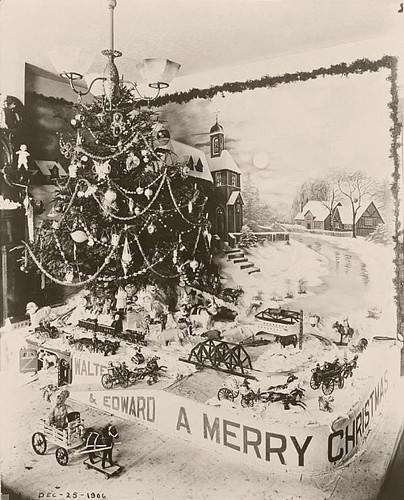
Your comments and appreciation really make the task of writing so much easier. Also, I want to acknowledge all the talented and generous people who've contributed so much of themselves to Appalachian History this year: Alice Feagan, Beth Kephart, C. Belmont Keeney , Dan Dutton, Dylan Thuras, Ed Kelly, Lynn Salsi, Molly Wilkins, Ralph Hall, Rebecca Dart, Roger & June Lowe, Sarah Moon, Sonja Ingram, Tim Hooker, Tipper Pressley , Will Benson, Christine Burke Ashwell, Cynthia Fife Coughlin, Betty Cloer Wallace, and Cindy Gladden Tuttle.
This blog is so much richer for their help.
I promise I'll get back to work posting more tasty things for you to read just as soon as I get done unwrapping a few of these pretty boxes over in the corner.
Technically, on the Catholic Christmas season calendar, December 13 is The Feast of St Lucia. Over in Fairmont, WV on that day this year the local Italian community instead celebrated the Feast of the Seven Fishes.
This southern Italian feast is traditionally celebrated on Christmas Eve. It stems from the observance of the Cena della Vigilia, the wait for the miraculous birth of Christ in which early Christians fasted on Christmas Eve until after receiving communion at Midnight Mass. At one time, Rome was the farthest point north where ‘La Vigilia’ was celebrated, but today Italians throughout the world celebrate it.
Fairmont local son Robert Tinnell is a screenwriter, director and author whose book, "Feast of the Seven Fishes," inspired Fairmont’s city fathers to launch the local celebration, now in its fourth year.
"When I was kid, eating fish on Christmas Eve was just something you did," says Tinnell. "We never called it by name. I never even bothered to question why we did it, especially as I had not been raised Catholic. All I knew was that December 24th meant a delicious meal of exotic foods, cooked up by my ancient great-grandmother, Isabella Oliverio, on her wood-fired stove in the basement of her modest home in Rivesville, WV."
At least 11 percent of the population of Harrison, Marion, and Monongalia counties has Italian ancestry. The larger communities are in the vicinity of Clarksburg, Fairmont, and Morgantown respectively. Many Italians originally immigrated to West Virginia in the early twentieth century to work in the coal mines throughout the state.
Specialty glass factories in this region were largely an Italian immigrant industry with factories in Fairmont, Mannington, and Clarksburg. Italian stonemasons were also common in the early communities. So 'La Vigilia' clearly has an established place among West Virginia Christmas traditions.
Why seven types of fish for this Christmas feast? Some believe that seven fishes are served because it took God seven days to create the world, while others mention the Seven Hills of Rome. There is also the possibility that the seven fishes symbolize the seven sacraments in the Catholic Church, along with the seven sins, or the seven days it took Mary and Joseph to reach Bethlehem, or the seven of the twelve Apostles who were fishermen. Some say it is because it took God seven days to create the universe.  Some regions of Italy require three courses (the Trinity or three Wise Men), nine courses (the Trinity times three), twelve courses (the Apostles), thirteen courses (the Apostles, plus Jesus), or even 25 courses(for the days in the Christmas season).
The origins vary, depending on who you ask, but quite clearly, you did not eat meat on Christmas Eve since it was the birth of Jesus, and just as you would not eat meat on Good Friday, you would not eat meat on Christmas Eve. As midnight brings Christmas day, that is when you would start cooking the sausage for Christmas Dinner, and often the eating would go on until the late/early morning hours.
The people from Naples are famous for their elaborate spreads of cold shellfish cocktails and hot fish dishes, as well as the roasted peppers and antipasti. In most of the southern coastal regions in Italy and Sicily, seafood was abundant and so offered the perfect opportunity to work fish into the menu for this festive day.
Two fish most traditionally found on Christmas Eve menus across Italy are baccalà (salted cod) and anguilla (eel). Other popular fishes that are eaten on this special holiday are prepared versions of calamari, kale patties, oysters, scallops, whiting, clams, and shrimp. At the Feast of the Seven Fishes, the meal usually begins with antipasto, the Italian equivalent of hors d'oeuvres. This can include a variety of cold foods such as cheeses and raw or marinated vegetables.
The meal ends with any number of delectable desserts. One that is almost always present is panettone, the famous sweet cake-like Christmas bread that is eaten during the Christmas holidays.
Sources: www.sicilianculture.com/food/xmasfish.htm
http://bleedingespresso.com/category/uniquely-italian
http://statejournal.com/story.cfm?func=viewstory&storyid=47866
www.gomestic.com/Cooking/Traditional-Italian-Feast-of-the-Seven-Fishes.58592
www.incanto.biz/letters_-_xmas.html
"So you wonder why I have spent the last ten years of my life behind this meat counter," said Jack Gallup. "You think I ought to be doin' something better, do you? Well, I'll tell you. For one thing, I never would study in school and I dropped out at the end of the fifth grade; and another thing is, I have never been able to get any money ahead because I spent it on gasoline and liquor.
I am not much over thirty, but I might have saved up enough money by now to start a small business of my own. I know the grocery business and I know the meat business from top to bottom. My uncle's store has a good trade and I do all the buying for the meat counter and stand behind the counter to cut it and weigh it. Particular people come in here and it's my business to please them.
In the course of time, you know, a man can learn anything if he puts his mind on it. I could have learned something out of books when I was in school, but I wasn't willin' to put my mind on it. I was interested in marbles and baseball and in playing pranks on the other boys and in deviling the teachers. A good lawyer here in Tucony once told my mother I'd make a good lawyer if I'd only study, but I wouldn't. What little I know I've learned right here in this store. In sellin' meat I learned some arithmetic because I had to, and I've learned to speak fairly good English from educated people who came in here to trade. I've always kept my ears open, and that's easier than studyin' books and worth more; I never could see much in books.
I remember at least one thing I heard a teacher say. It was somethin' about paying too dear for your whistle. These people who get a book education have to pay too much for it. I may not be right but that's my way of thinkin'. Anyhow I wasn't willin' to pay the price. It may be worth it to some people but not to me.
Have I always lived in Tucony? Most of my life. I was born out in the country six miles from town on a farm my granddaddy bought when this was a wild country, and I had my fun fishin' and huntin' and trappin'. I went to school when I had to, and I worked in the cornfield when I had to, but my daddy had to lick me sometimes to make me do it. I reckon the way I lived out in the country is what makes me so strong and healthy.
When my daddy moved into town so my sisters could go to high school, I got a job as an errand boy in a grocery store, and I don't ever seem to be able to get away from groceries. When I was growin' up I got several other small jobs, but I didn't keep any of 'em long. I got to runnin' round nights with the boys and we used to drink and prowl about, and sometimes times we got into fights and landed in the cooler. It cost my daddy a lot of money to get me out of trouble, and it was at a time when he had mighty little money. I don't know why it is but when I get liquor in me I want to fight. I'm just a plain fool.
Finally my uncle took me into his grocery and put me behind the meat counter. I got drunk once in a great while and he always threatened to fire me but he never did. He's a queer old duck, but he's good-hearted. He hates to see money go out of his hands but he'll give a bunch of ripening bananas to some of his kin to help feed the chillun. Some people would rather give things to strangers than to their kin. Not my uncle. He abuses everybody who works for him, but he is good to them in many ways. He'll do anything for them except raise their wages; some of them have been with him a long time.
He and his wife work hard - she with her butter-making and he behind his counter or an the road looking after his branch stores in neighboring towns. He drives his own automobile and he goes like the devil was after him. He says time's money, and money is what he wants. Two or three times he has run his car off the mountainside and rolled over and over, but he's so tough he was back at work in a day or so. He growls and says he's nearly dead but he goes on. I once told him he wasn't fit to die. I expected he'd beat me over the head with a stick, but he only laughed.
Spencer Mull,
Brevard, N.C.
interviewed August 7, 1939 by A.W. Long
Folklore Project of the Federal Writers' Project
for the U.S. Works Progress (later Work Projects) Administration (WPA)
online at http://lcweb2.loc.gov/wpa/27060407.html
You kin talk about y’r op’ras, y’r germans an' all sich
Y’r afternoon r’ceptions an' them pleasures o’ the rich
You kin feast upon y’r choc’lates an’ y’r creams an’ ices full
But none of ‘em is ekal to a good old candy pull.
For ther’ isn’t any perfume like the ‘lasses on the fire
A bubblin’ an’ a dancin’, as it keeps a risin’ higher
While the spoon goes stirrin’, stirrin’, till the kittle's even full
No, I reely think ther's nothin like a good old candy pull.
Then the exercise o’ pullin’, how it sets the cheeks aglow
While the tongue makes merry music as the hands move to and fro,
An’ with scarcely hidden laughter, the eyes are brimmin’ full
For the happiness is honest at a good old candy pull.
It's true we miss the music an’ the ballroom's crush an’ heat,
But ther’ isn’t any bitter that stays behind the sweet,
An’ I think the world’d be better, an’ its cup o’ joy more full
If we only had more pleasures like the good old candy pull.
The Candy Pull
By A. R. Luse
 They pulled it out and doubled it back, and looped it over, and pulled it out; and sometimes a peachblow cheek touched a bronzed one; and sometimes a sweet little voice spluttered out; "you Jack;" and there was a suspicious smack like a cow pulling her foot out of stiff mud.
 You hear young folk singers today sing happy work songs about mule drivers and mule-skinners. I sometimes wonder if any of them know what driving a mule is really like, and if they'd still sing so merrily if they knew.
My first job was carrying water on the Interstate Railroad grade at Josephine, about a half-mile from our old home near Norton. That was my introduction to mule driving. It wasn't nearly as glamorous as it sounds in the songs.
Underground coal cars, at that time, were pulled by mules. The driver who carried the largest whip and who used it the most forcefully was regarded as the best driver. Drivers generally were jealous of each other and the ones I knew considered themselves a cut above the miners who dug for coal.
The animals worked every day, usually about twelve hours. They had a terrible, repulsive odor about them. Their necks and shoulders seemed always to be raw around their collars, and their hind quarters bore great welts and scars from blows administered with the whip or the "butt stick." Mules are noted for their stubbornness, but few were as stubborn (and none as cruel) as the men who drove them. If a man wasn't brutal when he started the job, he soon learned to be. There may have been exceptions, but I can't recall any.
The whip wielded by a mule driver was about ten feet in over-all length. It was made of plaited leather, tapered from a maximum diameter of two-and-a-half to three inches in the middle down to about one inch on the ends. On the "cracker" end of the whip was a piece of rawhide about three-quarters of an inch wide and fourteen inches long; and on the end of that, a piece of twisted seagrass about the thickness of a lead pencil and twelve inches in length.
Mule drivers prided themselves on their skill and power with their whips. They could tear a man (or a mule) to pieces with one. The one distinguishing characteristic common to all mule drivers was a "red-eyed" appearance. This was not from drinking (though it might have very well been in most cases), but from the effects of having mud slung into their eyes by their mule's hooves.
I came to learn quite a bit about mules, and how to care for them and work them. In 1911, at the age of thirteen, I became a mule driver.
My career as a mule driver lasted just a few months. It was hard, cruel, dangerous work. In those days, we used the drift mouth method of mining coal. It was also called deep mining. A network of tunnels followed veins of coal deep into a mountainside, sometimes for several miles.
The mule I drove was called Old Red. He was a fine, strong animal. I thought of Old Red as my partner in the mining business, rather than a beast of burden. And I think he appreciated it. In fact, I'm sure he did. He rarely, if ever balked on me. I frequently led Old Red down into the shallow water of Powell's River beneath the Josephine Bridge and scrubbed him down with strong lye soap-- a practice which the veteran drivers viewed with scorn. But they couldn't deny that Old Red was the best-looking, best-smelling mule in the community.
The hours I worked were roughly 7 a.m. to 6 p.m. I had to spend an hour each morning feeding, currying, and harnessing my mule, and two hours in the evening unharnessing, rubbing down, and feeding him.
One morning I was hauling "Bowser" Farmer and three other miners into the mine on my car. As we approached their work area, I began to slue the car over the parting to the left, off the main line. In less time than it takes to tell it, a sudden rock fall buried Old Red and narrowly missed killing us all. The poor mule, my pet and my proud companion, never knew what hit him. It was probably the "closest call" I ever had in a coal mine--and a terrifying experience for a thirteen-year-old.
Only about eight feet separated a mule from his car, and I was sitting out on the bumper when that hundred tons of rock crushed Old Red. One second he was there, responding to my commands--and then suddenly, he was buried and gone forever, in less time than it takes to scream.
There was nothing to do but cut the traces, drop back a few feet, and cut a new entry. Another mule was hitched to my car. Everything was back to normal. We had to get that coal.
If I wasn't already a man, I became one that day.
The Life and Times of a Mountaineer Game Warden, by Dave O'Neill
(1898-1974, b. Norton VA), online at http://vagenweb.org/wise/MountaineerGameWarden.html
We post a new episode of Appalachian History weekly podcast every Sunday. You can start listening right away by clicking the podcast icon over on the left side of your screen. If you'd rather grab the show off itunes for later listening, click here: 
We open today's show with a look at fruitcake traditions in Appalachia. Yes, it’s heavy as a brick, and lasts long enough that you can re-gift it year after year without anyone commenting on its shelf life having expired. Blame the Scots.
We’ll pause in between things to catch up on a Calendar of Events in the region this week, with special attention paid to events that emphasize heritage and local color.
Next, Ohio farmer LP Bailey testifies before a 1912 Congressional agricultural subcommittee on the threat of an unregulated margarine industry to the health of America’s dairy industry. “I am interested---am in favor of oleo,” he says. “I believe there is a need for oleo---a place for it, a demand for it---but I want it to stand on its own merits like everything else stands on its own merits.” “When all the white boys and girls would be away Miss Beckie would gather the little negro children around the fire and talk with us,” explains former North Georgia slave Levi Branham (1852-1944) in his memoirs. “One day I said to Miss Beckie: ‘Why do we little negro children have to work for you?’ She said, ‘That's the way our fore-parents fixed the matter." I said to her, "when I get grown I am going to change the situation somewhat.’ "
John Gable was born in 1910 in Superior, WI, and moved to Konnarock, VA with his family in 1936. In this oral history excerpt from 1995 he examines the evolution of the Christmas tree farming industry in that area from his young manhood till now.
At 10:20 a.m., December 6, 1907, explosions occurred at the No. 6 and No. 8 mines at Monongah, WV. The explosions ripped through the mines at 10:28 a.m., causing the earth to shake as far as eight miles away, shattering buildings and pavement, hurling people and horses violently to the ground, and knocking streetcars off their rails. Three-hundred and sixty-two men and boys died. It remains the worst mine disaster in the history of the United States.
We’ll wrap things up with a look at the variations on the centuries old Christmas carol “The Cherry Tree.” The Appalachian versions mention the actual date of Christ’s birth, unlike the original English carol, and that helps folklorists to place a particular version in time. Old Christmas Day, NOT December 25, is the date they look for. In 1751, when a change in the calendar had become expedient, eleven days were dropped out between September 2nd and 14th, 1752, thus making January 4th the date of Old Christmas Day. In 1800, another day was taken from the calendar, and in 1900 still another, so that Old Christmas Day now falls on January 7th.
And, thanks to the good folks at the Digital Archive we'll be able to enjoy some authentic Appalachian music by the Knoxville trio Mountain Laurel in a modern recording of “Hewlett’s Air” by the great Irish Renaissance harpist and composer Turlough O'Carolan (Toirdhealbhach Ó Cearbhalláin).
So, call your old blue-tick hound up on the porch, fire up your corn-cob pipe, and settle in for a dose of Appalachian History.
Oleomargarine hearings before the Committee on Agriculture
House of Representatives
on bills proposing to amend the oleomargarine laws
February 28 to April 2, 1912
Statement of LP Bailey
Mr BAILEY: Mr. Chairman and gentlemen of the committee, I come before you today as a farmer---practical dairyman and general farmer. I represent the grange interests of Ohio. We have a membership there of something over 40,000. We have one or more active organizations in every county. I also represent the Ohio Cattle Club which is perhaps the strongest state club of organizations in the United States.
Now as I said I live on my farm, I have three boys on that with me and they are satisfied to remain on that farm if they feel that they have as good a show to make an honest living on the farm as they would to engage in other lines of business; and I assured them that the Congress of the United States will not enact any laws that are going to injure the farm interests of the country, and especially the dairy interests.  Ola Belle "Shorts" Schaub, an employee of Joseph Schaner Dairy in Yorkville, OH. Dairy farmers nationwide were outraged that butterine was undercutting their ability to compete fairly, and demanded protectionist laws from Congress.
I am interested---am in favor of oleo. I believe there is a need for oleo---a place for it, a demand for it---but I want it to stand on its own merits like everything else stands on its own merits. I want to give you an instance. It never has been sold under any legislation we have ever had. We have never yet had any legislation under which all of it, or a large per cent of it, was sold for what it was.
I happened to be for awhile connected with the dairy and food department of Ohio. At a little town on the hills along the Ohio River at Yorkville, a coal mining town, I went into a company store there. I learned that they were selling oleo in there for butter, and at the price of butter.
[Representative] HAWLEY: Oleo for butter?
Mr BAILEY: Yes; they called it butterine; and I went there to the store. They did not know me. I called for butter. They handed me out 2 pounds and I paid for it. I paid 50 cents for the 2 pounds and it was butterine or oleomargarine. At the same time the best brand of Elgin butter---the best creamery butter there was made then---was selling in Wheeling, WV, only a few miles below, and at Bridgeport and Martins Ferry on the Ohio side, at the same price 25 cents a pound.
Mr LEVER: Was this butterine wrapped in cartons?
Mr BAILEY: No, it was just wrapped in 2 pound papers. And they had a strict law in that state requiring the oleomargarine sign to be put up---I could not find any in that store. The merchant said it had been torn down.  $25.00 receipt for butterine delivery, from The Capital City Dairy Co., Columbus, Ohio, July 5, 1909.
I took that sample to Cleveland and had it analyzed by Prof. Hobbs. It contained a little over 3 per cent, not 4 per cent, of dairy butter---creamery butter. It was the very lowest grade of oleomargarine or butterine that the Capital City Dairy Co of Columbus, OH manufactured.
It cost this firm 11 cents a pound---10 cents for the butterine or oleomargarine a pound---and they protected the dealer there by him paying 1 cent extra. It cost him 11 cents---the dealer. He was selling that out as a poor man's butter to the poor man at the rich man's butter price, 25 cents a pound. That made it possible for that dealer to make 14 cents net profit on that butterine that he was selling there to those poor miners, and you will find that will be the case, and that was the case, and is the case today all over the country, that poor men are buying that oleomargarine and they are buying it largely at the rich man's butter prices.
Congressional hearing papers online at http://bit.ly/78boyr
This recent private commission by cut paper collage artist Alice Feagan depicts the small town of Saluda in the mountains of western North Carolina. Founded originally as a rest stop for weary train travelers and made famous by its annual Coon Dog Day, Saluda, as you can see from the illustration, is small town charm. "Saluda sits at the top of the Norfolk Southern Railway's Saluda Grade, the steepest standard gauge railroad line in the United States," says Wikipedia. "The main street has been improved since 1995 with new restaurants and art galleries. Tourists and cyclists are common on summer and fall weekends.
"Their fire department is the first department in Polk County to receive heavy rescue achievement. They have around 10 trucks, and a good staff along with a supposedly excellent dive team. There are 8 certified members."
Dan Dutton, whom she mentored, discusses her legacy in more depth today on the Dandylandmuse blog.
From his post:
Jean wrote this email to one of her folk music friends who wasn't feeling well a while back, and posted it on the Mudcat traditional music discussion board. It is such an insightful and brave introspection:
"Here. We're back- son Jon from a two-week hospital stay,still having tests after getting home as they still can't find what the trouble is. George from another series of test, taking 18 different pills a day, soon to be told to start dialysis. Myself growling around the house with a hundred aches and pains. I can see and feel big changes coming, and know that this long Growing-Old part of our lives is coming to an end--- We ARE old! I start reading sympathetically about poor OLD people, and suddenly it hits me: What? I myself am 86. What do we do with our house? Man- all these taxes, who'll pay them next year? Will we go to a nursing home? Have a live-in nurse? I tell you, it's so hard when you finally realize that Life makes you keep on learning- right up to the end. I guess, as long as I can understand Life's messages, I'll be able to go on.
"And I tell myself, "Just think of all the people that ever lived in this world. How many problems and worries and tragedies have they endured, along with the fewer joys and goodtimes and successes? And, when you come down to it, one is one and all alone and evermore shall be so. Or another way of putting it, You got to cross that lonesome valley by yourself. "I don't dread it, once I accept it. I have so loved my Mother and Father, all my gaggle of sisters, my three brothers (only one out of all of them is still in the world with me). We hurt with them if they have pain at the end, but we cannot go with them or ease that journey. Someone said, "The dead always look peaceful." I believe they are. I believe that they have walked the valley and found at last the destination we all are are striving to find. What else is Life, but a trip towards something higher and better? People who have almost died, have talked of being in a dark tunnel with a faint but bright light far ahead; then their passage is forbidden and they have to turn from the light and return to Life- to do an unfinished task there? To help or guide someone else for awhile longer?
"I wonder- but it doesn't matter, does it? None of us can live forever. We must live Life to the fullest, then give those behind us a loving farewell. That's what I hope I can do.
"I'll stop, because I don't know what I'm trying to say, but I thought it ought to be said. I guess I was trying to understand, myself, that not all of us CAN live to be old, or WANT to, and so arrive earlier at that entrance into the next world. In my personal prayers, I always say in my thoughts, "Lord, I'll stay as long as You need me, so show me what to do..."
"Big Mick, feel better, and I hope that Fate, or Karma, or whatever, eases up on you. I know you'll be needed in this Life for a long time, so take the reins that have been handed to you, and have a good, long run. You have many who love you and are running along with you, and that lonesome valley is still far away.
"Love to you all, Jean
"PS: Darn- I bet y'all will think this is a stupid letter, and tomorrow I may think so myself! But it's what I felt like saying."
I spent a large portion of my life in the Chief Vann house with my old master, Mr. Edmondson. He had a daughter by the name of Jennie. Jennie had a waitress who was named Tein. Another of his daughters was Sug, whose waitress was Fannie. Another one of his daughters was Georgia whose waitress was Elvie. These were all of the single daughters that Mr. Edmondson had when I was with him, but he had three married daughters whose names were Harriet, Sallie and Sue. Harriet married Bob Anderson, Sue married Street, and Sallie married Dr. Mathis. Levi and Mandy Branham, Spring Place, GA, about 1920.
One of my young masters was John Edmondson, another, Tom Polk Edmondson. I was Tom Polk's waitman until he went to the Civil war between the North and South. Bill, the youngest, was quite small. All of the waitmen and waitresses stayed in the Edmondson house now known as the Chief Vann house. The room in which we stayed had a fine carpet on which we slept. Mr. Edmondson gave us fine blankets and we surely did sleep warm and comfortable.
My old mistress, "Miss Beckie," was very good to us. She took more pains with us darkies than our parents did, simply because she had more to care for us with, and too, she loved us. Occasionally "Miss Beckie" would give us tea for medicine. She had a hard time getting this tea in me, but I had to take it after all. Sometimes she would give us peach brandy which I was always glad to get. Sometimes we would pretend that we were sick so we could get sweetened coffee and buttered biscuits which certainly tasted good to us darkies. I thought as much of "Miss Beckie" as I did my mother.
When all the white boys and girls would be away "Miss Beckie" would gather the little negro children around the fire and talk with us. One day I said to "Miss Beckie": "Why do we little negro children have to work for you?" She said, "That's the way our fore-parents fixed the matter." I said to her, "when I get grown I am going to change the situation somewhat."
My Mistress told me that the negroes were brought from Africa so that they could be enlightened and that they may be taught to serve God. That may be so, but I hardly know what to think of it. I had a colored friend who is now dead, who always argued with me that negroes were brought from Africa to be enlightened. It seems that the negroes do not stick to one another as the white people do. If one negro has money the others will stick to him, but if he has no money they are all down on him.
The negro race is a peculiar race, so far as color and mind is concerned. Some are black, some dark black, some are dark brown and some light brown, some are yellow and some are nearly white. To me they resemble Joseph's coat. They all have many different minds. I believe the North Georgia negroes had better treatment and were more enlightened than the South Georgia negroes. The Vann House circa 1930. Branham's memoir was published the year before.
Once upon a time Major Jackson and I carried a drove of mules that belonged to Mr. Sam Carter to South Georgia. The white man in South Georgia to whom we carried the mules, said he did not allow negroes in his house. I said to him, "I was reared in white folks' house." He said, "the negroes here would steal if they had to steal the dish rag." This white gentleman treated us very nice. Some of those negroes down in South Georgia said they wished Mr. Carter would bring them a sack of flour, because they had had no biscuits since last Christmas and it was almost Christmas again.
The old colored folks in South Georgia told me that the negro foremen were as hard again on them as their owners were. One old negro in South Georgia told me that they had to steal or perish because the white folks did not give them enough to eat.
I thank the Good Lord that my master always gave me plenty to eat and treated me like I was a human being.
from "Memoirs of a Slave/My Live and Travels," By Levi Branham (1852-1944), published 1929 by the A. J. Showalter Company of Dalton, GA. Online at http://www.murraycountymuseum.com/ms_3_1.html
JOSEPH was an old man,
And an old man was he,
When he wedded Mary
In the land of Galilee.
Joseph and Mary walk’d
Through an orchard good,
Where was cherries and berries
So red as any blood.
Joseph and Mary walk’d
Through an orchard green,
Where was berries and cherries
As thick as might be seen.
O then bespoke Mary,
So meek and so mild,
‘Pluck me one cherry, Joseph,
For I am with child.’
O then bespoke Joseph
With words so unkind,
‘Let him pluck thee a cherry
That brought thee with child.’
O then bespoke the babe
Within his mother’s womb,
‘Bow down then the tallest tree
For my mother to have some.’
Then bow’d down the highest tree
Unto his mother’s hand:
Then she cried, ‘See, Joseph,
I have cherries at command!’
O then bespake Joseph—
‘I have done Mary wrong;
But cheer up, my dearest,
And be not cast down.
 "In 1751, when a change in the calendar had become expedient, eleven days were dropped out between September 2nd and 14th, 1752, thus making January 4th the date of Old Christmas Day. In 1800, another day was taken from the calendar, and in 1900 still another, so that Old Christmas Day now falls on January 7th. In Miss McGill's version [Folk Songs of the Kentucky Mountains] the date is given as the 6th of January."
At 10:20 a.m., December 6, 1907, explosions occurred at the No. 6 and No. 8 mines at Monongah, West Virginia. The explosions ripped through the mines at 10:28 a.m., causing the earth to shake as far as eight miles away, shattering buildings and pavement, hurling people and horses violently to the ground, and knocking streetcars off their rails. Three-hundred and sixty-two men and boys died. It remains the worst mine disaster in the history of the United States.
The Monongah Mines Nos. 6 and 8 were located on the West Fork of the Monongahela River, about six miles south of the town of Fairmont, West Virginia. The mines were connected underground and were considered model mines, the most up-to-date in the mining industry. Electricity was used for coal cutting machinery, locomotives were used to haul coal, and the largest areas of each mine were ventilated by mechanical fans. For a time pandemonium reigned. Every local mine official was missing. It was impossible to fathom the nature and extent of the catastrophe, or to tell whether either mine was on fire or full of gas.
Soon after the explosion, four miners emerged through an outcrop opening, dazed and bleeding but otherwise unharmed. The stunned survivors could tell nothing of the fate of the others still underground.
With the hundreds of shrieking, half-crazed women and crying children came every man left in the town. Volunteers were willing and anxious to help with the rescue work.
Frantically, they cleared away the wreckage at the entrance and tried to force their way into the mine. They soon began to succumb to the toxic mine air and had to be rescued themselves.
The explosion filled the mine with "black damp", an atmosphere in which no human being could live. It blocked the main heading with wrecked cars and timbers, and demolished one of the fans, which greatly restricted ventilation.
Choking coal dust, rubble, and wrecked equipment impeded the progress of volunteer rescue teams. The No. 8 mine's huge ventilation fan had been destroyed, and a smaller fan was used to ventilate both mines. Brick stoppings, the partitions used to direct air through the mines, had been blown out. As rescue parties slowly advanced, they used canvas curtains to restore ventilation, dilute gas, and disperse dust.
At the bottom of No. 6 slope, debris from a wrecked trip was found scattered for 250 feet along the headings. Cars were smashed and piled on top of each other nearly blocking the entry. The trip had been pulled up the slope and stopped at the knuckle a short time before the explosion causing the coupling pin on the first car to break. The entire trip consisting of eighteen loaded two-ton cars went down the incline. The explosion occurred before the cars had gone into the pit mouth and before the trip had reached the bottom of the slope.
At 4:00 p.m., moaning was heard near a crop hole, and a rescuer was lowered through the hole on a rope. About 100 feet below, he found miner Peter Urban sitting on the shattered body of his brother, Stanislaus, staring glassy-eyed into space as he sobbed uncontrollably. He was the last survivor of the Monongah disaster.
Exhausted volunteers found conditions in the mines almost unbearable, heat was intense, and afterdamp caused headaches and nausea. In some headings, ventilation materials and bodies had to be hauled 3,000 feet over massive roof falls and wrecked machinery, mine cars, timbers, and electrical wiring. The stench of death was barely tolerable, and became overpowering as the search dragged on.
Searchers never lost sight of the fact that there might possibly be some men in the mine alive. They continued to explore all parts of the workings with all possible speed, leaving unnecessary work for another time.
Embalmers worked around the clock in shifts. Caskets lined both sides of the main street. The bank served as a morgue. Churches conducted funeral services several times a day as dozens of men dug long rows of graves on nearby hillsides. Disputes flared over identification of victims, and more than once, a body was claimed by two families.
By December 10, the number of people killed was over 175. It was obvious to most rescue workers, but not to relatives of missing men, that Peter Urban would be the last man to be brought out alive. By Thursday, December 12, all workings had been ventilated and searched and 337 bodies recovered. Twenty-five more victims were found during cleanup operations. A special graveyard, soon filled, was laid out on a bleak hillside. Company houses flanked the burial ground. Rows of open graves were dug in the sodden, half-frozen, rain-drenched and snow-flecked West Virginia soil.
The 362 casualties of Monongah's coal mine disaster left more than 1,000 widows and children.
The Marion County Coroner's Jury, after hearing from numerous witnesses, concluded the victims of the disaster died from an explosion caused by either a blown-out shot or by ignition and explosion of blasting powder in Mine No. 8.
"Mining Disasters - An Exhibition," Mine Safety and Health Administration; online at www.msha.gov/DISASTER/MONONGAH/MONON3B.asp
ED- Are there people you know in the Konnarock area with these Christmas tree plantations?
JG - Yes, we have a little Christmas tree plantation here, too. We planted them ourselves and sold them for several years. They are getting pretty big now, but we've got some small ones that are 5 to 6 feet tall and they are still there. Those are frazier firs. They are born and raised in the Whitetop area, and we bought them and planted them, just little sprigs.
ED - Do you think a fair amount of money is made in Konnarock?
JG - Oh, yes. Over there in the Helton area there are some rich people because of the land and the trees that they own. Of course they got froze out, but the government was able to pay them something for the freeze problem.
ED - How did they get the government to do that?
JG - Some of them are on government land. I don't know just how that come about that they got paid for their trees.
ED - There are some people growing Christmas trees on government land?  Christmas tree farm in adjoining Grayson County, 1987
JG - I think so. I think some of it is owned land or leased land from the government, either leased from the government or other people. There are several landowners. J. Baldwin is one who sells Christmas trees every year. You have to be at least 3,000 feet high before you can start a frazier fir farm so it's only in the mountains that you can raise these frazier firs.
ED - Can people buy them and grow them elsewhere?
JG - They seem to; some do. I think maybe it's because they give them special care. People would buy the Christmas trees from us and then planted them and they would grow. They dig them up by the roots. The reason they don't grow when they are young is because it gets too warm in the wintertime. They begin to bud out too soon and then the buds get killed by frost.
ED - That's a major change from the '30s. There was nothing like that in the '30s.
JG - Except that they lashorned firs.
ED - Back in the '30s, were there tree plantations at all?
JG - They were just naturally formed.
ED - So people who owned land back in the '30s wouldn't have had that option for making money?
JG - I don't think so. If they sold their land to the lumber
company . . .
ED - Even though you saw mostly stumps when you came in the '30s, were there still people selling off lumber from their land?
JG - There was new lumber beginning right away from trees that had been planted immediately. They had grown up to pretty good size, but nothing like it is today where there are trees everywhere. Some are of a size that can be turned into lumber but some are not. We have some trees on our place that can be sold for lumbering purposes.
ED - People would not have seen much value in their land back in the '30s?
JG- Probably not.
ED - Because you couldn't make much money off of only land, could you?
JG - Well, they would set up small sawmills out in the woods and saw wood and sell it for lumber, sell it for firewood. They would saw rough lumber and people would use that to build barns.
ED - There were some local people making money off their land back then. Were there major landowners back in the '30s, families that owned most of the land?
JG - I think most of the families had small plots of land.
---excerpt from oral history with John Gable, (b. 1910 Superior, WI, moved to Konnarock, VA 1936)
Interviewed in 1995 by Edward H. Davis, Virginia Foundation for the Humanities and Public Policy, Charlottesville, VA, now in Appalachian Studies collection, Kelly Library, Emory & Henry College; online at http://library.ehc.edu/konnarock.html
Many thanks to Jacob Stump for his assistance on this article.
We post a new episode of Appalachian History weekly podcast every Sunday. You can start listening right away by clicking the podcast icon over on the left side of your screen. If you'd rather grab the show off itunes for later listening, click here.
We open today's show with a Jack Tale from the Beech Mountain region of North Carolina. You’ve of course known the Jack and the Beanstalk tale since childhood, but Jack is the hero of many other stories retold in central Europe, the Scandinavian countries, England and Appalachia. Jack is a trickster, so he often bends the truth, and his tactics may be questionable, but his tales are truly entertaining, as you’ll see here.
We’ll pause in between things to catch up on a Calendar of Events in the region this week, with special attention paid to events that emphasize heritage and local color.
This is a time of year when hunters, from the earliest settlers on, have entered the forest seeking wild game to supplement the winter larder. The custom of mincemeat pies during the holidays is partially a holdover from putting up wild game in the days before freezers. The mincemeat mixture was a method of preservation, as the combination of the acids from the fruits and the heat from baking inhibited the growth of bacteria in the meat.,”“For Christmas you didn't get much. There wasn't much,” Gwynn Jones (b. 1908) of her childhood in Warrensville, NC. “One little country store close by. There were more in the county, but they had nothing for children. We would get some oranges (they had oranges for Christmas) and some candy. We had no toys; however, there were dolls. As I remember they did have little dolls for the girls. My father and mother would get the girls a little doll."
In ‘A Kentucky Christmas,’ Thomas D. Clark tells us that thousands of country children were happier waking up in a cold farmhouse on Christmas morning because Santa Claus had not forgotten the firecrackers and Roman candles. “There were also torpedoes, which exploded with thunderous repercussions when dashed on the floor underneath girls’ feet, and Roman candles gave great gusto to the Christmas celebration.”
“Mark Morrison, manager of Morrison’s, well known local drug firm, was arraigned yesterday before Esquire Kerby, charged with violating the child labor law,” began an article in the Chattanooga Daily Times on December 12, 1915. “Page Zarley, a 12-year old boy, had been employed by the Morrison Drug company as table boy and had been required to work from noon until 11 at night.”
“Jesus, Jesus, rest your head,
you have got a manger bed,” goes the refrain of an old Kentucky folk carol transcribed by John Jacob Niles (1892-1980). Niles began collecting Appalachian folk songs and composing music as a Kentucky teenager. “A sweep of his hand and the dulcimer gave forth magical sounds which caused the stars to gleam more brightly, which peopled the hills and meadows with silvery figures and made the brooks to babble like infants,” enthused one fan.
We’ll wrap things up with a look at the Christmas tradition of belsnickling. Up until the second World War, if a Shenandoah Valley family was a member of the Lutheran or Reformed church, the children could expect a Christmas Eve visit from the Belsnickle. The Belsnickle was not Santa Claus! He was ugly and he frightened the children. He typically wore a costume made from stockings and burlap or paper bags, and traveled from house to house brandishing his switches in the air.
And, thanks to the good folks at the Digital Library of Appalachia we'll be able to enjoy some authentic Appalachian music by the Whoopin’ Hollar Stringband in a 2006 recording of “Breakin’ up Christmas.”
So, call your old blue-tick hound up on the porch, fire up your corn-cob pipe, and settle in for a dose of Appalachian History.
Chattanooga Daily Times, December 12, 1915--
Mark Morrison, manager of Morrison’s, well known local drug firm, was arraigned yesterday before Esquire Kerby, charged with violating the child labor law, on a warrant sworn out by Mrs. O. D. Glenn, special investigator for the state. Mr. Morrison waived preliminary examination, and was bound over to the grand jury on a $250 bond.  In the warrant Mrs. Glenn charges that Page Zarley, a 12-year old boy, had been employed by the Morrison Drug company as table boy and had been required to work from noon until 11 at night, in violation of the state statutes prohibiting the employment of children after 6 in the evening.
Mrs. Glenn told a Times reporter that the Morrison company, as all other drug stores in the state, had been notified of the state laws in this respect in a bulletin sent out, and exhibited their receipt of same in a signed coupon which had been detached from the bulletin. She said that the Zarley boy had not been in school a day this year. Mrs. Glenn has a signed affidavit regarding the youngster’s age.
Young Zarley’s mother is a widow and has a boarding house at 216-1/2 Oak Street.
It was stated at the Morrison Drug company last night that the Zarley boy had been employed by the head soda dispenser, who he had told he was 14 years of age. William J. Morrison stated last night that the boy claimed he was needy, and in his position at their store was helping support his widowed mother. "We are always very careful," Mr. Morrison stated, "in employing boys in compliance with the labor law, and were told by young Zarley that he was 14, but neglected to get an affidavit. We have been compelled to refuse several deserving and needy boys employment on account of the laws governing these cases."
Esquire Kerby, when asked yesterday if he would take the case, said that under his oath of office he had no alternative. He said, however, that in the event it was shown that the boy was working to help support himself and mother, and had been given employment through kindness, he would dismiss the case. He said he took the position that when a minor has no other means of support he should be permitted to retain his employment even if his hours do conflict with the statutes in that connection.
"The people of Chattanooga do not seem to be in favor of regulating the employment of children and females, as is set forth in the statutes," said Mrs. Glenn last night. "They seem willing to allow them to work under any conditions, but I am here to enforce these laws, and I will make every effort to stop agues of the laws."
*Mrs. Glenn left last night for Knoxville where she will remain for several days before returning here.
About the photo by Lewis Hines: caption reads "Street Bretzau, who is a 'Tube bou' in mule-room [at Richmond Spinning Mills]. Mule is apparently more dangerous than ring spinning. (See bandaged finger.) Photo during working hours. Chattanooga, Tenn., 12/06/1910"
From 1908 until 1912 Hines (1874-1940) traveled across the U.S. photographing conditions of child labor in many different settings. His photos show the haunting images of children bound to work in factories, mills, and street trades, to name a few. These pictures encouraged labor law reform and the implementation of safety laws.
sources: http://snipurl.com/1v8m2
www.appstate.edu/~hindmanhd/lewishine.html
child+labor Lewis+Hines Chattanooga+TN appalachian+history appalachian+mountains+history appalachia
Clarence Nixon wrote of his father’s store in his understanding book, Possum Trot, "We stocked up with fruit in December, and I still think of Christmas when I smell oranges in the country."
The South was a land of deep sentimentality. Family ties were close, and the hard years following the war tended to knit them even more securely. Christmas was a time a family re-dedication and a season of erasing old and irritating scars of discord. It was a period for visiting and feasting.
Celebration of the holiday was the one institution which came through the war unchanged except for the matter of simplification. Until 1915 rural observance was uncontaminated by commercialization. Simple gifts were passed around, and these, as a matter of course, came from the country store.
Much of the masculine taste in celebration ran to boisterous forms of expression. For more than fifty years the liquor barrel furnished ample cheer for all customers who could rake together enough cash or stretch their credit to buy a quart of Kentucky or Maryland bourbon, or a half-gallon of North Carolina corn. A quart of whisky was admittedly a vigorous start toward a glorious Christmas season.
For the temperate, however, a package of firecrackers was enough holiday amusement. One little nickel package of Chinese firecrackers provided plenty of Christmas joking and pranking. A favorite stunt was to explode the tiny cylinders at the heel of some humorless deacon, with the hope of starting him into cussing. Another was setting them off near a pair of mules in a storehouse yard. The number of runaways made many a good celebrant regret there was such a thing as Christmas. But there was the more pleasant aspect to this form of amusement. Thousands of country children were happier waking up in a cold farmhouse on Christmas morning because Santa Claus had not forgotten the firecrackers and Roman candles. There were also torpedoes, which exploded with thunderous repercussions when dashed on the floor underneath girls’ feet, and Roman candles gave great gusto to the Christmas celebration.
They lifted the holiday spirit high into the air in sputtering balls of varicolored fire followed by sulfurous tails which outdid Halley’s Comet in the eyes of the backwoods cotton farmers. Sometimes they were used in sham battles, which generally wound up unhappily. But all in all, there was something in the violent cracking of fireworks that gave zest to Christmas week, and which marked the completion of one crop year and the beginning of another.
'A Little Bit of Santa Claus'
From Pills, Petticoats, and Plows: The Southern Country Store
By Thomas D. Clark
Reprinted in A Kentucky Christmas, University Press of
Kentucky Press, 2003
Christmas+in+Appalachia chinese+firecrackers appalachia appalachian+culture appalachian+mountains+history
"Late fall we'd start getting up the wood for the winter. You couldn't believe it would take that much wood. You would see wood from here, well, say a hundred feet long. You would think, well, golly, that's a lot of wood! But it didn't take long to get rid of that much wood in the winter. The winters were rough and it was cold back then.
"Oak was our better wood. We had plenty of wood and plenty of water.
"We had a two-story home. We had one large bedroom, Daddy and Mother's bedroom, downstairs. We had a large kitchen, a large living room, and they called the other room at that time, a parlor. That was for guests or visitors. There was the parlor. When the preacher came, he goes in the parlor. Then, upstairs we had four bedrooms. The two rooms downstairs on either side had fireplaces.
"We had a fireplace on the south side and one across on the north side across the hall, and we had a large hall. We had a large hall that came through with some closets and then the upstairs. No heat upstairs, but the heat would come up from the fireplaces. I mean, the heat goes up.
"It was colder, but we used featherbeds. You would sleep on a featherbed. One time Mother came up, it was real cold in the winter, and put a featherbed over us for the cover over top. Golly, you would just perspire!
"My brother and I would open a window. When it would be zero, we would crack a window. We always liked a little fresh air. We were used to it. We didn’t know about all of these new-- modern things then. It's what you were used to, I imagine.
"There was a lot of snow. There's nowhere to go, but you could get on a horse and go to the store, the country store, which was something like a mile away, if you had to. But you could get along fine. We would get our big fireplaces going. Had apples. Now, we would eat apples. We would always have a basket of apples in the living room. We’d all eat apples. Maybe before bedtime have an apple, peel an apple and have some apple.
"The children didn't have many things to do, but they would get together and have candy pullings in the winter, and games, different kinds of games. The ladies would get together in the winter time and make quilts; they’d have quiltings; they had the frames that had the spikes in them. They'd make some beautiful quilts.
"But the boys didn't have too much a-going. When the New River would freeze over we would go skating. We would skate on top of ice. It would stay frozen over for maybe two months! The river was almost in sight of where we lived. It was about one-fourth of a mile to New River. It starts up in Ashe county; they call it the head of the river. You can step over it two feet there. Today you could go there. The north fork of New River starts in Ashe County. It sure does.
"Mother would have something special, cook up something special for Christmas, like cakes. We always had cake. For Christmas you didn't get much. There wasn't much. One little country store close by. There were more in the county, but they had nothing for children. We would get some oranges (they had oranges for Christmas) and some candy. I know stick candy. They had these boxes of stick candy, different flavors. But we thought it was great, whatever we got! We didn't know about these other things like they have nowadays. Oranges were something special. Of course we had apples. You know, apples, oranges, candy.  Lenci doll on display at the Angela Peterson Doll and Miniature Museum, High Point, NC. Tag in case reads: "Lenci Doll Circa 1920. Designed by Madame de Scavini. The name "Lenci" came from a pet name given to Madame de Scavini by her husband. The designer was known for the mischievous look in the eyes of her dolls."
"We had plenty to eat, and we would get something to wear for Christmas, like a new shirt or a new pair of pants or a new pair of shoes. One neighbor (his name was John Eller), made my brother and me a little mill, and it had a crank on it. You would turn it by hand.
"You would take it down along the creek, and we would run sand through it and have a lot of fun with that. We would use sand. It was like a little gristmill, or like you were grinding some kind of grain. We thought that was wonderful.
"We had no toys; however, there were dolls. As I remember they did have little dolls for the girls. My father and mother would get the girls a little doll."
---excerpt from oral history by Gwynn Jones
(b. 1908 in Warrensville, NC)
Interviewed June 22, 1976
Southern Highlands Research Center
Louis D. Silveri Oral History Collection,
D. H. Ramsey Library Special Collections,
University of North Carolina at Asheville
Online at http://toto.lib.unca.edu/findingaids/oralhistory/SHRC/jones_gwynn.pdf
Up until the second World War, if a Shenandoah Valley family was a member of the Lutheran or Reformed church, the children could expect a Christmas Eve visit from the Belsnickle. The practice might even go well beyond just one evening, running for nearly two weeks, starting a week before Christmas and continuing until New Year.
The Belsnickle was not Santa Claus! He was ugly and he frightened the children. He typically wore a costume made from stockings and burlap or paper bags. In many cases, Belsnicklers used charcoal to blacken their faces – the ultimate goal being to disguise yourself enough as to prevent identification. Group of belsnickles from Pendleton County, WV. Early 20th century, no date.
The Belsnickle traveled from house to house brandishing his switches in the air. He would use these switches to whip naughty children. To good children the Belsnickle would hand out cakes or candies. These “gifts” were thrown upon the floor, but if a child were to try to recover them in the presence of the Belsnickler, the child would quickly receive a “whack” on the backside with a whip.
It was the custom for the Belsnickle to receive a treat at each house. While not welcome in all homes, in most instances, Belsnicklers were indeed invited in, and after unmasking and identifying themselves, were rewarded with refreshments of doughnuts, molasses cakes, coffee, lemonade, or cider.
Nor were alchoholic libations uncommon. In which case, as the Belsnickle proceeded on this visits, he no doubt became more and more oblivious to his behavior and the severity of his whippings.
By the early 20th century Belsnicklers usually traveled in groups – much like trick-or-treaters of contemporary times – from farm to farm, “making merriment as they went, a boisterous, noisy, and happy group.” Starting shortly after dark, the practice would end long before midnight.
 Jesus, Jesus, rest your head.
You have got a manger bed.
All the evil folk on earth,
Sleep in feathers at their birth.
(But) Jesus, Jesus, rest your head.
You have got a manger bed.
Have you heard about our Jesus?
Have you heard about his fate?
How his mother came to the stable,
On that Christmas Eve so late?
Winds were blowing.
Cows were lowing.
Stars were glowing, glowing, glowing.
Jesus, Jesus, rest your head.
You have got a manger bed.
---Kentucky folk carol; collected by John Jacob Niles: 1912-1913 and 1932-1934
John Jacob Niles (1892-1980) began collecting Appalachian folk songs and composing music as a Kentucky teenager. In 1925, Niles published his first song collection---"Impressions of a Negro Camp Meeting"--- and in 1933, he toured the U.S. and Europe with Marion Kerby to critical acclaim. He released his first album for RCA's Red Seal label, "Early American Ballads" in 1938.
"Like a psalmodist, he intoned his verses in an ethereal chant which the angels carried aloft to the Glory seat. When he sang of Jesus, Mary and Joseph they became living presences. A sweep of the hand and the dulcimer gave forth magical sounds which caused the stars to gleam more brightly, which peopled the hills and meadows with silvery figures and made the brooks to babble like infants. We would sit there long after his voice had faded out, talking of Kentucky where he was born, talking of the Blue Ridge mountains."
Henry Miller, Plexus: Book 2 of the Rosy Crucifixion, pp. 366-367, Grove Press, 1965
Sources: johnjacobniles.com/articles.htm
www.pbs.org/wnet/americanmasters/dylan/dylan_niles.html
Christmas+in+Appalachia Christmas+carols John+Jacob+Niles appalachia appalachian+culture appalachian+mountains+history


