
Denim Quilt, April 2007
3 months ago


"A Hard Journey" brings to life Don West, poet, ordained Congregationalist minister, labor organizer, educator, leftist activist, and one of the most important literary and political figures in the southern Appalachians during the middle years of the twentieth century. Author James J. Lorence is a professor emeritus of the University of Wisconsin, Marathon County, and served as Eminent Scholar of History at Gainesville State College, Gainesville, Georgia, when writing "A Hard Journey." 
"I first met Don West in the early summer of 1983," says Jeff Bigger, author of The United States of Appalachia.
"I was a dropout from the University of California and had just gone through a wild nine-month tour of duty in Berkeley’s corridors, spending more time in jail and at leftist political meetings than in classrooms. I failed to finish my last quarter.
"Returning from a stint in jail for a demonstration in central California, I was involved in a tragic car accident, which resulted in the death of a young woman. I was at the wheel. Still in a daze, I eventually took a Greyhound across the country, and then started hitching and hiking through the South, drifting into the Appalachian Mountains. I was angry, resentful, and adrift. I had lost faith in the power of education, politics or even activism. Don West saved my life that summer.
"Here are his bona fides as I see them: Raised by a sharecropper from the north Georgia mountains, West put himself through Lincoln Memorial and Vanderbilt Universities at the same time the southern Agrarian literary movement took the stage in the late 1920s. But West was no youthful antebellum sycophant; he earned a master’s in divinity, traveled around Scandinavia and Europe to examine folk schools, and returned to the South to launch his own revolution in the mountains. Raised by a radical Republican grandfather in a part of Appalachia that had supported both the Union and Confederacy, West rejected the hillbilly stereotypes for his proper place in the mountain South’s vanguard for independence, freedom, and enlightenment.
"In 1932 he co-founded the Highlander Folk School, which became the training ground for the civil rights movement. As one of the lonely activists in the generation before the glorious Montgomery bus boycott, he went underground and defended a radical black (Communist) leader in Atlanta in the mid-1930s. Wanted dead or alive by the Atlanta authorities, he fled the state and became a union organizer for mill workers and miners in the Carolinas and Kentucky and was often beaten and jailed, often forced to quietly return to work his farm in Georgia.
"Not too quietly: In a top secret FBI file, West was added to a proposed list of dangerous Americans who should be interned during World War II. In fact, one memo referred to the poet as the most dangerous man in the South.
"There were some good times. After turning a small Georgia school district into an acclaimed model of transformative pedagogy and cooperative learning, he returned to the national scene with his Clods of Southern Earth. In 1946, New York publishers Boni and Gaer (Boni had published Ernest Hemingway’s first stories) announced the release of West’s record-breaking volume of poetry. Here is where his secret life began to haunt him.
"During all of these years, riding an Indian Chief motorcycle across the mountains and down the East Coast, West had left a legacy of poems in his wake, as author John Egerton has written, like a phantom revolutionary—poems that unveiled the miseries of mill hands, miners, and sharecroppers, and the hopes of justice and racial unity in the South. His pioneering work reclaimed Appalachia as a progressive region and purveyor of the good life. For a while, he became the proverbial people’s poet, his work passed out at rallies and memorized by miners who had never read a book in their lives.
"Hounded and red-baited by newspaper after newspaper in the late 1940s and 1950s, West drifted into oblivion, losing job after job, called time and again into the House Committee on Un-American Activities hearings that popped up in the South with the regularity of catfish fries. In one of the most unusual persecutions in American literary history, West’s poetry was often used against him at hearings and in newspaper editorials. Destitute, he even took to peddling vegetables from his garden on the streets of Atlanta. The Ku Klux Klan added a final touch, burning down his farm and his collection of books, manuscripts, and family heirlooms. After editing a newspaper in a mill town in North Georgia during a volatile period, he even had to flee a lynch mob; scurrying across the back mountain roads, West shot his way out of a jam, when a car attempted to drive him off the road. He finally left the South in exile.
"When I was literally dropped on Don West’s doorstep in the 1980s, he had returned to Appalachia as one of the elder statesmen in their folk revival. He had become the link between the Old Left and New Left activists in the 1960s, and had founded a new folk school and farm, the Appalachian South Folklife Center in West Virginia, which had become a hub of activity for young Appalachians in search of their history and progressive culture. His poetry returned to print and sold thousands. His role as an Appalachian historian became more poignant with a series of pamphlets he printed in his barn in the tradition of his hero, Tom Paine.
"With less than 10 bucks in my pocket, I worked on West’s farm that summer. I attended classes he set up for school dropouts and mountain youth in an employment program. We listened in awe at West’s poetry readings and his lessons on the heroic role of mountaineers at Kings Mountain during the American Revolution. 'Remember,' he would shout, 'we had the first abolitionist newspaper, not the northerners,' and then pausing, he would always end, 'and we didn’t burn any witches in these hollows.'"
Related posts: “Poverty pays unless you’re poor”
appalachia appalachia+history appalachian+language Appalachian+poetry Don+West Highlander+Folk+School James+J.+Lorence
It’s back to school time. How would you like to have attended the same school that Rosa Parks, Eleanor Roosevelt, Pete Seeger, Woody Guthrie, Martin Luther King Jr., Andrew Young, and Fanny Lou Hamer all attended?
That would be Highlander Folk School, near Monteagle, TN, for many years the only place in the South where white and African-American adults could live and work together, something that was highly frowned upon in that strictly segregated society. The 1950s brought Highlander to national attention, as civil rights legends and social activists learned the ways of non-violent protest there in the school’s “Citizenship School Program.” Rosa Parks’ participation in a Highlander workshop in the summer of 1955, 5 months before her back of the bus incident, had a crucial influence on her. And during the subsequent Montgomery bus boycott, Highlander co-founder Myles Falls Horton introduced Rosa Parks to Eleanor Roosevelt as “the first lady of the South.”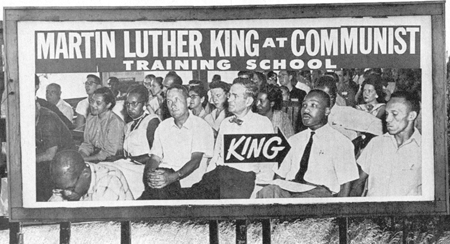 Political enemies angrily erected billboards across the South showing Martin Luther King and Rosa Parks attending an integrated event at the Highlander Folk School in 1957.
But two decades earlier when the school was first begun, poor, uneducated miners learned about self-respect and self-empowerment at the school. In his autobiography, Horton wrote, "We didn't think of ourselves as working-class, or poor, we just thought of ourselves as being conventional people who didn't have any money."
Highlander, Horton once claimed, held the record for sustained civil disobedience, breaking the Tennessee Jim Crow laws every day for over forty years, until the segregation laws were finally repealed.
Horton attended Cumberland College in Tennessee, Union Theological Seminary in New York City, and studied Danish folk school models on site before opening the Southern Mountains School, in 1932. A short time later, he and co-director Don West, a Congregational minister from Georgia, changed the name to the Highlander Folk School. At Highlander the purpose of education was to make people more powerful, and more capable in their work and their lives. Horton had what he called a "two-eye" approach to teaching: with one eye he tried to look at people as they were, while with the other he looked at what they might become.
Not everyone was tickled by the Highlander formula. One anonymous Tennessee citizen wrote FBI director J. Edgar Hoover in 1936: “This school is a hot-bed of communism and anarchy. This is proven by the part taken by its members in the strikes at Harriman Tenn., Daisy Tenn. and at the present at Rockwood Tenn.” Hoover promptly opened a file, one that over the years accumulated in excess of 1,000 pages.
For his outspoken support of union, civil rights, and poor people's organizations, Horton endured arrests, threats, violence, and denunciations from industrialists, politicians, and segregationists.
Finally, in 1961, the state of Tennessee closed the school, revoked its charter, and sold off the assets at auction. During this time, many of the buildings were burned by arsonists. Undaunted, Myles Horton redesignated the folk school as a research center under a new charter and moved from Monteagle to Knoxville, and then to the present location in New Market, Tenn., where it is now known as the Highlander Research and Education Center.
sources:www.etsu.edu/cass/archives/Collections/afindaid/a598.html
http://education.stateuniversity.com/pages/2072/Horton-Myles-1905-1990.html
http://tennesseeencyclopedia.net/imagegallery.php?EntryID=H073
Related posts: "Don West background"
Highland Folk School, Montagle TN, Myles Falls Horton, Don West, civil rights, adult education, appalachia, appalachian history, appalachia history, history of appalachia
Home-Coming (1946)
And I've come back to you,
Mountain Earth--
Come to laugh
And sorrow
And sing--
To dig my songs up
From your soil
And spin a melody
Of corn blades,
Top-fodder,
Crab-grass,
And a clean-plowed furrow.
I've come to sing and grope--
With a people who know
Deep songs,
Who stumble up
A long crooked road....
I've come because
Your great silent agony
Echoed everywhere
And the weary foot-steps
Of my old Dad
Still sound upon the mountain
Where his sweat dripped down
To water your dirt....
Don West achieved success as one of the foremost southern regional poets of the twentieth century. He was at different times a labor organizer, political radical, preacher, progressive educator, and outspoken spokesperson for human equality in the generation before the civil rights movement. Although he is best known for his literary works, West was also an effective proponent of the Social Gospel, embraced by some of the South's most dedicated religious reformers. Born in 1906 in Devil's Hollow, near Ellijay in Gilmer County, Donald L. West grew to young adulthood in the north Georgia mountains. The eldest son of a farmer, he took pride in the independent spirit that had made his forebears nonconformists who opposed slavery in the antebellum years. This heritage of independence expressed itself in West's career, during which he often found himself at odds with the folkways and beliefs of the communities in which he lived and worked. Throughout his life he remained committed to a progressive view of ethnic and racial harmony, which linked him with his personal family history.
In 1964 West and his wife helped to open the Appalachian South Folklife Center at Pipestem, West Virginia, where West worked until his death in 1992.
Source: http://www.georgiaencyclopedia.org/nge/Article.jsp?id=h-2569&hl=y
Don+West Georgia+poets appalachia appalachian+culture appalachian+history appalachian+language history+of+appalachia


