
Denim Quilt, April 2007
2 months ago


Merry Christmas everyone! I want to take a minute and thank all my readers for stopping by and having a look around here at the site throughout this past year. 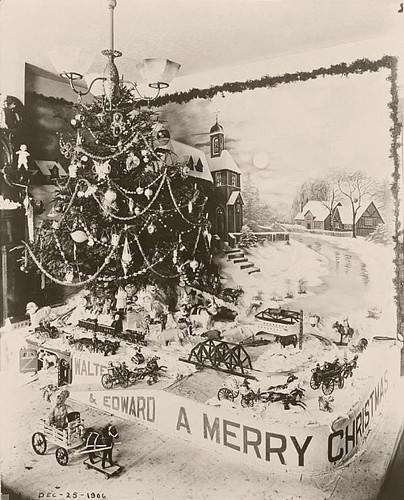
Your comments and appreciation really make the task of writing so much easier. Also, I want to acknowledge all the talented and generous people who've contributed so much of themselves to Appalachian History this year: Alice Feagan, Beth Kephart, C. Belmont Keeney , Dan Dutton, Dylan Thuras, Ed Kelly, Lynn Salsi, Molly Wilkins, Ralph Hall, Rebecca Dart, Roger & June Lowe, Sarah Moon, Sonja Ingram, Tim Hooker, Tipper Pressley , Will Benson, Christine Burke Ashwell, Cynthia Fife Coughlin, Betty Cloer Wallace, and Cindy Gladden Tuttle.
This blog is so much richer for their help.
I promise I'll get back to work posting more tasty things for you to read just as soon as I get done unwrapping a few of these pretty boxes over in the corner.
Technically, on the Catholic Christmas season calendar, December 13 is The Feast of St Lucia. Over in Fairmont, WV on that day this year the local Italian community instead celebrated the Feast of the Seven Fishes.
This southern Italian feast is traditionally celebrated on Christmas Eve. It stems from the observance of the Cena della Vigilia, the wait for the miraculous birth of Christ in which early Christians fasted on Christmas Eve until after receiving communion at Midnight Mass. At one time, Rome was the farthest point north where ‘La Vigilia’ was celebrated, but today Italians throughout the world celebrate it.
Fairmont local son Robert Tinnell is a screenwriter, director and author whose book, "Feast of the Seven Fishes," inspired Fairmont’s city fathers to launch the local celebration, now in its fourth year.
"When I was kid, eating fish on Christmas Eve was just something you did," says Tinnell. "We never called it by name. I never even bothered to question why we did it, especially as I had not been raised Catholic. All I knew was that December 24th meant a delicious meal of exotic foods, cooked up by my ancient great-grandmother, Isabella Oliverio, on her wood-fired stove in the basement of her modest home in Rivesville, WV."
At least 11 percent of the population of Harrison, Marion, and Monongalia counties has Italian ancestry. The larger communities are in the vicinity of Clarksburg, Fairmont, and Morgantown respectively. Many Italians originally immigrated to West Virginia in the early twentieth century to work in the coal mines throughout the state.
Specialty glass factories in this region were largely an Italian immigrant industry with factories in Fairmont, Mannington, and Clarksburg. Italian stonemasons were also common in the early communities. So 'La Vigilia' clearly has an established place among West Virginia Christmas traditions.
Why seven types of fish for this Christmas feast? Some believe that seven fishes are served because it took God seven days to create the world, while others mention the Seven Hills of Rome. There is also the possibility that the seven fishes symbolize the seven sacraments in the Catholic Church, along with the seven sins, or the seven days it took Mary and Joseph to reach Bethlehem, or the seven of the twelve Apostles who were fishermen. Some say it is because it took God seven days to create the universe.  Some regions of Italy require three courses (the Trinity or three Wise Men), nine courses (the Trinity times three), twelve courses (the Apostles), thirteen courses (the Apostles, plus Jesus), or even 25 courses(for the days in the Christmas season).
The origins vary, depending on who you ask, but quite clearly, you did not eat meat on Christmas Eve since it was the birth of Jesus, and just as you would not eat meat on Good Friday, you would not eat meat on Christmas Eve. As midnight brings Christmas day, that is when you would start cooking the sausage for Christmas Dinner, and often the eating would go on until the late/early morning hours.
The people from Naples are famous for their elaborate spreads of cold shellfish cocktails and hot fish dishes, as well as the roasted peppers and antipasti. In most of the southern coastal regions in Italy and Sicily, seafood was abundant and so offered the perfect opportunity to work fish into the menu for this festive day.
Two fish most traditionally found on Christmas Eve menus across Italy are baccalà (salted cod) and anguilla (eel). Other popular fishes that are eaten on this special holiday are prepared versions of calamari, kale patties, oysters, scallops, whiting, clams, and shrimp. At the Feast of the Seven Fishes, the meal usually begins with antipasto, the Italian equivalent of hors d'oeuvres. This can include a variety of cold foods such as cheeses and raw or marinated vegetables.
The meal ends with any number of delectable desserts. One that is almost always present is panettone, the famous sweet cake-like Christmas bread that is eaten during the Christmas holidays.
Sources: www.sicilianculture.com/food/xmasfish.htm
http://bleedingespresso.com/category/uniquely-italian
http://statejournal.com/story.cfm?func=viewstory&storyid=47866
www.gomestic.com/Cooking/Traditional-Italian-Feast-of-the-Seven-Fishes.58592
www.incanto.biz/letters_-_xmas.html
Clarence Nixon wrote of his father’s store in his understanding book, Possum Trot, "We stocked up with fruit in December, and I still think of Christmas when I smell oranges in the country."
The South was a land of deep sentimentality. Family ties were close, and the hard years following the war tended to knit them even more securely. Christmas was a time a family re-dedication and a season of erasing old and irritating scars of discord. It was a period for visiting and feasting.
Celebration of the holiday was the one institution which came through the war unchanged except for the matter of simplification. Until 1915 rural observance was uncontaminated by commercialization. Simple gifts were passed around, and these, as a matter of course, came from the country store.
Much of the masculine taste in celebration ran to boisterous forms of expression. For more than fifty years the liquor barrel furnished ample cheer for all customers who could rake together enough cash or stretch their credit to buy a quart of Kentucky or Maryland bourbon, or a half-gallon of North Carolina corn. A quart of whisky was admittedly a vigorous start toward a glorious Christmas season.
For the temperate, however, a package of firecrackers was enough holiday amusement. One little nickel package of Chinese firecrackers provided plenty of Christmas joking and pranking. A favorite stunt was to explode the tiny cylinders at the heel of some humorless deacon, with the hope of starting him into cussing. Another was setting them off near a pair of mules in a storehouse yard. The number of runaways made many a good celebrant regret there was such a thing as Christmas. But there was the more pleasant aspect to this form of amusement. Thousands of country children were happier waking up in a cold farmhouse on Christmas morning because Santa Claus had not forgotten the firecrackers and Roman candles. There were also torpedoes, which exploded with thunderous repercussions when dashed on the floor underneath girls’ feet, and Roman candles gave great gusto to the Christmas celebration.
They lifted the holiday spirit high into the air in sputtering balls of varicolored fire followed by sulfurous tails which outdid Halley’s Comet in the eyes of the backwoods cotton farmers. Sometimes they were used in sham battles, which generally wound up unhappily. But all in all, there was something in the violent cracking of fireworks that gave zest to Christmas week, and which marked the completion of one crop year and the beginning of another.
'A Little Bit of Santa Claus'
From Pills, Petticoats, and Plows: The Southern Country Store
By Thomas D. Clark
Reprinted in A Kentucky Christmas, University Press of
Kentucky Press, 2003
Christmas+in+Appalachia chinese+firecrackers appalachia appalachian+culture appalachian+mountains+history
"Late fall we'd start getting up the wood for the winter. You couldn't believe it would take that much wood. You would see wood from here, well, say a hundred feet long. You would think, well, golly, that's a lot of wood! But it didn't take long to get rid of that much wood in the winter. The winters were rough and it was cold back then.
"Oak was our better wood. We had plenty of wood and plenty of water.
"We had a two-story home. We had one large bedroom, Daddy and Mother's bedroom, downstairs. We had a large kitchen, a large living room, and they called the other room at that time, a parlor. That was for guests or visitors. There was the parlor. When the preacher came, he goes in the parlor. Then, upstairs we had four bedrooms. The two rooms downstairs on either side had fireplaces.
"We had a fireplace on the south side and one across on the north side across the hall, and we had a large hall. We had a large hall that came through with some closets and then the upstairs. No heat upstairs, but the heat would come up from the fireplaces. I mean, the heat goes up.
"It was colder, but we used featherbeds. You would sleep on a featherbed. One time Mother came up, it was real cold in the winter, and put a featherbed over us for the cover over top. Golly, you would just perspire!
"My brother and I would open a window. When it would be zero, we would crack a window. We always liked a little fresh air. We were used to it. We didn’t know about all of these new-- modern things then. It's what you were used to, I imagine.
"There was a lot of snow. There's nowhere to go, but you could get on a horse and go to the store, the country store, which was something like a mile away, if you had to. But you could get along fine. We would get our big fireplaces going. Had apples. Now, we would eat apples. We would always have a basket of apples in the living room. We’d all eat apples. Maybe before bedtime have an apple, peel an apple and have some apple.
"The children didn't have many things to do, but they would get together and have candy pullings in the winter, and games, different kinds of games. The ladies would get together in the winter time and make quilts; they’d have quiltings; they had the frames that had the spikes in them. They'd make some beautiful quilts.
"But the boys didn't have too much a-going. When the New River would freeze over we would go skating. We would skate on top of ice. It would stay frozen over for maybe two months! The river was almost in sight of where we lived. It was about one-fourth of a mile to New River. It starts up in Ashe county; they call it the head of the river. You can step over it two feet there. Today you could go there. The north fork of New River starts in Ashe County. It sure does.
"Mother would have something special, cook up something special for Christmas, like cakes. We always had cake. For Christmas you didn't get much. There wasn't much. One little country store close by. There were more in the county, but they had nothing for children. We would get some oranges (they had oranges for Christmas) and some candy. I know stick candy. They had these boxes of stick candy, different flavors. But we thought it was great, whatever we got! We didn't know about these other things like they have nowadays. Oranges were something special. Of course we had apples. You know, apples, oranges, candy.  Lenci doll on display at the Angela Peterson Doll and Miniature Museum, High Point, NC. Tag in case reads: "Lenci Doll Circa 1920. Designed by Madame de Scavini. The name "Lenci" came from a pet name given to Madame de Scavini by her husband. The designer was known for the mischievous look in the eyes of her dolls."
"We had plenty to eat, and we would get something to wear for Christmas, like a new shirt or a new pair of pants or a new pair of shoes. One neighbor (his name was John Eller), made my brother and me a little mill, and it had a crank on it. You would turn it by hand.
"You would take it down along the creek, and we would run sand through it and have a lot of fun with that. We would use sand. It was like a little gristmill, or like you were grinding some kind of grain. We thought that was wonderful.
"We had no toys; however, there were dolls. As I remember they did have little dolls for the girls. My father and mother would get the girls a little doll."
---excerpt from oral history by Gwynn Jones
(b. 1908 in Warrensville, NC)
Interviewed June 22, 1976
Southern Highlands Research Center
Louis D. Silveri Oral History Collection,
D. H. Ramsey Library Special Collections,
University of North Carolina at Asheville
Online at http://toto.lib.unca.edu/findingaids/oralhistory/SHRC/jones_gwynn.pdf
 Jesus, Jesus, rest your head.
You have got a manger bed.
All the evil folk on earth,
Sleep in feathers at their birth.
(But) Jesus, Jesus, rest your head.
You have got a manger bed.
Have you heard about our Jesus?
Have you heard about his fate?
How his mother came to the stable,
On that Christmas Eve so late?
Winds were blowing.
Cows were lowing.
Stars were glowing, glowing, glowing.
Jesus, Jesus, rest your head.
You have got a manger bed.
---Kentucky folk carol; collected by John Jacob Niles: 1912-1913 and 1932-1934
John Jacob Niles (1892-1980) began collecting Appalachian folk songs and composing music as a Kentucky teenager. In 1925, Niles published his first song collection---"Impressions of a Negro Camp Meeting"--- and in 1933, he toured the U.S. and Europe with Marion Kerby to critical acclaim. He released his first album for RCA's Red Seal label, "Early American Ballads" in 1938.
"Like a psalmodist, he intoned his verses in an ethereal chant which the angels carried aloft to the Glory seat. When he sang of Jesus, Mary and Joseph they became living presences. A sweep of the hand and the dulcimer gave forth magical sounds which caused the stars to gleam more brightly, which peopled the hills and meadows with silvery figures and made the brooks to babble like infants. We would sit there long after his voice had faded out, talking of Kentucky where he was born, talking of the Blue Ridge mountains."
Henry Miller, Plexus: Book 2 of the Rosy Crucifixion, pp. 366-367, Grove Press, 1965
Sources: johnjacobniles.com/articles.htm
www.pbs.org/wnet/americanmasters/dylan/dylan_niles.html
Christmas+in+Appalachia Christmas+carols John+Jacob+Niles appalachia appalachian+culture appalachian+mountains+history
As long as I can remember there has been a Spies Jewelry Store in Steubenville, OH. The one I am thinking of now was on Market Street across from Beall & Steele's Drug Store. Spies was not ordinarily important to a boy, since it sold only a lot of worthless stuff like solid gold breast pins, shiny diamonds and jeweled combs. Came a Christmas when I was in the money and I decided to go all out and buy mother a really fancy present instead of giving her one of those fat old pin cushions we made in school, or a button hook with genuine pearl handle for 10 cents from Billy Beerbowers.
By "in the money" I mean I had 75 cents to blow in on mother. The word "Spies" came to mind. In my family it was a solid gold word, denoting the very best. With nose pressed to glass, I appraised the costly wares in the window. Inside, everything was very dignified and quiet, like in church, as fine ladies and gentlemen fingered the watches and brooches.
My head scarcely came to the counter top, but finally Mr. Spies saw me. He was a pudgy little man, and I can still see his disembodied head peering at me thru heavy spectacles. My eye had singled out a tray of hat pins in the window. It was brought out. Some of the hat pins were modestly jeweled with tiny seed pearls, a few with fine filigree work, others plain ovals waiting to be monogrammed.
But one alone took my eye-it boasted a magnificent blazing ruby, as big as a robin's egg, set in a fancy frame. I was sure it was absolutely genuine. Spies never sold imitations, did they? I asked the price. $1.25. The tag was old and shopworn.
I gazed longingly at the hat pin as Mr. Spies momentarily waited, then he said, "You chuss keep on looking, son, I'll be back". Customers came and went. The minutes melted into almost an hour, when the proprietor no doubt began to think about his supper. I told him I wanted this pin but had only 75 cents to pay for it. He suggested cheaper ones, but I said, "I want this very one. It's for my mother and she won't think it's good unless it comes from your store."
Mr. Spies glowed. He lived for words like that since he was proud of his reputation. His daughter and helper (Miss Lulu or Miss Marie) saw me and whispered to her father. He came around in front of the counter, and saw all of me for the first time.
"You Chimmie Mosel's boy, yes?" he asked.
"Yes sir, but how about the pin?"
"Vell, I tell you vhat. You chuss give me the 75 cents and take the hat pin. Here, I put it in a fine box for you with my name on it."
There wasn't a prouder boy in all Steubenville when I gave mother that hat pin with the blazing ruby on top. She wore it many times, mostly at night, to visit my grandmother or Aunt Emma Ewing, but never to church where there were very many people around.
It never occurred to me to wonder why.
Under the Buckeye Trees, by George A. Mosel, publ. Hamilton I. Newell Inc., Amherst, Mass., 1962
Three remaining parts of the hog deserve brief mention. One, the tail, is a most delectable morsel when roasted in an oven or over an open fire.
Two, the hog's spleen, sometimes called the milt (German), is a tasty delicacy when roasted and sprinkled with salt. Immediately after its removal, along with the viscera en masse, the spleen often was broiled on a hot rock taken from the hog-killing fire. Eating of spleens thus prepared was one of the perquisites of hog-killers.
Finally there was the hog's bladder. It was a common practice during my youth and in my hillbilly community, for people to inflate hogs' bladders and hang them up in the attic or smokehouse to dry. A bladder-blowing tube was needed for this. The classic procedure for making a tube was to punch the pith from a section of sassafras bush by means of a piece of hay-baling wire. Some simply used a short length of dead ragweed stalk.  Anyway, the tube, whatever its origin, was introduced into the opening at the neck of the bladder. As much air as it could hold was blown in, and the bladder neck was tied off with a string. Considerable shrinkage would occur as the bladder dried.
However, by warming it over an open fire or stove the contained air would expand and produce a tensely inflated balloon. The conventional thing to do with this used to be to take it out of doors on Christmas morning, after distending it completely by warming, lay it down and jump on it with both feet.
The sound of its popping was quite like that of a firecracker. It was much less expensive than a firecracker and far less dangerous. Incidentally, Christmas and not the Fourth of July was the time for setting off firecrackers in my boyhood community.
Although my home was less than 20 miles from that of the author of the Declaration of Independence, we paid little attention to the Fourth of July except as the day by which we tried to have our growing corn "laid by," i.e., the deadline for the last cultivation of the corn.
---Herbert Lamont Pugh
born in Batesville VA, 1895
author of "Navy Surgeon," online at www.archive.org/stream/navysurgeon027128mbp/navysurgeon027128mbp_djvu.txt
In Appalachia Santa Claus comes the weekend before Thanksgiving.
Since 1943, the Santa Special, more commonly known as the Santa Train, has traveled 110 miles through the mountains of eastern Kentucky, southwest Virginia and northeastern Tennessee to distribute loads of candy, toys and other goodies to eager bystanders, most of whom have made it a family tradition. The train typically passes through more than 30 towns delivering Christmas cheer. This year Wynonna Judd is joining CSX as the special guest on the 2009 Santa Train. Wynonna, who is originally from Ashland, KY, is revisiting her childhood as a part of her partnership with CSX, Food City and the Kingsport Area Chamber of Commerce.
The 67th annual Santa Train will make 14 stops on Nov. 21. Wynonna, Santa Claus and volunteers will deliver 15 tons of toys to thousands of Appalachian residents who live along the route. “Sharing the joy of the season with children who grew up just like I did is something that I am so privileged to have the opportunity to do,” Wynonna said. “Appalachia has always been close to my heart, and participating in the Santa Train is something very special to me.”
Train staffers throw candy, crackers, popcorn, bubble gum, cookies, stuffed animals, electronic games, hats, handmade gloves, mittens, toboggans, T-shirts, wrapping paper and other treats from the train’s caboose.
The Santa Special was the brainchild of Kingsport, TN businessmen who wanted to show their appreciation to the people of the coalfields for their patronage throughout the year.
Santa Special officials have said that the first Santa Train pulled just one car and a meager load of gifts. It reached towns and cities that at the time had no other means of transportation. Some believe the train provided many children the only toys they received during World War II.
Joe Higgins played the role of Santa Claus in 1943-44 --- the run's first two years.
sources: www.dickensoncounty.net/santatrain.html
www.kingsportchamber.org/portal/santaframe.htm
http://www.appvoices.org/index.php?/site/voice_stories/santa_train_rides_again_through_appalachia/issue/523
Santa+Train Joe+Higgins CSX Kingsport+TN Pikeville+KY Christmas+in+Appalachia appalachia+history +appalachian+culture
 Charlie and Ollie Grogan Tucker built this home in 1914. It is located in Pine Ridge, NC. The stove is similiar to the one Ollie Tucker owned. It is a wood burning stove with six burners, a water tank on the side and warming closets at the top. Pots and pans are hung on the wall in the same spots where Ollie hung her pots. The vintage Christmas cloth belonged to Charlie and Ollie’s daughter-in-law, Rosa Green Tucker.
Charlie Tucker was born on May 1, 1866 in the Pine Ridge Community. Ollie Grogan Tucker was born March 1, 1875 in Freetown near Dobson. They married on April 8, 1894. Eleven children were born to Ollie and Charlie. Nine lived to adulthood. They were Betty, Fannie, Sarah Mallie, Willie, Claude, James Boston, Viola, Jesse David and Joe Hollie.
Charlie died in 1953. Ollie passed away in 1961. Following Ollie’s death, two families lived in the house (at different times) and raised tobacco on the property. The house has not been occupied since the mid 60’s. It became a place for storage. In 2003, four of the couple’s grandchildren decided to restore the homeplace. Work began on September 31, 2004 and went through October 2005.
source: http://surrycounty.pastperfect-online.com/
Christmas+in+Appalachia Surry+County+NC appalachia appalachia+history appalachian+history
OLD CHRISTMAS
They’s heaps o’ folks here still believe
On Christmas – that’s Old Christmas – Eve,
The elders bloom upon the ground,
And critters low and kneel around
In every stall, though none I know
Has seen them kneel, or heard them low,
Unless, maybe, ‘t was Judith Daughn
And she’s been dead these years agone.
But, as a girl, I ‘member well
How, sitting at her loom, she’d tell
Of a strange thing that once befell,
When she lived here upon this creek
With Jason. I’ve heard old folks speak
Of their log-house, when it was new.
All kinds of colored lilies grew,
On bushes, to the very door;
And Jason laid a puncheon floor,
And framed a table and a bed
For Judith. They had just been wed,
When they came here from mouth o’Ball.
Judith, you see, she was a Hall,
And all her folks was mighty sore
When she took up with Jason; for
They long had been a row between
The Daughns and Halls. The Daughns was mean.
Jim Daughn, he killed Dalt Hall, and then
Dalt’s brother got one of their men.
And so, for years, the fighting went,
With every sort o’ devilment,
Till Jason saw Judith one fall day.
poem continues HERE...
from 'Old Christmas and other Kentucky Tales in Verse, by William Aspenwall Bradley, Boston & New York, Houghton Mifflin Company, 1917
I have tried to invest each story, as I have told it, with as much as possible of the peculiar color and atmosphere of mountain life, and to make it a means of interpreting the spirit of that life to the country at large, which has need of what the mountaineer---still intact in all his vital and spiritual energy---has to offer it.
William Aspenwall Bradley
Sunday Gazette-Mail
Charleston, WV
Dec 22, 1968
Fayetteville-- Their search has dragged on for 23 years, but George & Jeannie Sodder will never believe five of their children burned to death in that Christmas morning fire of 1945.
A weather-scarred billboard on a lonely WV road offers $10,000 for information leading to the five, regarded as lost in the fire that leveled the Sodder home in minutes.
The undying hope that the two boys and three girls still are alive has taken the Sodders to a Mexican border town and a Spanish hamlet in Florida. But always frustration: nothing. For nearly two decades, this billboard stood at the site of the Sodder house fire. It showed photos of the missing Sodder children and offered a $5,000 reward for information leading to their recovery.
Still, after all these years, the Sodders receive letters, photographs and telephone calls from persons across the country, from those who say they saw the children.
Authorities in this small coal mining community snuggled in the Appalachian mountains refuse to concede anything but that the children died in the fire on that bitterly cold and windy Christmas day.
George Sodder, then a 50-year-old Italian immigrant, ran a small coal trucking business. He and his wife decided to retire early that Christmas Eve.
Two older boys –John, 23, and George Jr., 16—turned in early, too, for they had worked a hard day with their father. They slept in the attic, along with two other boys and four girls.
But the two youngest sons---Maurice, 14, and Louis, 10---and three of their sisters---Martha Lee, 12, Jennie, 8, and Betty, 6---pleaded with their mother to let them play with toys 17-year-old Marian had brought them from her dime store job that day.
Mrs. Sodder consented but she reminded Maurice and Louis not to forget to feed the cows and close the chicken coop. She took 3-year-old Sylvia off to bed with her.
The phone rang just after midnight and the woman caller asked for a man whose name Mrs. Sodder didn’t recognize. Mrs. Sodder later recalled the woman caller’s weird laugh just before hanging up.
Mrs. Sodder dismissed it as a prank and returned to the bedroom. But she noticed the lights were still on and the shades had not been drawn. And the doors weren’t locked, all chores the well-minding children always did before going to bed.
A short time later, as she was dozing off, Mrs. Sodder remembered hearing "something hit the roof---like a rubber ball. It rolled and hit the ground with a thump."
News article continues here...
sources: www.npr.org/templates/story/story.php?storyId=5067563
http://profile.myspace.com/index.cfm?fuseaction=user.viewprofile&friendid=139901334
http://sodderchildren.com/
www.register-herald.com/local/local_story_358182913.html
www.rootsweb.ancestry.com/~wvrcbiog/WhatReallyHappenedToChildrena.html
Sodder+family+fire Fayetteville+WV Christmas+in+Appalachia appalachia appalachian+history appalachian+mountains+history
Yes, it’s heavy as a brick, and lasts long enough that you can re-gift it year after year without anyone commenting on its shelf life having expired. Blame the Scots.
Early versions of the rich style fruitcake, such as what we know today as Scottish Black Bun, date from the Middle Ages, and were luxuries for special occasions. Slices would have been served on Twelfth Night. The dessert was later known as Scotch Christmas Bun before becoming Black Bun. From the Irish and English some Appalachian residents have come to know this type of fruitcake as Scotch bun, or Dundee cakes.
The heavily spiced, dense, chewy black mixture is made with dried fruit, nuts and whiskey a few months in advance of Hogmanay (New Year’s Eve) eating, in order to give it time to mature.
It's wrapped in a shell of very thin, hard pastry to trap in the flavor over these months. It's cut into slices for serving, as gingerbread would be, although it's very different. One’s definition of fruitcake in Appalachia depends on one’s ancestry. Folks in the region with English heritage might traditionally flavor fruitcakes with ginger and add candied peel to the dried fruits and nuts, sometimes soaking the cake in liqueurs, not whiskey.
And in German influenced households the stollen served at the holidays is fluffy and breadlike, much closer to the panetone found in Italian homes. Dresdner Christstollen, originating from Dresden, Germany, introduced marzipan into the mix.
“They always had fruitcake for Christmas,” relates Kentuckian Sidney Saylor Farr about her friend Nell Caldwell in More Than Moonshine. “But not your everyday traditional one made of candied fruits and nuts. There was no money to buy such things at the store. Instead she used homemade jams and jellies and preserves, and walnuts and hickory nuts gathered from the woods.”
‘Poor man’s fruitcake,’ by the way, is not fruitcake at all, but rather stack cake, the delicious dried apple cake found throughout the region.
Eugene O'Neill, in his 1914 play, ''The Movie Man,'' coined a memorable simile: ''We sure are as nutty as a fruitcake or we wouldn't be here.'' Can the dense brown confection ever shed the stereotype that comes along with being, well, a fruitcake?
And, finally, in the spirit of the season, a recipe for fruitcake from the Capital Scot site; be sure to read carefully!
You'll need the following:
1 C water
1 C sugar
4 large eggs
2 C dried fruit
1 tsp. baking soda
1 tsp. salt
1 C brown sugar
lemon juice
nuts
1 FULL bottle of your favorite whisky (single malts are best)
Sample the whisky to check for quality. Take a large bowl. Check the whisky again to be sure that it is of the highest quality. Pour 1 level cup and drink. Repeat. Turn on the electric mixer; beat 1 C of butter in a large fluffy bowl.
Add 1 tsp sugar and beat again. Make sure the whisky is still OK. Cry another tup. Turn off the mixer. Break two legs and add to the bowl and chuck in the cup of dried fruit.
Mix on the turner. If the fried druit gets stuck in the beaterers, pry it loose with a drewscriver. Sample the whisky to check for tonsisticity. Next, sift 2 cups of salt. Or something. Who cares. Check the whisky. Now sift the lemon juice and strain your nuts. Add one table. Spoon. Of sugar or something. Whatever you can find.
Grease the oven. Turn the cake tin to 350 degrees. Don't forget to beat off the turner. Throw the bowl out of the window. Check the whisky again. Go to bed.
Who likes fruitcake anyway?
"I don't think I was ever any more excited than on that last day at school before Christmas when Miss Dumire asked three of us girls to untrim the tree. She gave each of us a box and said, 'Try to put the same amount in each box.' So we were careful, helping each other as the teacher wanted. Then she said for us to be sure to put some of each kind of trimming in each one. Those soft, heavy icicles and the ropes of tinsel. The glass balls and the red candles clipped to the tree limbs. When we finished, we set the boxes on top of the teacher's desk, tied shut. Then at recess she called the three of us aside and asked if we would each take a box home with us so that it would get used over Christmas. Said she would get some new and different trimming for next year. She probably knew, and maybe I even had told her, that we didn't trim a tree at home, that we didn't have any trimming."
"You probably asked for it," Blanche chided.
"No, no indeed! I never would have done that; but I'm sure she could tell that I was one excited girl over the tree trimming. It was the prettiest stuff I had ever seen. It's still about the prettiest thing I can think of."
The reminiscence of this truly bright spot in Mamma's life now brightened far more than the corner of her little home with the low ceiling and the unlevel floor. This was what home should be for her children and her man. As she opened the shoebox, the eager kids were almost uncontrollable with excitement over the dazzling tree ornaments for their very own tree; she struggled to keep them from spilling the ornaments all onto the floor.
"Now, kids, just you wait; wait till I take it all out here so we can see what we have. Then we'll trim the tree."
The kids, watching from perches on the chairs, were fascinated. Ruth and Foster and Franklin ooh-ed and aah-ed at the sparkling rope and the red balls. Then they all approached the bare, green, beautiful tree, and for a moment it was quiet.
source: "Sugarlands," A family memoir by Foster Mullenax, McClain Printing Co, Parsons WV, 1980
Christmas+in+Appalachia appalachia appalachian+history appalachian+mountains+history
CARSKADON'S
Raisins, figs, currants, citron, orange and lemon peel, mince meat and all those things which go to make the Christmas table attractive and beautiful. Do not fool your money away on useless toys, but come and supply yourselves with something worth 100 cents on the dollar. Come and see what we have to offer you.
Yours very truly, GEO T CARSKADON
Ad from KEYSER [WV] TRIBUNE
December 5, 1913
 They brought home a variety of oriental spices, which over time led to the addition of three spices to the meat pie (cinnamon, cloves and nutmeg) for the three gifts given to the Christ child by the Magi. In honor of the birth of the Savior, the mince pie was originally made in oblong casings (coffin or cradle shaped), with a place for the Christ Child to be placed on top. These pies were not very large. The baby was removed by the children and the manger (pie) was eaten in celebration.
  Community Christmas tree, Knoxville, TN. On Market Street between Union Avenue and Clinch Avenue. Night view. Ordered by Knoxville Community Service Council. December 21, 1921.
 "Two unidentified women (initials M.H.P. and A.H.) in 1908 sent this Christmas greeting to Kentuckian Mary McDowell, "The manner of our growing old is the measure of our life."
 Covered bridge, 32’ long, near Dunkinsville, OH.
 In the late 1800s and early 1900s, the Portland cutter was the most popular type of sleigh used in the United States.
Peter Kimball and his sons–notably Charles Porter Kimball of Portland, Maine, developed the design. Fancy cutters, trimmed with silk and silver cost about one hundred and fifty dollars. By 1910 plain cutters were available in the twenty dollar range.  Santa Claus is surrounded by children in front of O. J. Morrison's Store in Grafton, WV, circa 1920.
appalachia Christmas+in+Appalachia Knoxville+TN OJ+Morrisons Grafton+WV Portland+cutter covered+bridges appalachian+history appalachian+mountains+history

John Jacob Niles composed the Appalachian influenced Christmas carols 'The Carol of the Birds,' 'The Flower of Jesse,' 'What Songs were Sung,' 'Jesus, Jesus, Rest Your Head,' and 'Sweet Little Boy Jesus.''
'I wonder as I wander,' one of his most popular carols (as of 2008 it’s been recorded at least 231 times) illustrates the working methods of this inveterate collector of homegrown musicality:
"I Wonder As I Wander grew out of three lines of music sung for me by a girl who called herself Annie Morgan,” Niles explained. “The place was Murphy, North Carolina, and the time was July, 1933.
"The Morgan family, revivalists all, were about to be ejected by the police, after having camped in the town square for
some little time, coking, washing, hanging their wash from the Confederate monument and generally conducting themselves in such a way as to be classed a public nuisance.
“Preacher Morgan and his wife pled poverty; they had to hold one more meeting in order to buy enough gas to get out of town. It was then that Annie Morgan came out--a tousled, unwashed blonde, and very lovely. She sang the first three lines of the verse of "I Wonder as I Wander". At twenty-five cents a performance, I tried to get her to sing all the song. Duke Park in 1910/1911, Murphy, NC, where the Morgan family probably camped.
“After eight tries, all of which are carefully recorded in my notes, I had only three lines of verse, a garbled fragment of melodic material--and a magnificent idea. With the writing of additional verses and the development of the original melodic material, "I Wonder As I Wander" came into being. I sang it for five years in my concerts before it caught on. Since then, it has been sung by soloists and choral groups wherever the English language is spoken and sung."
I wonder as I wander out under the sky
How Jesus the Saviour did come for to die
For poor on'ry people like you and like I;
I wonder as I wander out under the sky
When Mary birthed Jesus 'twas in a cow's stall
With wise men and farmers and shepherds and all
But high from God's heaven, a star's light did fall
And the promise of ages it then did recall.
If Jesus had wanted for any wee thing
A star in the sky or a bird on the wing
Or all of God's Angels in heaven to sing
He surely could have it, 'cause he was the King
I wonder as I wander out under the sky
How Jesus the Saviour did come for to die
For poor on'ry people like you and like I;
I wonder as I wander out under the sky
Breakin’ Up Christmas is both the name for 12 days of partying, dancing, and music making ending up on January 6th, Old Christmas day, and also a song sung during that period. The tradition harks from the area that roughly includes Surry County NC, nearby Grayson and Carroll counties in VA, and the independent city of Galax located between the two.
Hooray Jake, hooray John
Breakin’ up Christmas all night long
Santa Claus come, done and gone
Breaking up Christmas right straight along
Don’t you remember a long time ago
The old folks danced the doesey-doe
 New tunes only slowly made their way into the area, often by visitors or because a community member made a trip outside of his locality. Even so, as a tune bounced back and forth over the mountains between North Carolina and Virginia, local musicians might give it a different name, speed it up, add a new twist, and come up with a 'souped-up' version.
 Early one day long ago from time out of memory the people of a Cherokee town awoke and faced east to say their morning prayers to the Creator in heaven (Ca-lun-la-ti). In the distance could be heard the cry of an owl, a sign of death and bad luck. The eastern sky began turning many colors, and it looked as if a storm was about to take place. Indians from other villages joined them and there was a feeling of sadness.
Soon, the Little People (Yun-wi T-suns-di -- dwarfs or fairies with long black hair) who lived deep in the forest appeared to the Cherokee; they were only two feet tall and often brought messages to the people. They spoke first to the tribal elders and then to everyone who had assembled in the town. They told a story of both greatness and sadness. Many years ago, a new star (no-t-lu-si) had appeared in the eastern sky beyond the big salt water. A special boy-child had been born to a tribe chosen by the creator. He had grown into a man of wisdom and had taught his people the ways of the Creator and the straight white path of peace.
He was a man of kindness and brought strong medicine (nu-wa-ti) to his people. Although he taught purity and harmony with the creator, he had many enemies who would not hear his message of peace. They would not believe that his medicine made sick people well. Thus, on this day, they would torture and kill this wise man, and he would walk towards the nightland (death).
As the sky grew dark, the Indians sang a death song to honor this beloved man of peace whom they called the Son of the Creator. All of the animal nations of the forests soon came and stood by them. Because of their sorrow, the Cherokee began to cry. Their tears soon covered the ground. When their weeping had ended, they looked down and saw that their tears had been changed into small stone crosses.
For the Indians, the cross design had always represented the cardinal points or the four directions. Now it had a new religious meaning. The Creator (E-do-da) had heard their prayers and songs and had given them a gift. The Cherokee kept these stone crosses and always honored them.
The Chiltoskey family of Cherokee, NC has preserved this Cherokee legend of the stone crosses.
source: www.patcovahistory.org/fairystone.htm
Cherokee+myths Cherokees Christmas+in+Appalachia appalachia Appalachian+tales appalachian+history appalachian+mountains+history
DECEMBER 1915 FRIDAY 24
"Well, the chittlings, a part of them Alice sent over by Pete. They were intestines cleaned ready to cut into short pieces to fry. I told Tillie she needn't fry any for me. They stood in water two or three days and by that time they were smelling like 'all get out' so Tillie carried them away some where. It nearly turns my stomach to think of them.
"After we got the children to bed to-night we three opened up the packages. Put the children's in their stockings which they had borrowed from me and hung up before going to bed. I got a night gown from Tommy & Ola, Sterling tatting shuttle from Al & Edna, Shawl from Jim & Mattie, flash light from Nellie, White silk poplin goods for dress from Mae and Ray silk stockings for Walter and Hilda vest pocket flash light, hand bag & stationery from Orville & Tillie.
"From Mrs. Wilson handkerchiefs, Mrs. Thomas book of quotations. Nellie also sent wrist crochet box for my birthday. Tommy and Ola a second package containing a diary for 1916 which was also for my birthday."
Store at Christmas in Radford VA, 1940
This is a set of diaries/journals that I have that were written 1915-1918 by my great grandmother, Mary Heathcote Thomas, while she was living with my mother's family when my grandfather was headmaster at New London Academy, New London, VA
– Elizabeth Shumate
source: http://snipurl.com/1vre1
Mary+Heathcote+Thomas New+London+VA Radford+VA Christmas+in+Appalachia ,appalachia appalachian+culture appalachian+mountains+history
Please welcome guest blogger Timothy W. Hooker, author of the Sushi Tuesday blog. Tim teaches English at Cleveland State Community College [TN], is a "Point of View" moderator for WDEF-TV 12, and is the author of several works, including: "Rocket Man: A Rhapsody of Short Stories," "Duncan Hambeth: Furniture King of the South," and "Looking For A City."
You know you are deeply imbedded in a culture when you take for granted things that other people have never heard of.
That’s what I’ve had to learn along the way. And, there’s no better example of it than Ruling Days. You can call it Hillbilly Witchcraft. You can call it White Magic. Or, you may think it’s simply a load of malarkey. But, Ruling Days have been around as long I can remember.
The core idea behind Ruling Days is that certain days are predictors for weather for the upcoming year. More specifically, those days coincide with what others would call Kingdomtide or The Twelve Days of Christmas. Here’s how it works.
According to the legend of Ruling Days, the weather on December 25th will be the predominant weather for the upcoming January. The weather on December 26th will indicate what kind of weather you will have in February. December 27th will forecast the weather for March. And, on it goes, until you get to the forecaster of the next December, which falls on Epiphany, aka January 6.
Trust me. The old folks in my neck of the woods swear by it. And, I, myself, have found it to be uncannily accurate.
I’m not an anthropologist, so I wouldn’t dare attempt to conjure a theory on how Ruling Days developed. I do know Southern Appalachia was settled by folks whom the European feudal system more or less rejected. And, so, some of the original settlers may have still had a bit of orthodoxy in them and they simply adapted it to their purposes.
I don’t know.
But, Ruling Days is a part of our culture. It’s a part that no amount of intellectualism or sophistication can take away. It’s in us, and that’s what makes it real.
Ruling+Days Christmas+in+Appalachia appalachia appalachian+history appalachian+mountains+history


