
Denim Quilt, April 2007
3 months ago


Coin collectors today consider the hobo nickel a numismatic treasure, a tribute to long- forgotten folk artists who often literally carved for their supper. The Buffalo nickel debuted in 1913, but it wasn’t until the Great Depression struck that hobo nickel carving reached its peak. During this period, buffalo nickels were the most common nickels in circulation.
The sudden scarcity of jobs in the early 1930s forced a huge number of men to hit the road. Certainly some coins were carved to fill the idle hours. More importantly, a 'knight of the road,' with no regular source of income, could take one of these plentiful coins and turn it into a folk art piece, which could in turn be sold or traded for small favors such as a meal or shelter for a night.
The nickel was an ideal coin from which to fashion such a token. The large profile of the Indian on one side and the classic image of the very wide American bison that complemented it on the reverse side provided an adequately sized canvas for the wandering hobo artist to use. It was portable, and the nickel (a copper-nickel alloy) is the hardest U.S. coin in circulation, ideal for carving. In a community of generally anonymous drifters, two carvers rose to prominence among hobo nickel creators. Bertram 'Bert' Wiegand was born in 1880 and carved from 1913 to 1949. He signed his coins by removing L I and Y from L I B E R T Y, leaving only B E R T. He tutored the man coin collectors consider the giant of hobo nickel carving: George Washington 'Bo' Hughes (born between 1895 and 1900 in Theo, Mississippi). Bert met the young teenager in a jungle, or hobo camp, along the Gulf, Mobile and Ohio railroad line, and Bo’s first nickels appeared two years later, in 1915. Bo carved till about 1980, when he was last seen by his friend of 40 years, Williard Chisolm, in a Florida camp.
Life as a hobo took its toll: the rigorous manual labor Bo undertook to survive during the money-tight, poverty-ridden 30s rendered his hands stiff and permanently damaged. Frequent beatings by ruthless detectives prowling railroads (where many hobos resided) in search of freeloaders and thieves compounded his dexterity impairment.
Nevertheless, devoted to his craft, Bo worked through the pain and frustrating impediments throughout the 1940s and into the 1950s, but in 1957, while he was working on a nickel, his chisel suddenly slipped and struck his hand. The injury forced the once-great hobo nickel engraver to resort to a haphazard punching method. Bo continued his work, but with less frequency and diminished quality, and as America moved into the post-war era genuine hobo nickels became a thing of the past.
The U.S. Mint ceased striking Buffalo nickels in 1938.
Related posts: Riding the Rails
sources: http://www.hobonickels.org/scraps19.htm
www.pcgs.com/articles/article2766.chtml
www.montgomerycoinclub.org/bulletins/2006/club_mccc200607.html
appalachia appalachian+mountains appalachian+mountains+history Bert+and+Bo Bert+Wiegand Bo+Hughes Hobo+Nickels
Kentucky began a campaign in the 1880s to attract Western European immigrants to the state, which had been losing population to America’s new westward movement at alarming rates. The Kentucky Bureau of Immigration, the State Geological Survey and the newly created Bureau of Agriculture, Labor & Statistics worked together to send agents abroad, loaded with broadsides and pamphlets, to describe Kentucky’s bright future prospects.  The Swiss jumped first. Many from Canton Bern came to Laurel County, drawn by the new coal mining jobs available in the north and east sections of that county, to found Die Kolony Bernstadt. This village was the largest of several Swiss colonies in the region, others in Laurel County being Die Kolony Langnau, Die Kolony Lily, and a group near Stanford, in Lincoln County.
The Bernstadt Colonisation Company, founded by Paul Schenk, the son of the Swiss President, and Otto Bruner, both agriculturalists, and Karl Imobersteg, the owner of a large passage office, bought 40,000 acres for the cultivation of vineyards. They encouraged German-speaking Swiss, who were suffering as a result of a farming crisis and high land prices in their native country, to come to Kentucky.
From 1881 to 1886, 336 families bought land and erected Protestant churches and two schools. The First Evangelical Reformed Church, also known as the Swiss Colony Church, was built in 1885. The Catholic Swiss families who immigrated here initially celebrated Mass at the home of one of their countrymen. Father Joseph Volk officially brought the Roman Catholic Church to East Bernstadt in 1888, when he established St. Sylvester’s. The Swiss immigrants’ improved farming methods produced well-known wines- Chasselas, Pinor Noir; and cheeses – Emmental, Gruyere, Raclette.
In addition to the Swiss colonies of Laurel County, an Austrian one gathered in Boyle County, a German one formed in Lincoln County, and the Ohio River towns attracted some French immigrants, but overall Kentucky’s effort to import Western Europeans to empty countryside pockets wasn’t a strong success. The Bernstadt post office, which had opened in 1881, finally closed in 1964.
sources: http://snipurl.com/2625m [www_triptrivia_com]
Kentucky Place Names, by Robert M. Rennick, Univ of Ky Press, 1987
The Kentucky Encyclopedia, by John E. Kleber, Univ of Ky Press, 1987
http://snipurl.com/2625t [saintwilliamhistory_cdlex_org]
Swiss+colonies Die+Kolony+Bernstadt Kentucky+Bureau+of+Immigration Swiss+immigrants+in+Kentucky appalachia appalachian+history appalachian+mountains+history,
Great numbers of Hungarian immigrants came to the United States around the turn of the century. The wave of immigration from 1880 to about 1915 was called the 'Great Economic Immigration' for Hungarians, and it drew about 1.7 million Hungarian citizens, among them 650,000-700,000 real Hungarians (Magyars), to American shores. These immigrants came almost solely for economic reasons, and they represented the lowest and poorest segment of the population. The outbreak of World War I in 1914 halted mass migration, but by 1922 7,300 Hungarian-born Magyars had found their way to West Virginia. The exclusionary U.S. immigration laws of 1921 and 1924 pushed the Hungarian quota down to under 1,000 per year.
Many Hungarian immigrants came hoping to make money and then return to their home country with enough capital to make themselves into prosperous farmers. Few of them achieved this goal---25% of Hungarian immigrants returned to Hungary---and virtually all of them became unskilled or semiskilled workers in America's bustling industries. They were the peons of America's Gilded Age, who contributed their brawn to American coal mines and steel smelters, and who produced the mythical Hungarian American hero, Joe Magarac, who could bend steel bars with his bare hands. It was they who unwittingly created the negative "Hunky" image of Hungarians, which then was transferred to all of the East and Southeast European immigrants. Michael Bartucz’ story is fairly typical: born in Debrecen, Hungary in 1879, he became a barber in the Hungarian Army, according to his grandson, James Nagy. When he read in a newspaper that he had been declared dead, he deserted a wife and the army and fled to the U.S. around 1900. With his uncommon name, he feared that he would be easily found out, so he changed his name to Charles Nagy. He became a coal miner in West Virginia but finally settled in the Pittsburgh, Pennsylvania area.
Family structure was very important to Hungarian immigrants, and they created close knit communities with their churches and other cultural societies. For example, the Hungarian Evangelical and Reformed Church in Morgantown, WV offered Sunday school instruction in Hungarian between the two World Wars.
Hungarian immigrants were likely victims of exploitation: they were handicapped by language barriers, used to abominable working conditions and were usually willing to take almost any kind of work. Traditionally, Hungarians typically look down on government aid and very few Hungarians ever received handouts. Some Hungarians, totally unaware of the labor conditions in this country, were brought to the coal mining regions of West Virginia and Virginia as strikebreakers. Much hatred and violence was directed against them because of this.
Új Elore, a Hungarian-language labor newspaper based in Cleveland, published countless short stories and poems, starting in 1921, which conveyed the many hardships endured by Hungarian immigrant laborers. The stories were written about fictional characters, however, they were based on actual incidents related by the immigrants themselves.  There were short stories published about the mining towns of Pennsylvania and West Virginia, where many of the Hungarians found initial employment. The writings conveyed the degradation of living in shabbily constructed company shanty towns, of having to work underground and breathing the soot and smoke of the mine. There were many other stories as well: of children who were orphaned due to industrial accidents and of young girls who worked in sweatshops under stifling, unhealthy working conditions for meager wages.
sources: www.clevelandmemory.org/Hungarians/pg241.htm
http://feefhs.org/ah/hu/hurl.html
www.energyofanation.com/f2790e65-0b2d-438e-925d-1175535c4053.html?NodeId=:
www.everyculture.com/multi/Ha-La/Hungarian-Americans.html
Hungarians+in+West+Virginia Magyars Morgantown+WV Új+Elore appalachia appalachian+history appalachian+mountains+history west+virginia+history Joe+Magarac
"Practically all Melungeons preferred a care-free existence with members of their own clan. For many generations they seldom married outsiders, and virtually all families in each area were related. Nearly all Melungeons, young and old chewed tobacco. They lived largely on bacon, corn pone, mush, and strong coffee. In early spring they gathered crow's foot from the woodlands, and bear's lettuce from spring branches, and ate them raw with salt. They liked wild fruits and berries to eat from the bush, but cared nothing for canning and preserving them. The holiday for Melungeon men was a week in late summer, after the crops were laid by, to be used for a ginseng expedition. No camping equipment was taken along except a water pail, knives, and a frying pan. They slept under the cliffs.
"No fisherman could compete with the Melungeons. He simply waded into the stream, shoes and all, and searched with his fingers for fish hiding under stones. It no time he emerged with a nice string of fish. "Theirs was a hardy race, and seldom did they rely on a doctor. They applied many home remedies for injuries and brewed herb teas. Childbirth was a casual matter, usually attended by mountain midwife. Babies, as a rule, grew and thrived without any pretense of comfort or sanitation.
"Their religion was of the simple Protestant type. They often attended their neighbors' churches, and occasionally had a patriarch-preacher in their group. They learned some of the old ballads and gospel songs from memory, for few of them could read or write. They accepted attendance at school, in most cases, an 'unnecessary evil.' Church picnics were always attended by Melungeon boys, but my mother once had a difficult time persuading young Willie that he must have a bath and wear a suit in order to participate in a children's day program. So he appeared, grinning broadly, in my brother's hand-me-down.
"Then came industry to the Appalachians - coal, timbering, and railroads. The change was slow. World War I drew Melungeons into industry as well as military service. Coal towns grew up rapidly, and the Melungeon, like other tenant farmers, loaded up his few belongings on a wagon and headed for the 'public works.' A few remained behind and bought little hillside farms. For some reason their number appears to have decreased sharply in the past three decades, probably a result of long intermarriage, or perhaps many have been lost in white blood. Soon they may become just a legend - a lost race."
The Melungeons, Their Origin and Kin, by Bonnie Sage Ball, self-published 1969
related post: "Educating the Melungeons"
Bonnie+Sage+Ball appalachia appalachian+history appalachian+mountains+history Melungeons
Before the days of T.V.A. and large power companies, electricity was supplied to rural areas by such imaginative and pioneering men as Arthur Abernathy Miller. In 1925, Miller, a brilliant self-educated electrical engineer, built the first hydroelectric dam in north Alabama --- the DeSoto dam in Ft Payne, AL.
Miller had furnished electrical power for two towns in Virginia and one in West Virginia before coming to Fort Payne from Chattanooga in 1921. He knew he had found an ideal location for his plant at this picturesque spot atop Lookout Mountain. His initial goal was to help supply power to his Little River Power Company, later sold to Alabama Power Company, which he constructed below the falls on the west side of the gorge.  After he decided to build his electric plant at DeSoto Falls, Miller's first problem appeared to be the area's inaccessibility. There were no roads at all and Miller's heavy Lincoln mired deeply in the muddy log trail on several occasions before he and Baltimore developer Phiffer Smith built the first road to DeSoto Falls. The road connected the falls with the brow of the mountain, where a road already ran to Valley Head.
Miller hired many local men for the construction of his dam, which was first built to a height of 10 feet. Later various people of the area contributed sufficient funds to raise the dam an additional 10 feet in order to increase the size of the lake.
The heavy diesel machinery purchased by Miller posed a problem, as he was at the south end of town and some distance from the depot. There was no double track to aid in the unloading, and train officials emphatically declared they could keep the train stopped for no longer than 30 minutes. They were certain this amount of time was totally inadequate for unloading such massive equipment. However, after skillful and detailed planning, Miller accomplished the feat in the allotted time.
At first Fort Payne was furnished with electricity from dark until midnight. Then, after a number of local women had purchased electric irons, power was supplied on Thursday afternoons to allow this task. Later electricity was made available all day and night. As there was no central switch for the street lights, Ernest Wallis, a young school boy, became Fort Payne's equivalent of the "ole lamp lighter", riding his bicycle up and down the streets at dusk to turn the lights on and returning after dawn to turn them off.
On many occasions Miller jumped up from his evening meal and rushed through the darkness from his home on the corner of Third and Gault to restore electric service after an incident of power failure. But his worst such experience was to keep the power flowing during a carnival's visit to town. Every time the merry-go-round made a few turns, all the machinery stopped and the lights went out.
Miller and his partner Smith saw great possibilities in further development of this beautiful area and purchased 300 acres of land surrounding the falls. They formed the DeSoto Falls Development Company, with Smith as president and Miller as secretary and treasurer. Their tract of mountain land was divided into 266 building lots, and plans were made for a community clubhouse and tennis courts. A historic old fortress area below the falls was to be preserved as a park. However the descending Depression years prevented the further development of their park.
Arthur Abernathy Miller’s generator has long been out of commission, but the dam, waterfalls, canyon and reservoir above the dam are now a tourist attraction. A square concrete base still marks the spot where electrical power was generated for Fort Payne, Mentone, Valley Head, Collinsville, AL and Menlo, GA.
sources: www.desotostatepark.com/lol-aamiller.htm
www.tourdekalb.com/history%20-%20A.%20A.%20Miller.htm
Arthur+Abernathy+Miller DeSoto+Falls Ft+Payne+AL hydroelectric+dams appalachia appalachian+history appalachian+mountains+history
When I go a-courtin',
I'll go on the train.
When I go to marry,
I'll marry Liza Jane.
Chorus:
O Law', Liza, po' gal,
O Law', Liza Jane,
O Law', Liza, po' gal,
She died on the train.
The hardest work I ever did
Was a-brakin'on a train;
The easiest work I ever did
Was a-huggin' Liza Jane.
When I went to see her,
She met me at the door;
Her shoes and stockings in her hand,
And her feet all over the floor.
When I went to see her,
She wrung her hands and cried;
She swore I was the ugliest thing
That ever lived or died.
I ask little Liza to marry me-
What do you reckon she said?
Said she would not marry me,
If everybody else was dead.
Goin' up the mountain
To raise a patch of cane,
To make a barrel of sorghum
To sweeten up Liza Jane.
Whisky by the barrel,
Sugar by the pound,
A great big bowl to put it in,
And a spoon to stir it round.
I wish I had a needle and a thread
As fine as I could sew,
I would sew all the girls to my coat-tail,
And down the mountain I'd go.
Old corn likker's done made,
Still's tore out an'gone.
What will pore little Liza do,
When I'm took off an' gone?
Don't you weep, my darling,
Don't you weep nor cry;
I'll be back to see you
In the long old by-and-by.
You can climb the cherry tree,
And I will climb the rose;
How I love that pretty little gal,
God'lmighty knows.
 Two influential recordings were made of the 'Liza Jane' tune in the 1920's which helped spread its popularity among early country musicians, says music historian Charles Wolfe (1991). The first was by the east Tennessee string band The Hill Billies, who released it under the title "Mountaineer’s Love Song," and the second was by another band from the same area, the Tenneva Ramblers, as "Miss Liza, Poor Gal." Bob Wills (Texas), the father of western swing, said this was the first tune he learned (as "Goodbye, Miss Liza Jane") to fiddle.
Back in nineteen and thirteen me and my brother coon hunted lots [in the] Smokies. We had a dog named Track. He was a good one. We went to Flat Creek one evening, built up a camp fire, and stayed till two o'clock the next morning. We left and went in on Stillwell, and old Track, he struck. Right up Stillwell he went, and us right after him. About ten o'clock in the day it begin to snowing.  We followed old Track about a hour, and the snow was about twenty-two inches deep. We turned back to the camp. About two o'clock in the evening old Track come back, and we had a big campfire. Chunks had rolled down, and old Track come in and set down by the fire, and directly he retched down and got a chunk of fire in his mouth, and right out the door he went.
We was right out after him, went back in on Stillwell, and we was a-trackin' him. He'd run off and left us. Right up Stillwell he went and us right after him, and about a mile above where we'd turned back, why, we found old Track at a big cliff. He took this chunk of fire, and he treed the coons in the cliff and stuck the fire under it and set the leaves afire, smoked the coons out, and had them, three big ones a-lyin' there dead. I give them to my brother and told him to come back the nigh way, and I'd go up to Balsam Corner, see if I could locate some bear sign.
Frank Mehaffey
b. 1894
Maggie Valley, Haywood County, NC
CCC blacksmith, farmer, and Baptist preacher
1939 interview
source: www.cas.sc.edu/engl/dictionary/transcripts/mehaffey_frank.html
coon+hunting Great+Smoky+Mountains+National+Park Haywood+County+NC appalachia appalachian+history appalachian+mountains+history
"Why--it's taken for granted that women are gossips by nature, by instinct and by training," said the Sparrow.
"Women ought to deny that charge every time they hear it, too!" she exclaimed. "It's just one of the many accusations men have repeated over and over until they have come to believe it."
The birds are used to hearing warm debates spring up between the Sparrows, shriek and flutter and prance for a while, and die amicably away. Their part is usually to provide a fair field and no favor, but when it comes up they sometimes listen, knowing that no marital infelicities can be brought about among settled Bird couples. "If you would listen better to street conversations," the Sparrow declared, "you would have found out long ago that it's the women who talk scandal and start idle rumors."
"They're not a bit worse than men! I tell you more than half the mischievous talk is retailed by some married woman, who heard it from her husband, who got it, of course, at his club."
"Nonsense! Men talk politics and business; it's the women who are always saying to each other, 'Now don't you ever tell I told you this,' and 'Isn't it terrible about Mrs. Wood Knott Wearen,' and 'Have you heard the story they are telling about Miss Geewotta Peeche'--huh! you can't deny it, women will gossip! Mind must have something mischievous to take up when they are idle."
"Then the thing to do is to give 'em something better to think about," said the arch-peacemaker, the White Pigeon. "Maybe the movies--"
Her little attempt was foredoomed to failure; the Sparrows were facing each other with open beaks and wings.
"I'll bet you a flaxseed there isn't a married man between here and the river that isn't full of exclusive information about his neighbors, unless his wife is deaf and dumb."
"How do you know that, I wonder! If their minds are so full of the weighty affairs of the city and the nation that they never gossip, how do you find out that they are full of scandalous information received from their wives?"
"Well----" The Sparrow was somewhat disconcerted. "They may occasionally help to spread a rumor, but --"
"They start them, too--by a turn of expression or a change of countenance; by a sneer or a gesture. And the man-gossip does vastly more harm than the woman; the malice of his tales is accented because it sounds smart."
The Sparrow seemed at last to have run out of replies, and the Gray Pigeon commented: "It is said that Wisconsin has a law against gossiping. Offenses are punishable with a fine of not more than $250, or imprisonment not to exceed a year in jail."
"All gossips ought to be jailed," said the Sparrow, perking up. "The everlasting 'Now don't you ever tell I told you this' ought to place the speaker on a level with a fellow that carries brass knucks or a sling-shot."
***** From April - June 1924 The Chattanooga News paid Emma Bell Miles $9.00 a week to write "Fountain Square Conversations." The "Conversations" cleverly combined her naturalist's knowledge and her social commentary. They featured birds and other creatures on the square conversing under the shadows of the human statues. Miles (1879-1919) is remembered primarily for "The Spirit of the Mountains" (1905), the first comprehensive study of Southern Appalachian culture.
sources: www.phoebeclaire.com/miles/fsc20.htm
http://community.berea.edu/appalachianheritage/documents/pdf/fall_2005/emmabell_miles.pdf
Emma+B.+Miles Chattanooga+TN appalachia appalachian+mountains+history appalachian+history
William Ganaway Russell had the good fortune to buy a farm exactly halfway between Walhalla SC and Highlands NC.
In 1849 an industrious group of Charleston German businessman were looking for a suitable parcel on which they could create a new settlement in SC, and formed the German Colonization Society to do so. Their plan was simple: they would buy a large fertile expanse of land, subdivide it, and resell it to immigrants who they would recruit from Germany.
After much deliberation, the Society purchased from Colonel Joseph Gresham 17,000 acres in Pickens District near the base of the Appalachians (in the center of modern day Oconee county.) They named the town they laid out Walhalla –‘paradise’ in German-- and within two years, the first settlers arrived and began to clear & farm the land. The Society took an active role to insure that the new Blue Ridge Railroad ran from Anderson, SC to the new town, thereby providing the last leg of a solid rail connection all the way to Charleston. They expected Walhalla to grow into a major railroad center as the train route eventually snaked west towards Cincinnati. That reality never materialized.
Meantime, by the end of the 19th century The Blue Ridge Railway was regularly taking vacationers escaping from South Carolina’s coastal heat as far as Walhalla. But Walhalla wasn’t their final destination. They were headed to Highlands NC, a summer resort founded in 1875 by Samuel T Kelsey and Clinton C. Hutchinson. The historic Highlands Inn, where generations have rocked afternoons away on the Main Street porch, was built there in 1880 (and is now on the National Register of Historic Places.) By 1931, Highlands' year-round population of 500 swelled to as many as 3,000 in the summer. Also in the 1930s the town became a golfing mecca when Bobby Jones of Atlanta and some of his well-heeled golfing buddies founded the Highlands Country Club. There was no railway service between Walhalla and Highlands. Nineteenth century travelers would have to ride horseback or via stagecoach on the Highlands Highway for two days to get to Highlands, 30 miles away. And waiting for them at the end of their first day’s ride, along the banks of the Chattooga River near the old Cherokee settlement of Tsatugi, sat the Russell farmstead and inn.
William Ganaway Russell (1835-1921) purchased the property in 1867 and built most of the buildings, including the main house. Family tradition says that Russell paid for the property with a fortune he made driving cattle to feed California gold miners.
The large house was gradually expanded to provide rooms for travelers. That frame two-story building, dating from the 1880s, expanded to include a projecting rear two-story ‘L’ added around 1890. A two-story front porch was also added later. The inn could accommodate as many as 80 people per night. In the early twentieth century numerous prominent Georgians and South Carolinians spent the night at the Russell’s, or shared meals there.
William Russell died in 1921 and his wife died in 1935, but the family continued to operate the establishment into the 1950s. In 1970, the federal government purchased the property. Although the main Russell house was burned by arson in 1988, enough of 28 outbuildings (barns, spring house, root cellar, etc.) remain to give a good idea of what a thriving working farm and stagecoach stop this once was.
sources:www.oconeesc.com/history.html
www.vergie.com/walhalla_sc.html
www.fs.fed.us/r8/fms/forest/about/russell.shtml
Backroads of South Carolina, By Paul M. Franklin & Nancy Mikula, Voyageur Press, 2006
Walhalla+SC Highlands+NC Russell+House William+Ganaway+Russell Chattooga+River German+Colonization+Society appalachia appalachian+history appalachian+mountains+history
"One of the most popular pages of the monthly publication of a tool collectors’ club is its Whatsis Column. Antique gadgets that stump the experts are frequently turning up. In the era of hand-made tools, it was logical that one-of-a-kind implements were created—the man who custom-made his own tools could allow himself the luxury of making tools to meet his needs.  "Then, too, there were devices that had many uses. Ladders were used as tobacco driers; the bars of a ladder-back chair held candleholders; meat hooks doubled as grappling hooks that retrieved things from the bottoms of wells. If you think it strange that a hook was so necessary to a household, remember that the well was used many times a day, that foods needing refrigeration were often lowered into it.
"Items lost beneath the water could not, of course, be seen, so they could be retrieved only by groping. The well hook was used as much as any other implement of the old-time household. After all, who wanted to drink water from a well filled with old pails?
"Today we think a hammer is a hammer—the same thing that lays a roof, cracks a nut! But the early craftsman (like a good golfer) knew that how you hit and what you hit with could make a difference in the job being done. See, in the drawing below, how the flail separates the grain while the pestle grinds it; yet both tools hit. "The ‘flinting pick’ did the job of making gun flints; the ‘bricklayer’s hammer’ and ‘axe’ and ‘raker’ did work that is still admired after two centuries. The ‘printing mallett’ stamped designs on painted floor cloths (popular before linoleum). The ‘flood gate hammer’ didn’t smash the gate; its massive weight just moved it. The ‘zax’ cut roofing slate and made nail holes in it. The ‘trunnel hammer’ knocked trunnels in without smashing them. And so on. Each ‘hammer’ hit a special kind of blow to do the specialty the craftsman needed done."
Source: "A Museum of Early American Tools" by Eric Sloane, 2002, Courier Dover Publications
farm+tools appalachia appalachian+history appalachian+mountains+history barn+implements

Ringing out the old, ringing in the new. Everyone's doing it tonight. One New Year tradition in Appalachia is the New Year baby. The custom of using a baby to signify the New Year originated in ancient Greece, the baby symbolizing in this case not birth, but re-birth. The Germans added the twist of a baby with a New Year's banner, bringing the idea with them to early America.
The traditional New Year's meal throughout the region generally centers around black-eyed peas. They might be accompanied by rice and stewed tomatoes, or ham and cabbage, or whipped into a Hoppin' John (or Hop'n John) stew. But wherever they turn up, they symbolize luck, friends, and money in the coming year.
Some folks in Appalachia open every door and window at the stroke of midnight to let out any residual bad luck. They make a loud ruckus banging on pots and pans, setting off fireworks and taking part in other noisy activities to chase it far away.
The Scots-Irish community often observes 'first-footing' on Hogmanay (Scottish word for the last day of the year) -- the first person to set foot over a neighbor's threshold on the New Year brings that household luck for the year. First footer greeters hope for a fair-haired man and that he will be carrying a lump of coal for the fire, a loaf for the table and whiskey for the man or men of the house.
source: www.wilsonsalmanac.com/book/jan1a.html
New+Years+Eve Hoppin+John appalachian+food Hogmanay Scots-Irish appalachia appalachian+culture appalachian+mountains+history
Merry Christmas everyone! I want to take a minute and thank all my readers for stopping by and having a look around here at the site throughout this past year. 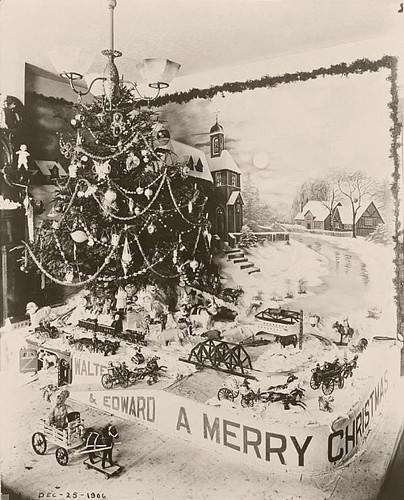
Your comments and appreciation really make the task of writing so much easier. Also, I want to acknowledge all the talented and generous people who've contributed so much of themselves to Appalachian History this year: Alice Feagan, Beth Kephart, C. Belmont Keeney , Dan Dutton, Dylan Thuras, Ed Kelly, Lynn Salsi, Molly Wilkins, Ralph Hall, Rebecca Dart, Roger & June Lowe, Sarah Moon, Sonja Ingram, Tim Hooker, Tipper Pressley , Will Benson, Christine Burke Ashwell, Cynthia Fife Coughlin, Betty Cloer Wallace, and Cindy Gladden Tuttle.
This blog is so much richer for their help.
I promise I'll get back to work posting more tasty things for you to read just as soon as I get done unwrapping a few of these pretty boxes over in the corner.
Chattanooga Daily Times, December 12, 1915--
Mark Morrison, manager of Morrison’s, well known local drug firm, was arraigned yesterday before Esquire Kerby, charged with violating the child labor law, on a warrant sworn out by Mrs. O. D. Glenn, special investigator for the state. Mr. Morrison waived preliminary examination, and was bound over to the grand jury on a $250 bond.  In the warrant Mrs. Glenn charges that Page Zarley, a 12-year old boy, had been employed by the Morrison Drug company as table boy and had been required to work from noon until 11 at night, in violation of the state statutes prohibiting the employment of children after 6 in the evening.
Mrs. Glenn told a Times reporter that the Morrison company, as all other drug stores in the state, had been notified of the state laws in this respect in a bulletin sent out, and exhibited their receipt of same in a signed coupon which had been detached from the bulletin. She said that the Zarley boy had not been in school a day this year. Mrs. Glenn has a signed affidavit regarding the youngster’s age.
Young Zarley’s mother is a widow and has a boarding house at 216-1/2 Oak Street.
It was stated at the Morrison Drug company last night that the Zarley boy had been employed by the head soda dispenser, who he had told he was 14 years of age. William J. Morrison stated last night that the boy claimed he was needy, and in his position at their store was helping support his widowed mother. "We are always very careful," Mr. Morrison stated, "in employing boys in compliance with the labor law, and were told by young Zarley that he was 14, but neglected to get an affidavit. We have been compelled to refuse several deserving and needy boys employment on account of the laws governing these cases."
Esquire Kerby, when asked yesterday if he would take the case, said that under his oath of office he had no alternative. He said, however, that in the event it was shown that the boy was working to help support himself and mother, and had been given employment through kindness, he would dismiss the case. He said he took the position that when a minor has no other means of support he should be permitted to retain his employment even if his hours do conflict with the statutes in that connection.
"The people of Chattanooga do not seem to be in favor of regulating the employment of children and females, as is set forth in the statutes," said Mrs. Glenn last night. "They seem willing to allow them to work under any conditions, but I am here to enforce these laws, and I will make every effort to stop agues of the laws."
*Mrs. Glenn left last night for Knoxville where she will remain for several days before returning here.
About the photo by Lewis Hines: caption reads "Street Bretzau, who is a 'Tube bou' in mule-room [at Richmond Spinning Mills]. Mule is apparently more dangerous than ring spinning. (See bandaged finger.) Photo during working hours. Chattanooga, Tenn., 12/06/1910"
From 1908 until 1912 Hines (1874-1940) traveled across the U.S. photographing conditions of child labor in many different settings. His photos show the haunting images of children bound to work in factories, mills, and street trades, to name a few. These pictures encouraged labor law reform and the implementation of safety laws.
sources: http://snipurl.com/1v8m2
www.appstate.edu/~hindmanhd/lewishine.html
child+labor Lewis+Hines Chattanooga+TN appalachian+history appalachian+mountains+history appalachia
Clarence Nixon wrote of his father’s store in his understanding book, Possum Trot, "We stocked up with fruit in December, and I still think of Christmas when I smell oranges in the country."
The South was a land of deep sentimentality. Family ties were close, and the hard years following the war tended to knit them even more securely. Christmas was a time a family re-dedication and a season of erasing old and irritating scars of discord. It was a period for visiting and feasting.
Celebration of the holiday was the one institution which came through the war unchanged except for the matter of simplification. Until 1915 rural observance was uncontaminated by commercialization. Simple gifts were passed around, and these, as a matter of course, came from the country store.
Much of the masculine taste in celebration ran to boisterous forms of expression. For more than fifty years the liquor barrel furnished ample cheer for all customers who could rake together enough cash or stretch their credit to buy a quart of Kentucky or Maryland bourbon, or a half-gallon of North Carolina corn. A quart of whisky was admittedly a vigorous start toward a glorious Christmas season.
For the temperate, however, a package of firecrackers was enough holiday amusement. One little nickel package of Chinese firecrackers provided plenty of Christmas joking and pranking. A favorite stunt was to explode the tiny cylinders at the heel of some humorless deacon, with the hope of starting him into cussing. Another was setting them off near a pair of mules in a storehouse yard. The number of runaways made many a good celebrant regret there was such a thing as Christmas. But there was the more pleasant aspect to this form of amusement. Thousands of country children were happier waking up in a cold farmhouse on Christmas morning because Santa Claus had not forgotten the firecrackers and Roman candles. There were also torpedoes, which exploded with thunderous repercussions when dashed on the floor underneath girls’ feet, and Roman candles gave great gusto to the Christmas celebration.
They lifted the holiday spirit high into the air in sputtering balls of varicolored fire followed by sulfurous tails which outdid Halley’s Comet in the eyes of the backwoods cotton farmers. Sometimes they were used in sham battles, which generally wound up unhappily. But all in all, there was something in the violent cracking of fireworks that gave zest to Christmas week, and which marked the completion of one crop year and the beginning of another.
'A Little Bit of Santa Claus'
From Pills, Petticoats, and Plows: The Southern Country Store
By Thomas D. Clark
Reprinted in A Kentucky Christmas, University Press of
Kentucky Press, 2003
Christmas+in+Appalachia chinese+firecrackers appalachia appalachian+culture appalachian+mountains+history
 Jesus, Jesus, rest your head.
You have got a manger bed.
All the evil folk on earth,
Sleep in feathers at their birth.
(But) Jesus, Jesus, rest your head.
You have got a manger bed.
Have you heard about our Jesus?
Have you heard about his fate?
How his mother came to the stable,
On that Christmas Eve so late?
Winds were blowing.
Cows were lowing.
Stars were glowing, glowing, glowing.
Jesus, Jesus, rest your head.
You have got a manger bed.
---Kentucky folk carol; collected by John Jacob Niles: 1912-1913 and 1932-1934
John Jacob Niles (1892-1980) began collecting Appalachian folk songs and composing music as a Kentucky teenager. In 1925, Niles published his first song collection---"Impressions of a Negro Camp Meeting"--- and in 1933, he toured the U.S. and Europe with Marion Kerby to critical acclaim. He released his first album for RCA's Red Seal label, "Early American Ballads" in 1938.
"Like a psalmodist, he intoned his verses in an ethereal chant which the angels carried aloft to the Glory seat. When he sang of Jesus, Mary and Joseph they became living presences. A sweep of the hand and the dulcimer gave forth magical sounds which caused the stars to gleam more brightly, which peopled the hills and meadows with silvery figures and made the brooks to babble like infants. We would sit there long after his voice had faded out, talking of Kentucky where he was born, talking of the Blue Ridge mountains."
Henry Miller, Plexus: Book 2 of the Rosy Crucifixion, pp. 366-367, Grove Press, 1965
Sources: johnjacobniles.com/articles.htm
www.pbs.org/wnet/americanmasters/dylan/dylan_niles.html
Christmas+in+Appalachia Christmas+carols John+Jacob+Niles appalachia appalachian+culture appalachian+mountains+history
Stephens' "Book of the Farm" (1840) says "Winter is the especial season of man – our own season. It is the intellectual season during which the spirit of man enables him most to triumphantly display his superiority over the beasts each day that perish." In winter, the countryman plays a conqueror who sets forth each day to battle the elements, and winning, returns to the rewards of his harvests. It’s a daily game, beyond the ken of the city-dweller whose comings and goings lack the flavor of make-believe.
The coming of winter in the old days was heralded by a "banking-up season," when the north sides of houses and barns were stacked with proper insulation. Corn stalks, hay, leaves, or sawdust shouldered the base of the farmhouse against winter’s blast; cow dung did the job at the barn.
The first of December was Sled Day wherever winter and snow were synonymous; that was the day when sleds of all sorts were readied and sleigh bells were made to shine. Just over sixty years ago there were real sounds to winter: steel-shod runners squeaked over the packed snow and the almost constant music of sleigh bells filled the crisp air everywhere. Winter was a season of bells. Time was when you could recognize a neighbor’s approach by the sound of his sleigh bells, even tell which neighbor it was. Some farmers made up their own sets of bells and others preferred to use inherited sets. For those who wished to buy, however, there were Swiss Pole chimes, Mikado chimes, and King Henry chimes; the Dexter Body Strap of twenty-four bells was a popular buy. At first, sleigh bells were made from two half-globes of metal soldered together, but one-piece bells were later cast and sold separately, ready for fastening to harness. A matched set cost about $1.50.
The reason for using bells on a sleigh was not only for merriment but primarily for safety. A sleigh was a silent vehicle and a fast one, which its driver often found the greatest difficulty in stopping. Furthermore, everyone wore ear muffs or some other sort of ear-covering in the early days, so that winter pedestrians were practically deaf. Just as lights and horns are now required on the highway, bells were once a “must” for all winter traffic.
"The Cracker Barrel"
by Eric Sloane
(Funk & Wagnalls, 1967)
appalachia appalachian+culture appalachian+mountains+history banking+up Eric+Sloane Sled+Day sleigh+bells winter
You could check to see if the bees are flying low, observe the size of the acorns on the trees, or pay close attention to how foggy recent mornings have been in order to gauge what kind of a winter it'll be.
Easiest of all, you could get yourself over to Banner Elk, NC this weekend to the 32th Woolly Worm Festival, where more than 1,000 of the little critters will compete for the honor of proclaiming the official winter weather forecast. Beattysville, KY also hosts a Woolly Worm Festival; this year is their 20th one. At either festival, the worm that most quickly reaches the top of a three-foot piece of string gains fame and glory, makes his mark in local weather history, and wins prize money. Mountain folk use the brown and black stripes on the woolly worm to predict winter's path. Tradition says that the black stripes predict cold and snowy weather, while brown stripes point toward milder conditions. Furthermore, the narrower the band, the harsher the winter. Woolly worms have 13 different bands of color, each representing the 13 weeks of winter from December through March.
The woolly worm is known in the scientific world as Isia Isabella. Other common names for this caterpillar are woolly bears, black-ended bears and banded woolly bears (the name approved by the Entomological Society of America). After hunkering down in a tight ball for the winter, the Isia Isabella will emerge next year as a tiger moth.
The woolly worm’s genus---Pyrrhactia---includes many different species. Some are solid black without any bands, and others have bands of varying sizes. Woolly worms go through six larval stages before entering their pupal or winter cocoon stage. In other words, the caterpillar molts six times and the color and size of its bands may change from molt to molt. Scientists say variations in their bands are linked to differences in species and larval stage, not the weather. But you can still root for your favorites at your favorite Woolly Worm Festival every fall, regardless!
Sources: www.woollyworm.com/node/7
www.mountaintimes.com/mtweekly/2004/1014/isia.php3
www.wtov9.com/weather/9535109/detail.html
woolly+worms Banner+Elk+NC weather+prediction appalachia appalachia+history appalachian+culture appalachian+mountains+history
It’s the heart of ginseng harvesting season. The berry clusters have ripened. The leaves are yellowing. The roots are ready. But stay awhile. The best hunting is still to come, after the first hard frost.  But don’t wait too long. Because of wild ginseng’s endangered status, the U.S.Fish and Wildlife Service has mandated that states allowing its export have protective regulations in place. Consequently, most states have adopted a late-summer through early-fall ginseng hunting season.
"I remember digging ginseng when I was six years old. I've always seen it as a big equalizer for people from Appalachia," says Fred Hays of Elkview, WV, spokesman for the West Virginia Ginseng Growers Association, noting that the harvest surges when unemployment is high or the region's coal miners are on strike and ginseng becomes an alternative income for many. Drought has taken a toll this year, deer have eaten the leaves, turkeys eat the seeds, and rodents go after the root itself. But the harvest makes it worthwhile. Full article here.
Notice the link above takes you not to the Charleston Gazette or the Dominion Post in Morgantown, but to Reuters UK! The British typify a widespread attitude beyond America’s borders, which is that, while ginseng can be found in many parts of the continent besides Appalachia---Panax quinquefolius' range includes the eastern half of North America, from Quebec to Minnesota and south to Georgia and Oklahoma---ginseng and Appalachia are seen to simply go hand in hand.
Ginseng’s hold on our consciousness has been strong for a long long time. Alice Lounsberry’s comments from "Southern Wildflowers and Trees," published in 1901, capture the gist of it well: "Its true value lies, as we know, in its curious rootstock, long famed as being a cure for almost every sort of ill, and an antidote for every poison. Even the word panacea is believed by many to have been derived from its generic name. In China, where it has been largely cultivated and also exported from that country in immense quantities, it is still regarded as being possessed of properties more powerfully stimulating to the human system than those of any other drug."
So if it’s such a wonder drug, and the Chinese are cultivating it, why hasn’t it simply taken its place in our country as a Big Agriculture cash crop, next to soybeans or tobacco?
“You can cultivate that stuff,” says Lake Stiles in Foxfire 3, “and it won’t bring you half as much as wild ginseng. If it’s cultivated, it makes a great big root. If it’s wild, it’s just a small root. But you can’t get by with cultivated sang with a [ginseng dealer] who knows what he’s doing.”
Wild ginseng favors mature hardwood stands where the terrain is sloping to the north and east. Panax quinquefolium loves a moist but well-drained and thick litter layer with more than just a tad of undergrowth. You will find yourself looking at a lot of other species of plants for the prize. A young hickory or Virginia creeper will confuse the beginner.
So: it’s highly sought, it’s an endangered species, its hunting season is fairly narrow, it's easily confused with other plants, and you have to look in very particular areas on a mountain or in a holler. Should be enough to keep British reporters intrigued for years to come.
sources: http://forestry.about.com/od/alternativeforest/ss/panax_ginseng_4.htm
http://uk.reuters.com/article/lifestyleMolt/idUKN2836786520071001
Foxfire 3 (Anchor Press/Doubleday, Garden City, NY 1973) p. 254
Ginseng West+Virginia+Ginseng+Growers+Association Panax+quinquefolius appalachia +appalachia+history appalachian+culture appalachian+mountains+history
"I've been a guide now for quite a few years, and I was borned and rared in the Great Smoky Mountains, at the foot of Mount Leconte, and when I was a boy, I didn't do anything but hunt. One day I went out to, to shoot some turkey, and just as soon as I entered the woods, here I saw a big flock of turkeys up on a limb, and I had this old cap and ball gun.
"Well, I was a little bit choicey, and I didn't want to just shoot one and all the rest of the flock would fly away. So I tried to figure out some way that I could line these turkeys up and kill more than one, as this cap and ball gun that takes you so long to load them, why, the whole flock of turkeys is gone.
"And I was a very good shot at that time, but the trouble was that I always made them, the meat, the feathers fly, but the trouble was the meat went with it the most of the time. So I decided I couldn't line these turkeys up, and I just decided that I'd just pick one out or aim at the middle of the limb probably would be better. So I just aimed at the middle of the limb where these turkeys was settin'. Photo caption reads: "Doug Smith, Raymond Torrey, Wiley Oakley, and George Barber on a special hike. October 11, 1925”
"At the crack of this gun, why, I split the limb open and all these turkeys' feet fell right down in the crack of this limb. It closed in on them and fastened the whole flock. Here I had about a dozen or two fastened in this limb. By aiming at the limb instead of picking out one turkey, why, I got the whole business, but I had a hard time in climbing up the tree to get the turkeys out.
"Of course, when I yodel to the end of a story, that means you don't have to believe it unless you want to [YODELING]. Lord, Lord, this is about the best turkey hunt I ever made. Well now then, I have a true story. When they're true, why I don't yodel to end of the story, but when I was a boy, I did do quite a bit of hunting, and, and we had these old-fashion kind of guns.
"The first kind of gun was called the flintlock gun. You had to carry powder in the horn, and they had a little pan where you pour the powder in, and then the flint lock goes down and sets the powder off, and of course, of a rainy day you couldn't do much good a-huntin'. This was the first kind of a gun that I ever owned.
"Then a little later I had the cap and ball gun. You could go out on a rainy day and kill turkey, but you wouldn't kill them by the dozen. You'd only kill one at the time. The most of the time it was like I said before. They, usually you'd do a lot of good shooting, but they always knocked the feathers out, but the meat went along with them. So I'm not very good at story, story telling, not today, beg to be excused."
---Wiley Oakley
Gift shop owner and professional guide
born Sept. 12, 1885, Gatlinburg, TN
Joseph Sargent Hall interviewed Oakley in the Great Smoky Mountains in 1939. Oakley had a fourth- or fifth-grade education and some self-education.
As a graduate student, Hall began working for the National Park Service in the summer of 1937 collecting the speech of the Smoky Mountain inhabitants. He talked to people still living within the bounds of the park and to former Smoky Mountain residents who had been displaced by the park.
That first summer, Hall collected four notebooks full of details of the language, informant profiles, and bits and pieces of the mountain culture from songs to herbal remedies. The bulk of Hall’s work in the mountains spans from 1937 to 1941, but he continued refining and processing his collection for the rest of his life.
sources: Joseph Sargent Hall Collection/ East Tennessee State University/ Archives of Appalachia --- http://www.etsu.edu/cass/archives/Collections/afindaid/a422.html
http://www.cas.sc.edu/engl/dictionary/transcripts/oakley_wiley.html
Joseph+Sargent+Hall Great+Smoky+Mountains+National+Park Wiley+Oakley Gatlinburg+TN appalachia appalachian+history appalachian+mountains+history
No more important fruit tree graces the homesteads, farms, and backyards of Appalachia than the apple. When early settlers headed west from the eastern seaboard, they took apple seeds because they didn’t weigh too much or take up too much space.
And no figure from American folklore personifies the spread of the apple into the heartland like Johnny Appleseed, aka John Chapman. Not a great deal is factually known about him, and by now the tall tale spinners have probably entirely obscured the full reality of the man himself. He was a strict vegetarian. He also primarily wore discarded clothing or would barter some apple saplings for used clothes. He walked alone in the wilderness, without gun or knife, slept outdoors, walked barefoot and ate berries. Stories that he wore a cooking pot as a hat, however, seem to have been stitched on at a later date. Reproduction of an illustration depicting John Chapman, known as Johnny Appleseed, published in A History of the Pioneer and Modern Times of Ashland County From the Earliest to the Present Date by H. S. Knapp, 1863.
One thing is clear: he was as his legend suggests a man who moved around a great deal. Born in Leominster, MA, on September 26, 1774, John became a Christian minister who beginning in 1802 and for 43 years thereafter planted apple orchards from western Pennsylvania, across central Appalachia into Kentucky, and on throughout Ohio, Indiana and Illinois. While doing so, he spread the word of God as a self-appointed missionary for the mystical Swedenborgian church.
Legend says Chapman’s first seed scatterings were culled from the orchards he frequented as a child. It’s said that he gathered canoe-fulls of apple seeds from western Pennsylvania at cider-making time as he headed westward.
It’s easy to forget that Chapman, painted as a romantic mystic, was a level-headed, if eccentric, orchard businessman. For example, he owned more than 1074 acres of land in fifteen different tracts in Ohio. He sold his seedlings for three cents each, or planted an orchard for six cents a tree, earning about three dollars a day (compared to laborers in Philadelphia who earned about a dollar a day.) One of Johnny Appleseed’s authenticated varieties, the Albemarle Pippin (also known as the Newtown Pippin) is today one of the premier mountain varieties.
There are no records to indicate John Chapman had a wife or children, but according to the Johnny Appleseed Education Center & Museum in Urbana, OH Chapman had a sister and a brother. His brother died in infancy and mother soon after. Chapman's father remarried and had an additional family, thus giving Chapman ten half brothers and sisters. Visits to them help document his whereabouts at various points in his life.
We know, for example, that in 1816, while visiting family members in Center Township, OH he planted at least one orchard in Bristol Township for a Mr. Fuller.
Chapman’s last Ohio visit, in 1842, included a trip to Moscow Mills in Center Township in Morgan County to see his brothers Nathaniel and Parley and sister Sally Whitney, who lived there. In March 1845, Johnny Appleseed passed away at age 70 in Fort Wayne, IN.
Sources: www.morgan.lib.oh.us/Morgan%20County%20History%20Stories.doc
http://www.a-spi.org/tp/tp50.htm
www.urbana.edu/appleseed/museum.htm
www.ohiohistorycentral.org/entry.php?rec=94
John+Chapman Johnny+Appleseed appalachian+folklore appalachia +appalachian+history appalachian+mountains+history


