
Denim Quilt, April 2007
3 months ago


Traditional dancing in Appalachia includes several types: step dancing, set dancing, and couple dancing. Step dance traditions include clogging, buckdancing, flatfooting, and the Charleston. Set dances, involving two or more couples, include four couple squares, big set (ring) dances, reels, country (contra) dances, and play parties. Couple dancing, often referred to as "round dancing," includes the two-step and waltz.
Square dancing, one of the oldest forms of American folk dancing, evolved from several different Old World group dances, mainly the English country, or contra, dance and the French quadrille.
In the American version of square dancing, four couples form a square and dance to music from an accordion, banjo, fiddle, and guitar.
An old-fashioned Southern "square", sometimes called "running set"-- English musicologist Cecil Sharp coined the term while describing dancing in eastern Kentucky in 1916--, can accomodate as few as four or as many couples as want to crowd in. The formation is really a big circle with any number of couples. (There are, of course, a body of Southern squares that are done in 4-couple sets.) Most commonly, a Southern "running set" type of square dance is structured in two parts: First the major circle and then the minor circle. With all hands joined in one big circle around the hall, one or more introductory big circle figures are danced..jpg "Library of Congress Prints and Photographs Division/Farm Security Administration - Office of War Information Photograph Collection/fsa 8a17204") Square dance, Skyline Farms, AL, 1937. Photo by Ben Shahn.
Square dance, Skyline Farms, AL, 1937. Photo by Ben Shahn.
The big circle then breaks up and each couple joins with an adjacent couple to dance some little circle figures. The movements are not so much geometrical figures but little pantomimes: "Birdie in the cage and three hands around" (a girl steps into the center, the other three circle around her); "Around that couple and take a peek" (the active couple tries to look at each other behind the backs of of the inactives, who try to hinder them); "Chase a rabbit, chase a squirrel, chase a pretty girl around the world" (the man pursues his partner around the other couple); to name just a few.
The little circles can be spaced in a major circle around the hall, as in a Sicilian circle; or they can be scattered all over the dance floor. The couples move on to join a new couple and repeat the little figures; progression may occur several times. To conclude, all rejoin in a large circle and dance a finishing big circle figure. An American addition to square dancing is the caller.
Ladies do and the gents you know,
It’s right by right by wrong you go,
And you can’t go to heaven while you carry on so,
And it’s home little gal and do-si-do,
And it may be the last time, I don’t know,
And oh by gosh and oh by Joe.
—(Ernest Legg, WV)
Ernest Legg’s calls were featured on a number of 78s recorded by the Kessinger Brothers in 1928.
Clogging is an expressive style of American dance with origins in the folk dances of the British Isles, Africa, and pre-Columbian America. Settlers in the American South took elements of these styles to form a unique American dance style, Appalachian clog dancing.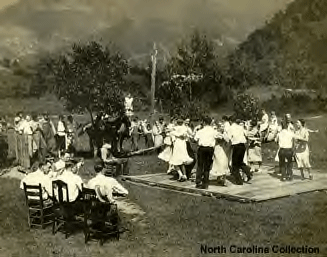
Though the eighteenth-century Scottish and Irish settlers brought with them the clog, a step dance characterized by a very erect upper body, the additional influences of the traditional dance of Native Americans with its toe-heel, toe-heel movement and African American buck dancing, in which the arms hang loosely at the dancer's sides, made for a distinctly American style. The basic clogging and buckdancing step consists of a double toe shuffle, where the dancer brushes forward the toe and then the heel of the free foot, shifts his or her weight to that foot, then rocks onto the other foot, before stepping back onto the foot that had originally been free. The leg is generally raised a little more than six inches off the ground in clogging, while the feet stay close to the ground in traditional buckdancing.
Team clogging, coupled dancers executing individual step dances together in group configurations, is a relatively new composite dance form that began in the 1920s in western North Carolina. In was initiated when The Smokey Mountain Dancers first performed at the Bascom Lamar Lunsford Festival in 1927 in Asheville. By 1938, team clogging had its own competition at the Lunsford Festival, and it was won by the well known Soco Gap Dancers from the Maggie Valley area.
They performed freestyle buck dance steps continuously while doing mountain style square dance figures called by one of the dancers. In freestyle (or traditional) clogging, the dancers perform spontaneous footwork, which allows them to improvise while moving about the dance floor in time to live music provided usually by string bands. Team clogging won more widespread respect and recognition when the Soco Gap Team performed at the White House in 1939 for an audience including the Queen of England. Queen Elizabeth was said to have remarked "that's just like our clogging."
sources: www.doubletoe.com/About.htm
http://tennesseeencyclopedia.net/imagegallery.php?EntryID=D002
http://canecreekcloggers.org/backintime.html
appalachian+history appalachian+culture history+of+appalachia appalachia


