
Denim Quilt, April 2007
3 months ago


Jane Gentry -- piano teacher, Appalachian folk-music historian, weaver -- was an inspiration for the movie Songcatcher.
She was born Jane Hicks in 1863, the first child of Ransom and Emily Hicks, in Watauga County, NC. "My pappy were a minister, name of Ransom Hicks. Mammy were always peckin' me over the head with a stick. She were turrible ill and cross, pore woman! I were that foundered with the peckin' that I declar'd that I would never whup ef God sent me childern. You'll whup as much into `em as you whup out o' em."
And later, Jane said of her life growing up, "Twere like a three-legged cat's. They didn't show me till I were nine yur old. I used to walk miles and miles bar'foot in the snow." She was twelve years old when the family moved to the Meadow Fork section of Spring Creek in Madison County. At sixteen, Hicks married Jasper Newton Gentry, though her parents were against the marriage because of her age. Around 1912, the Gentry family bought 'Sunnybank' in the town of Hot Springs, moving there so that their nine children could attend Dorland Institute, a Presbyterian mission school. Irving Bacheller, New York newspaper editor and author of books, short stories and magazine articles, (his novel Eben Holden, published in 1900, outsold The Wonderful Wizard of Oz, To Have and To Hold, and other popular books of that year) met Jane Gentry in April 1914 when he came to Hot Springs on vacation.
"I could hear voices as I came near the house," he recounted in his novel, The Tower of a Hundred Bells (1916), "and chiefly those of young children laughing as if at play. Then I heard the kindly voice of Mrs. Gentry. She sat on her little verandah sewing with a number of small children grouped around her. She was amusing them as she worked."
"Go on with your story telling," I pleaded. "I am a child myself as young as any of these."
"I were tellin’ some mount’n stories," she answered. "It mout be they’d tickle ye. So if you’ll be one o’ the young uns, set down thar an’ I’ll scratch around an’ see what I kin fetch out o’ my ol’ brains."
I took the chair she offered and sat down with a girl of four on my lap while Mrs. Gentry opened a mine of old mountain folk lore which delighted me.
"Well here comes:
Eight humly, bumly bees,
Seven humpity, crumpity no horn cows,
Six hicketty, ficketty, custards,
Five bob-tail, bald-face, skewball nags,
Four colly birds,
Two ducks and an ol’ fat rooster."
"Beyond The Grave: Ghost Stories and Ballads from the Mountains"
Susanna "Granny Sue" Holstein
Audio CD
Appalachian storytelling isn’t a theatrical performance with sets and costumes and lighting and accents, though a good storyteller can conjure all those things in the mind of the listener. And it’s not a recitation of history, with famous battles, treaties, statecraft and dates, though it can draw from any or all those historical aspects as needed.
Rather, the best of Appalachian storytelling weaves an emotional human narrative that, while local in details, makes the listener realize just how universal the characters and situations described really are.
Susanna “Granny Sue” Holstein of Sandyville, WV places herself firmly in this living tradition with her new collection of ghost stories and ballads, “Beyond the Grave.” One happy coincidence of CD packaging today is that a collection of stories runs for just about the length of time you might envision a group of family & friends gathering together on the porch or in the parlor after a meal to share a round of tale swapping. Holstein takes advantage of this time frame parallel by arranging her material in an order that suggests the unfolding of an evening together, rather than just a clump of recordings thrown together in a list. For example, she builds from one of the earliest known ghost stories in WV to a finish with “The Greenbrier Ghost,” the most famous of the lot.
She intersperses her stories with three a cappella tunes, two of which, “Pretty Polly” and “Railroad Boy” will be recognized immediately by many listeners, classics that they are. She maintains the feeling that she’s sitting on the rocking chair next to you RELATING these songs rather than PERFORMING them by wisely foregoing overproduced instrumental backup. She does use a touch of echo reverb combined with forest birdcalls, which adds a sense of longing and wistfulness to the tunes. Her singing voice is a crystal clear soprano and more than holds its own without any backup.
On the third tune Holstein shows us an important lesson in why traditional Appalachian storytelling remains so vital. It’s all too easy to assume that a storyteller neutrally transmits an existing body of tales to the next generation, but in fact the best storytellers invariably add their own material and personalities into the mix. Holstein, in “The Cruel Blacksmith” recording, has set her own lyrics for the story of Zona Shue, the Greenbrier Ghost, to the well known tune of ‘Barbara Ellen.’
Furthermore, she’s taken a historical account from a 1906 book “Jackson County: A History of Mill Creek and Sandy Valley,” and developed her own saga out of that. Holstein does manage to keep a delicate balance between her new material and the standards, so purists won’t feel abandoned here!
Good storytelling should raise the question: “How’s this connect to my world?” Holstein answers in several ways: after telling “Wizard Clipp” she invites her listeners to take a drive over to Middleway, WV where they’ll find a plot of land called “Priest Field” whose name came directly from this tale. Likewise she tells us about a plaque near Glenville, WV about the old “Village of Burnt House” that verifies the fire account she’s just laid out for us. And she graciously credits a young listener from Diana, WV who first shared the “Holly River Ghost” story with her before telling it herself. “My young informant,” she says in her liner notes, “told the story in a matter of fact manner that lent credibility to the tale.” So this set of recordings conveys a real feel of give and take between Holstein and her audience.
Lots of real dates, places and people are mentioned throughout each of these delightful narratives. But are the stories themselves true? “I can only answer that if you believe, then it is true for you,” winks Susanna “Granny Sue” Holstein.
Rebecca Dart, a Vancouver comic book artist and animator, is turning heads this week with her fresh visualization of the old-time tune "On the Banks of the Ohio." Click on each panel to see her wonderful linework enlarged.


Says Wikipedia of this tune: "Banks of the Ohio is a 19th century murder ballad, written by unknown authors, in which 'Willie' invites his young lover for a walk during which she rejects his marriage proposal. Once they are alone on the river bank, he murders the young woman.
"The first recording of the song was by Red Patterson's Piedmont Log Rollers on August 12, 1927. The song has since been recorded numerous times, by Henry Whitter, Ernest Stoneman, Clayton McMichen, The Carter Family, Blue Sky Boys (whose version, performed in 1936, appears in the soundtrack of the 1973 film Paper Moon), Johnny Cash, Monroe Brothers, Joan Baez, Olivia Newton-John (with Mike Sammes, in 1971, her second commercial single in the United States), Dave Guard and the Whiskeyhill Singers, and Doc Watson, with slightly different lyrics when sung by a female.
"The song is similar in subject to Pretty Polly, and likely tells the same story (Both songs date from approximately the same time, tell roughly the same story, and feature a villain named 'Willie')."
Please welcome guest blogger Cindy Gladden Tuttle of Salem, VA. She is the granddaughter of Texas Gladden (1895-1967), an American folk singer best known for her traditional Appalachian ballad style of singing.
A black and white log house. Red shuttered windows. Beds ablaze in summer with a multitude of blossoms of all kinds. Seven white pines, their boughs heavy laden with snow in winter. No furnace, but a wood cookstove and a stone fireplace. Spring water by gravity. Washtubs, washboards, and clotheslines. An unfinished attic bedroom, the presumed home of Rawhide & Bloody Bones and the Hairy Teeth Man. The sweet aroma of fried apples. Afternoon Bible stories sitting on the floor round Granny’s rocker.
These are some of my richest and warmest memories I have of childhood. The memories of the statuesque woman known affectionately to us as Granny, to others as Mom, and to the rest of the world as Texas Gladden. She possessed a literate style of speech accompanied by a gentle laugh and a radiant smile. She was a lady devout in her Mormon faith and devoted to her family of husband James, nine children, and twenty-eight grandchildren. Her countenance and manner belied the treasure she carried within herself.  Born in 1895 in Smyth County, VA, Texas Gladden had a repertoire of over 200 old time mountain ballads. These are songs that traveled to these mountains with the early settlers and were handed down through the generations. They are of Anglo-Saxon/Celtic origin and contain the remnants of the European ideals of female subjugation. These old ballads also gave expression to the wishes, desires, and fantasies of the women like Granny who cultivated them. Some of these ideas are easily illustrated in ballads such as The House Carpenter ---the tale of a woman lured away from her loving husband and babies only to discover her ill-fated mistake.
Granny always said that these songs should be sung by an uneducated voice as the ballads themselves were uneducated. She stylized these songs through the use of odd phrasings and grace notes. She defined grace notes, which she learned from her mother, as unexpected twists on a note. She never thought that people who sang operettas should tinker around with mountain music. An hour or so of immersion into the music of the mountains allows the listener to understand that Granny was correct in her thinking on this concept.
Most of Granny's singing was done at home and she modestly claimed she didn’t sing anything but lullabies. Raising nine children during the Great Depression certainly left her with little time to do much else. Her public appearances were rather sparse. She sang on occasion at community events at the old Fort Lewis School and at the festivals at Whitetop Mountain during the 1930s. She and her brother, Hobart Smith, performed at the White House in 1933 at the request of Eleanor Roosevelt. Her only other known public appearance came in 1941 at the request of Alan Lomax. In 1959, as part of his Southern Journey project, Lomax visited Granny at home and recorded a number of her songs. These can be found on Ballad Legacy: Texas Gladden (Rounder CD 1800). This CD also contains snippets of Lomax' interview with my Granny. Listening, one can hear warm gentility. She says during these interviews that she always had a perfect mental picture of the story in the song. Listening to her rendition of 'Mary Hamilton,' one can see the tragic picture she paints, both for the audience and in her mind, as she sings:
Word has come from the kitchen
And word has come to me,
That Mary Hamilton drowned her babe,
And throwed him into the sea.
Down came the old Queen,
Gold tassels around her head
Oh Mary Hamilton, where’s your babe,
That was sleeping in your bed?
Go to sleep, go to sleep,
Go to sleep little baby,
When you wake, get some cake,
And ride them pretty little horses.
Black and a bay, sorrel and a gray,
Whole heap a’ little horses.
Black and a bay, sorrel and a gray,
Whole heap a’ little horses.
Little old horse, little old cow,
Ambling around the old hay mound,
Little old horse, he took a chew,
"Darned if I don't," said the old cow too.
Some know the song as "Nancy Brown," others as "The West Virginia Hills," but according to The Frank Gullo Music Sheet (sic) Collection at Millersville University, "She Came Rollin' down the Mountain" was written by Arthur Lippmann, Manning Sherwin, and Harry Richman and published by Crawford Music Corporation in 1932.
The ditty tells the tale of Nancy Brown, who throws over one suitor after another until she finds the man she's been waiting for: "A city slicker with hundred dollar bills." They live happily ever after, until…
In the hills of West Virginia
There's a gal named Nancy Brown
She was the fairest maiden
in city or in town
Now Nancy and the Deacon
climbed the mountainside one noon
they climbed up to the summit
but very very soon
She came rollin' down the Mountain,
rollin' down the mountain
Rollin' down the mountain mighty wide
No, she didn't give the Deacon
not a thing that he was seekin'
She remained just as pure
as the West Virginia sky.
Then there came that ol' cowboy
came a cowboy with his song
took Nancy up the mountain
but she still knew right from wrong
She came rollin' down the Mountain
rollin' down the mountain
Rollin' down the mountain by the Dam
and despite that cowboys urgin'
she remained the village virgin
she remained just as pure
as the West Virginia sand
Then there came that Old trapper
with his words so soft and kind
took Nancy up the mountain
but when she read his mind
She came rollin' down the Mountain
rollin' down the mountain
Rollin' down the mountain by the shack
She remained as I have stated
not the least contaminated
she remained just as pure
as Satin's apple jack
Then there came a city slicker
with a hundred dollar bill
took Nancy and his Packard
way up on the hill
Oh, she stayed up on that mountain
stayed up on that mountain
she stayed up on that mountain all that night
She came down next morning early
more a woman than a girly
and her pappy kicked that hussy out of sight
And now she's livin' in the city,
she's living in the city
livin' in the city mighty swell
Now her life's all beer and skiddles
and she lives on fancy viddles
and those West Virginia hills can go to hell.
Well there came a big depression,
and the slicker lost his pants;
First he lost his Cadillac,
and then he lost his Nance.
And she came back to the mountain,
She came back to the mountain,
She came back to the mountain mighty sore,
And the cowboy and the deacon
Got that thing that they were seekin'
And she's known as West Virginia's biggest...used car dealer.
 A six-stanza parody of "She Came Rollin' down the Mountain"was published in 1952 by textile tycoon Elliot Springs, to advertise his Spring Maid bedsheets. Here's an illustration from that campaign.
Breakin’ Up Christmas is both the name for 12 days of partying, dancing, and music making ending up on January 6th, Old Christmas day, and also a song sung during that period. The tradition harks from the area that roughly includes Surry County NC, nearby Grayson and Carroll counties in VA, and the independent city of Galax located between the two.
Hooray Jake, hooray John
Breakin’ up Christmas all night long
Santa Claus come, done and gone
Breaking up Christmas right straight along
Don’t you remember a long time ago
The old folks danced the doesey-doe
 New tunes only slowly made their way into the area, often by visitors or because a community member made a trip outside of his locality. Even so, as a tune bounced back and forth over the mountains between North Carolina and Virginia, local musicians might give it a different name, speed it up, add a new twist, and come up with a 'souped-up' version.
 Hail the blest morn
See the Great Mediator
Down from the regions of Glory descend!
Shepherds, go worship the Babe in the manger,
Lo, for the a guard the bright angels attend. Brightest and best of the sons of the morning,
Dawn on our darkness and lend us Thine aid
Star of the East, the horizon adorning,
Guide where our infant Redeemer is laid.
Cold on His Cradle the dew-drops are shining
Low lies His head with the beasts of the stall;
Angels adore Him in slumber reclining
Maker and Monarch and Savior of all.
Vainly we offer each ample oblation,
Vainly with gifts would His favor secure;
Richer by far is the heart’s adoration,
Dearer to God are the prayers of the poor.
Shall we not yield Him in costly devotion,
Odors of Edom and offerings divine,
Gems of the mountains and pearls of the ocean,
Myrrh from the forest and gold from the mine?
"I guess Christmas is without a doubt the best time in the whole year, all around the world, for all folks who celebrate it, and in our family in Kentucky it must be better than any place else. I suppose every child must feel that way about his own home place and his family and their Christmases together. I can remember looking forward all year round to the happy time in December when all the scattered ones of us would gather in around our fireplace and sparkling tree. Just thinking about it would fairly send me out of my mind with joy and excitement.
"On Old Christmas Eve we’d sit fore the fire and Mom and Dad and Granny’d atell us about the baby Jesus born in a stable on this night, and they’d say that if we’d go out at midnight we’d see the elderberry bush blooming in the fence corner right in the snow, and that if we’d peep in through a chink in our stable and make no racket atall we’d see the cow and the old mule kneeling, paying honor to the little King of Kings. Then maybe Granny’d sing us her Christmas carol, "Brightest and Best," in the old mountain tune, and we’d all sing some…That used to be our Christmas."
Jean Ritchie, Singing Family of the Cumberlands
University Press of Kentucky, 1988
"The Barrenshe Run mishap was one of the worst log train wrecks in West Virginia history.
"As the story became legendary, the runaway train gained additional notoriety as the subject of a local blind poet, who supported himself by selling copies of his works for a nickel on Oakford Avenue in Richwood WV. The poem brought additional attention to the accident, popularizing it more than recounting of the wreck circulated by word of mouth.
"Like so many items from the past, today there are several uncertainties about the poem. In one version of the poem, Charles Lough [one of 3 railroadmen known to have been killed in the accident] is replaced by Luke King, and the identities of the loadermen seem a bit uncertain. Although the poem leads to a degree of confusion, it is invaluable in many respects-including verifying the date of the accident.
“As for the story behind the poem, one version is that J. A. Howell of Diana wrote and peddled it with his other poetry. Another recollection is that J. A. Collins was the blind poet from Diana. Jim Comstock, editor of the West Virginia Hillbilly, prefers the story that J. A. Howell originated the rhyme, adding that Howell wrote other poems about mountain railroading.”
---Long Train Runaway on Berrenshe Run 1912, by George Deike, publ. in The Log Train, issue 80, Nov 2004  Original photo caption reads: Before the clean up: wreckage strewn down the hillside on Barrenshe Run. Visible are several tracks from the skeleton log cars, the Barnhart loader, and Shay no. 7’s diamond smokestack.
THE WRECK ON THE BAREEN-SHE RUN"
On Cranberry River,
Up Barren-She Run,
The trainmen seemed jolly,
Were having their fun,
Eight cars they had loaded,
And four empties, it seemed,
The crew got on board and
turned on the steam.
Ivan Green jumped off
As she started down hill;
They had lost all control,
It was running at will,
Dick Green and Luke King
Both jumped off alarmed;
Near eighty rod further the
excitement grew worse,
The further the faster
Those loaded cars flew.
Frazier Adams, engineer,
Jumped off and was killed;
His head struck a tie,
His brains they were spilled,
Joe Taylor, conductor,
And Russell Berry turned brake.
Both stood to their places,
Which was a mistake.
For the cars jumped the track,
And their lives fled as fog
Their bodies were covered
With the wreckage of logs.
The engine still rolling
And left on the road
Pete King, (the log rollerman)
Alone left on board.
The engine turned over
In Barren-She Run
But, Pete, he slipped out
Of the cab as she turned.
So, he took a tie-ticket
For Camp Four, so they say;
And he arrived there quickly,
The very same day.
For he thought himself all
That was left to tell now
The crew, cars and engine
Broke up in a row.
Squire Thomas and Doctor McClung
Got the word and rushed
To the scene - as quick as they could,
Ivan Green and Dick King
Were both badly hurt,
So Doctor McClung was
Soon put to work.
I must speak of an act
Joe Taylor in Life;
He left some support for his
children and wife.
Sixteen-hundred dollars,
In a check that was good,
His wife she received from their
good brotherhood.
Taylor, Adams and Berry
Were three youngful men,
So prompt in their business,
But sudden their end.
Their bodies were mangled,
In all abscess.
Their spirits departed:
They greatly are missed.
But, those four should be thankful,
To God for their breath,
He, the Great Prophet,
Hath saved them from death,
That they may have time
To prepare for the grave:
God is always able and willing
to save.

SALLY GOODIN'
Love her, love Sally Goodin'
Love her, sweet thing Sally Goodin'
A big piece of pie, a big piece of puddin'
Give it all away, to hug Sally Goodin'
Looked on the hill, seen Sally runnin'
Yes my my, sweet thing Sally comin'
Up and down the road , the road all muddy
To hug Sally Goodin, till she can't stand steady
Upon the hillside, hewin' on a log
Frogs in the millpond, barking like a dog
Before you hear that rooster crow
Sprinkle little meal before her door
---Queen family version of traditional western North Carolina folk song
"The 1927 Sessions in Bristol [TN] were so successful artistically and in terms of commercial sales," says Dr. Ted Olsen, interim director of East Tennessee State University's Center for Appalachian Studies and Services, "that the other labels said, 'Aha, Victor is doing something really smart' ... by going to the mountains to get the music rather than expecting mountain musicians to travel outside Appalachia to the big cities of Atlanta or New York."
Johnson City, TN, like Bristol, was a haven for early recording artists, including the legendary Jimmie Rodgers. And so, in 1928 and 1929, Frank Buckley Walker, head of the Columbia Records “hillbilly” recordings division, headed there, field recording instruments in tow, in search of native Appalachian musical talent. The scraggly bearded man was known by Johnson Citians simply as "Uncle Fuzz."
From October 15-18 1928, the Brading-Marshall Lumber Company’s business office at 334 East Main Street (a site now occupied by an Interstate 26 onramp) attracted a myriad of local musicians, each auditioning for a potential record contract with Columbia Records. Walker listened intently as each individual or group played music, in hopes of being invited back that same week for a recording session in their rented temporary makeshift studio. Historians would later tag his pioneering efforts as the "Johnson City Sessions."
One of the most well-known old-time musicians to emerge from these sessions was Country Music Hall of Fame fiddler Charlie Bowman. Three of his brothers and two of his daughters recorded with him. The two daughters, Jennie and Pauline, were among the first sister acts recorded in the genre. Fiddlin’ Charlie Bowman was a major influence on the distinctive fiddle style that defined 1920s and 1930s country music, and cut two of his signature pieces --- "Gonna Raise the Ruckus Tonight" and "Roll on Buddy" --- in Johnson City.
 The Roane County Ramblers, another group that developed a wide following, recorded four songs on Oct. 15, 1928, and another six, including “Johnson City Rag,” on Oct. 21, 1929.
The Bentley Boys' "Down on Penny’s Farm" from the 1929 sessions ricocheted forwarded 30 years to impact a young folk singer from Minnesota who was about to make his own mark on the world.
"Bob Dylan was so moved by that particular performance from the Johnson City Sessions that he used the melody for a song ... 'Hard times in New York Town,'" Olsen said.
Olsen said Dylan also borrowed the theme of "Down on Penny’s Farm" for the classic, "Maggie's Farm."
But the gravy train would not continue. "…the deepening Depression eventually curtailed field recording activity," says Charles K. Wolfe in The Bristol Sessions, "and after the 1929 Columbia sessions in Johnson City, no more records would be made in the Tri-Cities area until after World War II."
“If not quite as majestic in scope as the 1927 Bristol Sessions, at least the 1928-29 Johnson City Sessions are extremely distinctive in terms of the quality of music they produced,” said Olsen.
Sources: www.tricities.com/tristate/tri/entertainment/crooked_road_promo/partthree.apx.-content-articles-TRI-2007-03-03-0073.html
www.birthplaceofcountrymusic.org/node/468
www.gotricities.com/content/article.dna?idNumber=031022121606
"The Bristol Sessions"
Writings About the Big Bang of Country Music
Edited by Charles K. Wolfe and Ted Olson
McFarland, Jefferson, NC, 2005
Johnson+City+Sessions Columbia+Records Frank+Buckley+Walker Charlie+Bowman Roane+Country+Ramblers Bentley+Boys appalachia +appalachia+history Appalachian+ballads appalachian+culture appalachian+history
Yes, Nashville has the Grand Ole Opry and the big name recording artists. But Bristol, the town that straddles the Tennessee/Virginia border, stakes its claim as the birthplace of country music. And lately Bristol's been working hard at capitalizing on that fact. This weekend, for example, the town expects 40,000 country and bluegrass music fans to attend the Rhythm & Roots Reunion, an extravaganza boasting 3 outdoor stages and 12 indoor venues.
Victor Talking Machine Co. was the first record producer to catch wind of the (to them!) fledging "hillbilly" music scene (it wasn’t called country music in the 1920s). In the spring of 1927 they released a single by Delaney, AR fiddle player Eck Robertson. On the heels of its success, producer Ralph Peer spearheaded the push to tap the market for rural mountain music, and in July and August he set about to discover and develop the area's musical talent.  Musicians and singers originally traveled to Victor’s New York studios to record their music, but when remote recording became possible, Bristol became Peer's initial hub of operations -- chosen because of the proximity of local musicians such as Ernest and Hattie Stoneman, the Johnson Brothers, and Henry Whitter.
"In no section of the south have the pre-war melodies and old mountaineer songs been better preserved than in the mountains of East Tennessee and Southwest Virginia, experts declare, and it was primarily for this reason that the Victrola company chose Bristol as its operating base." -- Bristol Herald Courier, July 24, 1927.
Soon Peer recorded talent from other southern states, including West Virginia, Virginia (the Carter Family) and North Carolina (Jimmie Rodgers). The Carter Family got their start on July 31, 1927, when A.P. Carter and his family journeyed from Maces Springs, Virginia to Bristol to audition for Peer. They received $50 for each song they recorded. Both the Carters and Rodgers were unknowns when they wandered, separately, to Bristol that summer. All in all, Peer recorded 76 performances by nineteen different groups.
These early recording sessions, called the "Bristol Sessions," would mark the birth of country music, and laid the groundwork for much of the genre’s music that followed. Because Bristol is not usually thought of as the place where country music began, it was especially important that the U.S. Congress recognized Bristol's contribution to music history. In 1998, Congress passed a resolution recognizing Bristol as the "Birthplace of Country Music."
Sources: http://lcweb2.loc.gov/diglib/legacies/VA/200003609.html
http://www.thecrookedroad.org/BCMA.htm
http://www.blueridgecountry.com/music/music.html
related posts: "Jimmie Rodgers"
"Carter Family"
Bristol+VA Ralph+Peer Victor+Talking+Machine+Co Bristol+Sessions appalachia +appalachia+history Appalachian+ballads appalachian+culture appalachian+history history+of+appalachia
She had hosted Susan Steele Sampson, wife of Kentucky’s governor, the previous year at her first American Folk Song Festival, held at the Traipsin' Woman Cabin. Now, in August 1931, Jean Thomas found herself invited to the Governor's mansion in Frankfort to discuss the creation of an American Folk Song Society and an annual festival open to the public. How did Thomas get to this point, and why did she call herself the “Traipsin’ Woman?”Photo: Jean Thomas and Susan Steele Sampson at Governor's mansion, Frankfort, Kentucky, August 1931. Thomas presents Mrs. Sampson a copy of her newly published book, “Devil’s Ditties.”
Jean Thomas was born Jeanette Mary Francis de Assisi Aloysius Marcissum Garfield Bell in Ashland, Kentucky in 1881. She earned the nickname "Traipsin' Woman" when, as a teenager in the 1890s, she defied convention to attend business school, learn stenography, and become a court reporter, traveling by jolt wagon to courts in the mountains of eastern Kentucky.
Using money saved from her court reporter wages, Thomas moved to New York, where she attended Hunter College and the Pulitzer School of Journalism. She married accountant Albert Thomas in 1913, a marriage which lasted only one year. She then held a variety of jobs, including work as a script girl for Cecil B. de Mille's The Ten Commandments, as secretary to the owner of the Columbus Senators of the National League and as press agent for Ruby "Texas" Guinan, the notorious entertainer and owner of prohibition-era speakeasies.
In 1926 Jean Thomas met William Day, a blind fiddler from Rowan County. Using the skills she had acquired as press agent and manager, she changed his name to Jilson Settles, secured recording contracts and booked him (as the "Singin Fiddler from Lost Hope Hollow") in theaters. Day eventually played in London's Royal Albert Hall. He was the subject of Thomas' first book, Devil's Ditties (1931). Thomas went on to author another seven books including the semi-autobiographical The Traipsin' Woman (1933), The Singing Fiddler of Lost Hollow (1938), and The Sun Shines Bright (1940).
The first American Folk Song Festival was held in 1932 in Jean Thomas’ home town of Ashland, and featured 18 acts. During the early years of the American Folk Song Festival, Jean Thomas carried a camera wherever she went as she sought out musicians who would perform at the annual event.
At the 8th festival, TIME magazine (June 30, 1938) noted with amusement that the musicians were presenting not only “ballads and hymns that can be traced to Elizabethan England,” but also “ballads from yesterday's newspaper headlines.” One such example, titled “Franklin Delano Roosevelt, the Brave Engineer (to the tune of Casey Jones)” [musician not cited in article]:
Now some folks kick, say he didn't cut his pay
Remember, he's not fishing, he's working every day
He gave the Republicans a mighty slam
He didn't take twelve years to start the Coal Creek Dam
He sent word to foreign countries, both near and far
Just what to expect if they started to war
He put the mills to working under the N. R. A.
Which means shorter hours, and much more pay
He's made his stand, and you know he's tried
He's made many friends on the Republican side
He's balanced the budget with revenue
He's brought back whiskey and the three point two
Got in a little trouble at the county seat
Lord they put me in the jailhouse for loafing on the street
When the judge heard the verdict I was a guilty man
He said forty five dollars or thirty days in the can
That'll be cash on the barrelhead son you can make your choice you're twenty one
No money down no credit plan no time to chase you cause I'm a busy man Found a telephone number on a laundry slip
I had a good hearted jailer with a six gun hip
He let me call long distance she said number please
And no sooner than I told her she shouted out at me
That'll be cash on the barrelhead son not parting cash but the entire sum
No money down no credit plan cause a little bird tells me you're a travelling man
Thirty days in the jailhouse four days on the road
I was feeling mighty hungry my feet a heavy load
Saw a greyhound coming stuck up my thumb
Just as I was being seated the driver caught my arm
That'll be cash on the barrelhead son this old grey dog is paid to run
When the engine stops and the wheels won't roll
Give me cash on the barrelhead I'll take you down the road
"Cash on the Barrelhead"
The Louvin Brothers
Ira Louvin vocals, mandolin
Charlie Louvin vocals, guitar
recorded May 4, 1956
Born and raised in Alabama's northeastern sliver of the Appalachian mountains, both Charlie (born Charlie Elzer Loudermilk, July 7, 1927) and Ira (born Lonnie Ira Loudermilk, April 21, 1924; d. June 20, 1965) were attracted to the close-harmony country brother duets of the Blue Sky Boys, the Delmore Brothers, the Callahans Brothers and the Monroe Brothers. Their group, formed in Knoxville, TN in 1940, built a reputation for unexcelled gospel singing by the early 1950s.
The minor hit "The Get Acquainted Waltz" (recorded with Chet Atkins) was their first foray into secular music. In 1955, after ten unsuccessful auditions, they finally joined the Grand Ole Opry, where they performed to great acclaim until 1963, when they broke up. They had a number of hits, including the much-covered "When I Stop Dreaming" and "Cash on the Barrel Head." In 2001, the Louvin brothers were inducted into the Country Music Hall of Fame.
sources: http://www.alamhof.org/louvin.htm
http://music.yahoo.com/ar-256404-bio--The-Louvin-Brothers
Related posts: "How-DEE! I'm just so proud to be here"
Louvin+Brothers Ira+Louvin Charlie+Louvin Cash+on+the+Barrelheard Grand+Ole+Opry appalachia Appalachian+ballads appalachian+culture appalachian+history history+of+appalachia
The 80th annual Mountain Dance and Folk Festival got underway last night in Asheville, NC. It’s the oldest continuously running folk festival in the United States. "Even the moon came out over Beaucatcher Mountain and laughed in the spirit of the occasion," said one of the local newspapers at the inaguaral festival in 1928.
What started as the Rhododendron Festival of 1927 was transformed into what we today recognize as a ‘folk festival’ by Bascom Lamar Lunsford (1882-1972). Lunsford was a superb mountain musician who spent his life hunting down the songs, dances and unknown performers of the Appalachian region. Friends said he would cross hell on a rotten rail to get a folk song. He performed at the festival every year until he suffered a stroke in 1965. 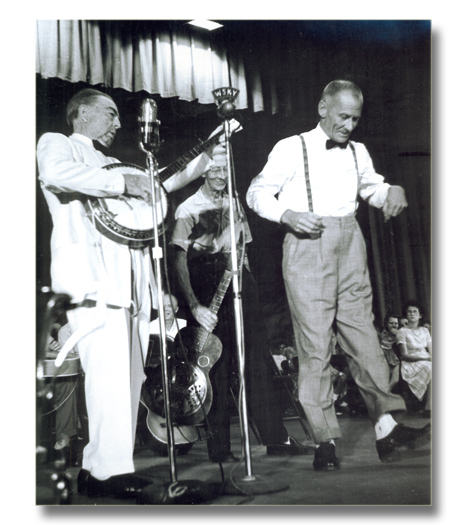
As a young man, Bascom Lamar Lunsford practiced law, sold fruit trees, managed democratic political campaigns, worked as an auctioneer, and waltzed through other professions before returning to his first love, mountain music and dancing. Ultimately he performed for both Franklin D. Roosevelt at the White House and in England for King George VI and Queen Elizabeth. He recorded his "memory collection" of some 350 songs, tunes, and stories for Columbia University in 1935 and the Library of Congress in 1949. His collection of songs (not just his own) make up the largest oral archives in the Library of Congress (The Archive of Folk Song).
“Lunsford often referred to old singers dying with their treasures of ballads, of the old ways dying out, of the progressive pushing out the traditional and of the failure of the young to appreciate the value of old ways. He started a festival to showcase traditional musicians and dancers at a time when most of his peers were clamoring for the fruits of the industrial age, and in fact, used a largely phoney tourist-attracting promotional effort to present his ‘authentic’ show. He invested in the real estate boom that was a major threat to the very traditional culture that he cherished.
“He was of the folk and yet he was also middlestream mountain gentry. True, this made him uniquely able at enlisting the participation of almost all types of people in the mountains because, in addition to his enthusiastic and engaging personality, he could converse with one and all within the framework of their interests and understanding.
“One has to remember, however, that in addition to his presenting authentic folk talent around the country, he also traveled for the Asheville Chamber of Commerce puffing the virtues of the Land of the Sky and giving a shameless argument as to why the well-to-do should spend their money in Western North Carolina. The politicians he promoted for public office were those who looked after the progressive business interests of his area.”
Minstrel of the Appalachians: The Story of Bascom Lamar Lunsford by Loyal Jones, University Press of Kentucky, 2002
I said T for Texas
T for Tennessee
Oh, yeah, I said T for Texas
T for Tennessee
Said, T for old Thelma
The gal who made a wreck out of me
Well, if you don't want me momma
You sure don't have to start
Ah, if you don't want me momma
You sure don't have to start
'Cause I can get more women
Than a passenger train car
Yeah, I said T for Texas
T for Tennessee
Whoa, T for Texas
T for Tennessee
I said, T for old Thelma
The gal who made a wreck out of me
I'm gonna buy me a pistol
Just as long as I am tall
I'm going to buy me a pistol
Just as long as I am tall
I'm gonna shoot down old mean Thelma
Just to watch her jump and fall
I said T for Texas
T for Tennessee
I said T for Texas
T for Tennessee
T for old Thelma
The gal who made a wreck out of me
Gonna buy me a shotgun
With a great long shiny barrel, oh yeah
I'm gonna buy me a shotgun
With a great long shiny barrel
Gonna shoot down that rounder
That stole away my girl
I'm going where the water
Tastes like cherry wine
Yeah, I'm going where the water
Tastes like cherry wine
'Cause the water down here in Georgia
Tastes like turpentine
I said T for Texas
T for Tennessee
Oh I said, T for Texas
T for Tennessee
I said T for old Thelma
The gal who made a wreck out of me
Oh yeah, women make a fool out of me
Jimmie "The Singing Brakeman" Rodgers was born outside Meridian, MS, but he staked his claim to country music fame smack dab in the middle of Appalachia. In 1924 Rodgers started singing in traveling shows, vaudeville shows, medicine shows, and various other productions. Radio listeners in Asheville, NC heard his first performances in that medium in 1927, and he recorded his first songs in Bristol, VA.
Although he made records for only six years, between 1927 and his death at age 36 from tuberculosis in 1933, Rodgers recorded more than 100 songs. “T for Texas,” also known as “Blue Yodel No. 1,” became his signature tune and was the first of 13 tunes in his "Blue Yodel" series. Rodgers was the first inductee into the "Country Music Hall Of Fame” in 1961.
Sources: www.geocities.com/ajsblue/country/country_b.html
mshistory.k12.ms.us/features/feature54/rodgers.htm
Related posts: "You've been fooling me, baby"
"Carolina Sunshine Girl"
T+for+Texas The+Singing+Brakeman Jimmie+Rodgers country+music appalachia Appalachian+ballads appalachian+culture appalachian+history history+of+appalachia
Oh come all you young fellers so young and so fine
Seek not your fortune in a dark dreary mine
It'll form as a habit and seep in your soul
Till the stream of your blood runs as black as the coal
Where it's dark as a dungeon damp as the dew
danger is double pleasures are few
Where the rain never falls the sun never shines
It's a dark as a dungeon way down in the mine
It’s a-many a man I have seen in my day,
Who lived just to labor his whole life away.
Like a fiend with his dope and a drunkard his wine,
A man will have lust for the lure of the mines.
And pray when I'm dead and my ages shall roll
That my body would blacken and turn into coal
Then I'll look from the door of my heavenly home
and pity the miner digging my bones.
The midnight, the morning, or the middle of day,
Is the same to the miner who labors away.
There the demons of death often come by surprise,
The fall of the slate and you’re buried alive.
It’s dark as a dungeon and damp as the dew,
The danger is double and pleasures are few,
Where the rain never falls and the sun never shines
It’s dark as a dungeon way down in the mine.
"Dark as a Dungeon"
written by Merle Travis
(1917-1983)
born Rosewood, KY
American country and western singer, songwriter and musician. Travis was a master at the "thumb picking" style of guitar. The song achieved much of its fame when it was performed by Johnny Cash in his Folsom Prison concert on January 13, 1968 (album: “At Folsom Prison”).
Related Posts: "You've been fooling me, baby"(song lyrics)
"The death of Molly Vaughn" (song lyrics)
"Come All You Virginia Girls" (song lyrics)
"Amaze your friends and irritate your enemies with it." (musical instruments)
Merle+Travis Dark+as+a+Dungeon Johnny+Cash appalachia Appalachian+ballads appalachian+culture appalachian+history history+of+appalachia
“I’ve been all over Europe, Stirrup, Asia, Africa and parts of Hell, but Braxton County is the best God damned state in the university.” (said after he returned from the longest trip of his life, to the 1893 Chicago World’s Fair).
“Bread is potato’s mother.”
“I could eat soup even it was made over a lizard.”
“It’s just my luck that if it was raining soup, I’d have a fork instead of a spoon.”
“In the old days we did everything by hand-power and awkwardness.”
“They say that money talks, but all it ever said to me was goodbye.”
“I’ve been as lucky as a one-legged man at an ass-kicking!”
“You have to believe in yourself, even if you know you’re wrong.” Shelt Carpenter was an early 20th century fixture as a guide to fisherman on WV’s Elk River. He also entertained at the fishing camps with his fiddle and his tales. He was well known by the professional class of doctors and lawyers from Charleston who brought him to their fishing camps. He showed them where to fish, when to fish, and what bait to use. He told tales, played music, and drank their whiskey.
Family lore has it that Shelton’s great grandfather Jeremiah and his son Solomon were fiddlers. Certainly Shelton’s father Squirrely Bill was, and Shelton passed the tradition down to his son Ernie.
"My father was a good old-time fiddler," said Ernie. He used to keep that fiddle in a large safe that we had. The safe was never locked. He kept that fiddle on the top shelf. Just kept it laying in there on a cloth, never had a case for it. Not a kid on the place ever touched that fiddle or ever even went close to it. I was the first one to take an interest in it when I got big enough. As soon as I hit my first note on the fiddle, he said, ‘The fiddle is yours. I’m through. I won’t be a-playin’ no more. You’re going to do the playing from now on.'"
Ernie Carpenter was awarded the Vandalia Award, WV’s highest folklife honor, at age 80.
From "Play of a Fiddle" by Gerald Milnes
1999, University Press of Kentucky
Appalachia Appalachian+ballads appalachian+culture appalachian+history Elk+River+WV history+of+appalachia old+time+fiddlers Shelt+Carpenter
I don't want you any more, mama
Ain't no use in you hanging around
For I found another mama,
And now I am Chicago bound
You've been fooling me, baby
You've been telling me your lies
When I thought you were an angel
Just sent down from the skies
 Sing those parting blues to me, sweet Nell
When you leave you'll leave me sad
'Cause my daddy's gone and left me
I just wouldn't treat him right
You've been fooling me, baby
You've been telling me your lies
When I thought you were an angel
Just sent down from the skies
I wouldn't give him much loving
Wouldn't stay home at night
Now I hear the train a-coming
He has gone out of sight
You've been fooling me, baby
You've been telling me your lies
When I thought you were an angel
Just sent down from the skies
In the late 1920's, A.P. Carter, his wife Sara, and his brother's wife Maybelle came together to make music as The Carter Family. Their music, a composite of traditional ballads, blues songs, gospel numbers, heart songs, and instrumentals both reflected and shaped the tastes of the rural south. Together, their career spanned a little over two decades and nearly 300 recordings. Maybelle became the matriarch of a great country music dynasty as the mother of the Carter Sisters.
Despite dying in relative obscurity, A. P. Carter was inducted into the Nashville Songwriters Hall of Fame in 1970. In 1993, his image appeared on a U.S. postage stamp honoring the Carter Family. In 2001 he was inducted into the International Bluegrass Music Hall of Honor. Today there are Carters in the very veins of country music.
sources: http://countrymusic.about.com/od/cdreviewsmz/gr/blunbrkncircle.htm
http://www.bluegrasswest.com/ideas/carter.htm
http://famouslikeme.com/35061/article.html
AP+Carter Carter+Family bluegrass Appalachian+history Appalachian+culture Appalachia history+of+Appalachia
Molly Vaunder went a walking, when a shower came on;
She went under a birch tree the shower to shun.
Jimmie Randells was a hunting, a hunting in the dark.
He shot at his true love and he missed not his mark.
He picked up his gun, to his uncle did run
Saying, "Uncle, dearest uncle, I have killed Molly Vaughn!
I've killed that fair damsel, the joy of my life,
And I always intended to make her my wife."
Up stepped Jimmie's father, with his locks turning gray
Saying, "Jimmie, dearest Jimmie, do not run away.
Stay in your country till your trial comes on;
You ne'er shall be hurt for killing Mollie Vaughn."
On the day of Jimmie's trial, Mollie's ghost did appear.
"Say, ye gentlemen of the jury, young Jimmie goes clear.
With a white apron round me, he took me for a swan
And Jimmie shall ne'er be hurt for killing Mollie Vaughn."
This ballad exists in many versions. In America the heroine is known as Molly Vaughn, Polly Van, Molly Banding, Molly Vaunders, Polly Bon, and Polly Bond, but often the ballad is called “Molly Bawn” or “Shooting of his Dear.”
source: http://www.ferrum.edu/applit/studyg/West/htm/molvau.htm
Molly+Vaughn appalachian+ballads appalachian+culture appalachian+history history+of+appalachia appalachia


