
Denim Quilt, April 2007
3 months ago


Forest City, N.C.
August 15, 1928.
Dear Friends,
You have been vouched for as a man who is thoroughly American, Protestant to the core, a law abider and lover of our Constitution, and one who has had the welfare of our country close to your heart. As such you are invited to attend a Lecture on “Americanism” by Dr. W. Earl Hotalen, a Lecturer of National reputation, at
8:00 P.M., TUESDAY NIGHT, AUGUST 21ST, IN THE HALL ON THE THIRD FLOOR OVER RECTOR’S CAFÉ, 7-1/2 W. PACK SQUARE, ASHEVILLE, N.C.
Dr. Hotalen will appear in Asheville under the auspices of the Knights of the Ku Klux Klan. If your only source of information regarding the Klan has been obtained through the Newspapers, many of which are unfriendly to us due to lack of information regarding our Organization, then you have no doubt a biased opinion toward the Klan and the principles it espouses. Now, just be fair and come out and hear our side. Dr. Hotalen will have some facts and statistics to present that will astound you.
If you wish, bring a good Protestant friend whom you can vouch for. You will be under no obligation in attending this meeting.
Yours very truly,
Amos C. Duncan
Grand Dragon
Realm of North Carolina
Knights of the Ku Klux Klan, Inc.
Ku Klux Klan pitch letter sent to Edgar M. Lyda (1873-1956), who was Chairman of the Buncombe County Commissioners and Finance at the time he received it.
source: http://toto.lib.unca.edu/findingaids/mss/lyda/series_lyda/folder_03_1927_1928.htm
Klu+Klux+Klan Edgar+M.+Lyda Asheville+NC appalachia appalachian+history history+of+appalachia
If you’re a lover of classical chamber music living in Asheville, NC, you can thank the efforts of Jeanette and Joe Vanderwart for helping make that performing art available locally. This couple moved to the area in the 1950’s, and Joe’s work in the lumber industry provided a good living. They were able to introduce the idea of forming the Asheville Chamber Music Series, a program they then helped support for over thirty years.
Jeannette’s parents had given their only child a cultured family life that included seats at the opera back in Kassel, Germany. But by 1936 the Nazi rise to power had become alarming, and so that year 24 year old Jeannette Goldberg was able to arrange passage to New York City based on an affidavit submitted by a US resident. Her parents, lacking such an affidavit, had to stay behind.
Jeanette had a cousin whose friend worked for the same wealthy family employing Josef Vanderwart as a butler and chauffeur. Jeanette's cousin's friend was a companion to the lady of the house. Jeanette's cousin invited Jeanette to dinner to meet Josef.
Josef Vanderwart, at twenty-four years of age, escaped the initial Jewish roundup in Ober-Riedenberg, Germany in 1939. Adult males were the first targets for concentration camp deportations, and Vanderwart understood it was only a matter of time before the Nazis would find him. He knew two Jewish women in a larger city whose father had already been taken away. Since the registered male of that house had been picked up in the first round of deportations, he reasoned that they might not return to that location. He reasoned incorrectly. One day the Nazis circled the house, and when Joe tried to escape he was caught. He was taken to a police station. There, one of the policemen happened to know one of the Jewish women who had hidden Joe, so he released him---an incredible stroke of fortune. As a diabetic he needed daily insulin shots. He could not have survived for more than two days in jail.
By this time Joe and his sister Gerda had applied for visas at the consulate and were waiting for their quota number to come up. It is unclear from family records who had sent them an affidavit.
While waiting at the consulate one day, Gerda met another hopeful immigrant named Kurt Loewensohn who was applying for a visa for South America. They later married and Kurt changed his last name to "Vandewart" as it sounded "less Jewish." Together Josef, Gerda, and Kurt came to the USA.
Joe took up residence with a German rabbi in Flushing, New York. This rabbi had been sponsored in the USA by one of the owners of Sears - Roebuck. "The rabbi was brilliant and worked as a doorman," Jeanette Goldberg recalled. He married Joe and Jeanette two years after they first met, and Joe's sister Gerda and her husband Kurt were the witnesses.
At first Joe, Jeanette, Gerda and Kurt all lived in Forest Hills, New York. Later these four moved into the same apartment building in Queens, New York.
After World War II ended, an American soldier contacted Jeanette to inform her that Marie and Moritz Goldberg were alive and in Germany. Jeanette wrote the Department of Justice requesting visas for her parents. As a result Marie and Moritz joined their daughter and son-in-law in the Queens apartment.
In the 1950's, Jeanette and Josef moved permanently to Asheville, NC. He died in 1985 and she ten years later.
sources: http://toto.lib.unca.edu/findingaids/oralhistory/SHOAH/vanderwart2.htm
http://toto.lib.unca.edu/findingaids/oralhistory/SHOAH/vanderwart.htm
Asheville+NC Appalachian+Jewry appalachia +appalachian+history history+of+appalachia
No, they’re not taking over the world, they’re not Illuminati. The Masons were and are a fraternity of men who all share similar moral beliefs (including a belief in a God) and get together regularly, often to raise money for various charities. And for many decades they were at the center of small town life--being a Mason was the entree to a town's business and political elite--which is why their presence is widespread throughout Appalachia.
Members bill the study of Freemasonry as a system of morality veiled in allegory and illustrated by symbols. This system offers three progressively harder grades, or degrees: Entered Apprentice, Fellowcraft, and finally Master Mason. There are numerous side degrees available in Masonry once a member has attained the Master Mason degree, though they are not part of the core rituals.  A side, or ‘chair,’ degree has a definite lesson to teach, and an inner meaning to its ceremony. Side degrees are not under the control of any central governing organization. Generally anyone who has received the degree can confer it upon someone else. Modern side degrees tend to be humorous fundraisers with the fees going to a designated charity.
The Thrice Illustrious Master is a good example of a side degree. “At a meeting of the Grand Council, Royal and Select Masters of North Carolina, held at Asheville in 1932, a resolution was adopted authorizing appointment of a committee to prepare a ritual for the degree of Thrice Illustrious Master,” says Ray Denslow in ‘Masonic Rites & Degrees.’
“Grand Master McKell appointed J. Ray Shute and J. Edward Allen as a committee to prepare the ritual, but charged with the responsibility of obtaining the right to its use from the Supreme Grand Chapter of Scotland, the only authority pretending to hold jurisdiction over the degree.
“The degree was exemplified at the annual assembly in 1933 and a committee was ordered to prepare the ritual, see that it was conferred at each annual assembly, and collect a $5.00 for each candidate, candidates being limited to those who had been elected as Masters of their respective Council.
“In some States the Order is referred to as the Order of Anointed Kings, in others, the Order of the Silver Trowel, and in other instances the Order of Thrice Illustrious Masters.
“Membership is limited to those who have been elected as Masters of Councils. The principal character is King David, and the ritual of the degree refers to events connected with the closing years of King David’s life.”
The ritual consists of two sections, the candidate representing the young King Solomon in both sections. In the first section, the candidate learns of the conspiracy by his half-brother Adonijah, to wrest the throne by cunning from Solomon.
He also learns of his mother (Bathsheba) interceding with the aged and ailing King David to prevent this. After securing David's approval, Solomon is symbolically conducted to Gihon by Benaiah where he is duly obligated, anointed and hailed as King by Nathan the prophet and Zadok, the High Priest.
In the second section, the newly anointed king is brought before his father David who, in his dying moments, instructs him in moral wisdom and counsels him to govern uprightly and to serve the Lord with all his strength. Upon Solomon's assent to all this, the king expires.
Sources: Masonic Rites and Degrees, by Ray V. Denslow, p 122, Kessinger Publishing, 2006
www.tngrandyorkrite.org/index.php?chapters=Y&page=OST
 That's the exact caption of this photo, and while the caption dwells in specifics, the photo itself captures a universal moment that most any parent can respond to.
Gertrude is the daughter of Darley Hiden & Mary Ramsey, of Asheville, NC. We don't know the date of the picture, or who shot it, though it's most certainly from the late 1920s. Hiden & Mary [nee Sumner] married in 1926.
The grown Gertrude served on the Board of Trustees for Asheville-Biltmore College starting in 1958. She was recognized for her work as the Society Editor at Asheville’s Citizen Times by Editor & Publisher International Year Book (1963) and by The Working Press of the Nation (1969).
Her father had paved the way for her career rather smoothly, having spent 23 years as the general manager of the Citizen-Times Company, corporate parent of the Citizen Times. He’d worked at the Citizen as an associate editor for a year starting in 1920, then moved over to editorship of the Asheville Times the following year (where he served till 1926). Ramsey also served on the State Board of Education (1945-1953) and on the State Board for Higher Education (1955-1960). He died in 1966 at age 75.
D. Hiden Ramsey did well enough as a newspaperman that he was able to endow the University of North Carolina, Asheville with a new library facility: the D.H. Ramsey Library. His correspondence, speeches, and writings, including more than 200 manuscript speeches on a wide variety of subjects and occasions, plus 30 essays and articles on public issues and events, have become the D. Hiden Ramsey Collection. And it’s over in a personal corner of that inventory that this charming photo resides.
source: toto.lib.unca.edu/findingaids/mss/ramsey/ramsey.html
appalachia University+of+North+Carolina Citizen-Times+Company D.+Hiden+Ramsey Gertrude+Ramsey Asheville+NC appalachian+history appalachian+mountains+history
Lillian Exum Clement was nominated as a Democratic candidate for North Carolina's House of Representatives two months before the 19th Amendment, granting the vote to women, was ratified in August 1920. The vote over her two male opponents in the primary was an astounding 10,368 to 41. She won the general election in November and, on January 5, 1921, took her seat in Raleigh, becoming the first woman in the South to hold legislative office.
"I was afraid at first that the men would oppose me because I am a woman," she told The Raleigh News & Observer on her first day in office, "but I don't feel that way now. I have always worked with men, and I know them as they are. I have no false illusions or fears of them. You may quote me as saying 'I am definitely for them.'" Others soon followed. In Tennessee, in a special election on January 25, 1921, Anna Lee Worley was selected to succeed her husband. In 1922 Kentucky gained female legislators. In North Carolina, the next women to serve were Julia Alexander and Carrie McLean, both of Charlotte, in 1925 and 1927 respectively.
Exum, as she was called, was born in Black Mountain, NC, the sixth of seven high-achieving children of George Washington Clement and Sara Elizabeth Barnett. Exum is a coastal North Carolina town where the teenaged George had gone to work supervising railroad crews before finding his way to Black Mountain. Exum's family moved to Biltmore after her father procured a job as foreman on the Vanderbilt estate. The Clement girls benefited from the support of one of the leading women of that era, Edith Vanderbilt.
Encouraged by her, Exum enrolled in the newly established Asheville Business School. She came to realize she could compete with the male students intellectually, and at age 14, went to work in the Buncombe County sheriff’s office while studying law at night. In February 1916 she passed the bar exam with top grades, and the next year hung out her shingle in the Law Building. She was the first North Carolina lawyer to practice without a male partner.
As a legislator (addressed by fellow solons as “Brother Exum”) she introduced seventeen bills including the measure for the secret ballot, the “pure milk bill” requiring tuberculin testing of herds, and a reduction in the abandonment period required for divorce from ten to five years.  Nineteenth century engraving of the State Capitol Building by J. & F. Tallis of London and New York.
She sponsored a bill to have the state assume control of a home for unwed mothers, garnering opposition (she was pelted with eggs and vegetables while speaking in its behalf in Asheville). Sixteen of her bills passed. Her bill proposing private voting booths for elections was defeated (some argued that other legislators opposed the bill because it would be impossible to bribe or intimidate voters if you couldn't see them cast their ballots).
In the summer of 1921 she married newspaperman E. Eller Stafford, necessitating a special bill to change her name in the short session. She did not seek reelection. At age thirty-one she died of pneumonia and was buried in Riverside Cemetery.
Sources:
“Brother Exum Takes Her Seat,” Asheville Citizen-Times, May 8, 1960, reprinted in Jack
Discovering North Carolina: A Tar Heel Reader , Claiborne and William Price, eds., 1991
Dictionary of North Carolina Biography, V, 419--sketch by Alice
R. Cotten, William S. Powell, ed.
Women State and Territorial Legislators, 1895-1995: A State-by-State
Analysis, with Rosters of 6,000 Women, by Elizabeth M. Cox, 1996
A Popular History of Western North Carolina: Mountains, Heroes, Hootnoggers, by Rob Neufeld, The History Press, 2007
Lillian+Exum+Clement Brother+Exum North+Carolina+politics Asheville+NC Biltmore appalachian+history appalachian+mountains+history appalachia
Late on the night of March 10, 1948, a fire started in a kitchen of the main building of Highland Hospital in Asheville, North Carolina. Spreading rapidly through a dumbwaiter shaft, flames reached every floor, and, in spite of efforts by hospital staff and local fire fighters to evacuate everyone from the building, nine patients died. Among the victims of the fire, identified only by her slipper, was Zelda Fitzgerald, who with her husband, the writer F. Scott Fitzgerald, represented for many the talent, sophistication, glamour and excess of American life of the 1920s. Highland Hospital, originally known as "Dr. Carroll's Sanatorium," was founded in 1904 by Dr. Robert S. Carroll, a distinguished psychiatrist. His program of treatment for mental and nervous disorders and addictions was based on exercise, diet and occupational therapy, and attracted patients from all over the country. The hospital was relocated from downtown Asheville to the northern end of Montford Avenue in 1909, and was officially named Highland Hospital in 1912. Dr. Carroll gifted the hospital to Duke University in 1939.
In 1928, Zelda Fitzgerald had decided to pursue a lifelong dream of becoming a professional ballerina, and had begun taking lessons in Paris from a famous dancer. But at that late age (she was born in 1900), three years of intense eight hour a day ballet work damaged her health, and prompted her first mental breakdown, diagnosed as "nervous exhaustion," in 1930. On May 22, after hearing voices and exhibiting delusional behavior she entered a clinic in Switzerland. On June 5 she entered another hospital near Geneva, Les Rives de Prangins. At Prangins she was diagnosed by Dr. Oscar Forel as schizophrenic.
Zelda would reside in and out of hospitals for the rest of her life.After she was released from Prangins on September 15, 1931 she returned to the United States. On February 12, 1932 she entered the Henry Phipps Psychiatric Clinic of the Johns Hopkins University outside of Baltimore. During her stay there, she wrote her first and only novel: Save Me the Waltz, which was an almost autobiographical account of her life up to that point.  Zelda’s creative output also included a play, Scandalabra, several short stories and articles, and a large number of paintings, paper dolls, and sketches—some of which were intended to be passed on to her daughter and grandchildren. She began a second novel in 1942, "Caesar's Things," which was never finished but which covered ground similar to her first book.
In April, 1936 Zelda checked herself for the first time into Highland, where she remained until April, 1940. By then estranged from Scott, she instead headed back to her childhood home in Montgomery, AL to live with her mother. She sought out Highland once more in August 1943 for a six month stay, again in early 1946 through the end of that year, and checked in for what became her final stay in November 1947.
Mary Porter worked at Highland and was involved in Zelda's treatment. She described that experience in an interview with Zelda's biographer, Nancy Milford:
We were very careful with Zelda; we never stirred her up. She could be helped, but we never gave her deep psychotherapy. One doesn't do that with patients if they are too schizophrenic. We tried to get Zelda to see reality; tried to get her to distinguish between her fantasies, illusion and reality. This is not easy for a schizophrenic. The psychotherapy was very superficial...She often rebelled against the authority, the discipline...She didn't like discipline, but she would fall into it.
Dr. Irving Pine, Zelda’s last psychiatrist, believed (too late) that she may have actually had severe untreated bipolar disorder. He speculated after her death that the cause of her breakdowns may have been as much from her husband's mental bullying and her treatment for her disorder as the disorder itself.
sources: www.lib.unc.edu/ncc/ref/nchistory/mar2007/index.html
www.nps.gov/nr/travel/asheville/hig.htm
www.cosmicbaseball.com/zelda8.html
www.pbs.org/kteh/amstorytellers/bios.html
Bryer, Jackson R. & Barks, Cathy W. (eds.). (2002), Dear Scott, Dearest Zelda: The Love Letters of F. Scott and Zelda Fitzgerald, New York: St. Martin's Press
appalachian+history appalachia Asheville+NC Highland+Hospital Robert+S.+Carroll Zelda+Fitzgerald appalachian+mountains+history
"[My father] started one trend that horrified all the old friends. He put the kitchen on the front of the house. This was a thing unknown, inconceivable to the local populous. You didn't put the kitchen on the front of the house. People built houses on Montford Avenue where there was a superb view in the back of the house, with porches that had the whole Pisgah range...the whole Cold Mountain, Pisgah, Spivey, Eagle's View panorama...in those days it was just clear as crystal all the time, that view. In those days you could see it, but now all that stuff is just a crick in a particulate fog.  "Anyway, they put a streetcar track on Montford Avenue, and there was a certain amount of traffic, and a certain amount of streetlights. People had porches on the front of their houses, where they could see nothing but whatever went on on Montford Avenue. This is entertaining, I think, because it illustrates the standards and mores of the period, and I guess of the people. The interest in activity far outweighed the interest in natural scenery or the fantastic set of views.
"The sun sets off this back porch, and its clouds troop across the garage...crocodiles followed by giraffes, incredible Chinese dragons would cross the sunset. Well, you don't see them anymore. It's a shame, because they were great pleasures. And big thunderheads we would get over the Duck Mountains out there. Tremendous cumulous clouds, and as it got darker they'd turn gray and keep lightning within the cloud...a flash of lightning would illuminate the whole into pink...it would warm up the whole into pink flesh, these gray clouds. Incredibly beautiful. …
"Well, [Asheville] was an exciting place, in the boom days. The pleasures were very simple, though. It was a very open, kindly, low pressure sort of place. In the late 20's the...at least that was the way it was to me...it was, for example, there were band concerts on the square. It was not this mad rush always. At least I didn't feel it. And it felt that way until the beginning of the second war.  "At first it was a stock company that gave the lease to the Plaza Theatre. And they would do a show every week, I guess or every two weeks, and they would rehearse with a chorus line with about 5...one of whom was Lenny's wife who was pregnant at the time, and could still kick as high as anyone else. And of course this was all during prohibition days. You went up there with a couple of friends, and you came out and had a cola or something...after probably Goode's Drug Store, a place where you were likely to encounter everybody you ever met.
"It was on Patton Avenue. Ran through...it was where the Wachovia Bank is now. Ran through from Patton to College. I remember Tom Wolfe holding forth on some trip he had made to France, his pleasure and amusement in the provincial French one night stands...and Charlie Parker, who was an architect here. They could all be found standing out front at Goode's, from about 1:00 in the afternoon to about 6:00 in the afternoon. He didn't stay in his office because people came in and bothered him. Then he'd go back after supper, at night, and turn it out, and go to work early the next morning. So this is the way we operated. But he was good. He's the man who did the Arcade building."
Anthony (Tony) Lord, 1900-1993
August 2, 1979 interview
Architect Tony Lord left his mark on many public and private buildings in Asheville, including the Pack Memorial Library and the D. Hiden Ramsey Library on the campus of UNC Asheville. He was also influential in the greening of downtown Asheville, planting and protecting trees. He was one of the founding members of the architectural group Six Associates. For many years he was a member of the Board of Directors of the public library.
source: http://toto.lib.unca.edu/findingaids/oralhistory/SHRC/lord.html
Asheville+NC architects Thomas+Wolfe appalachia appalachian+history appalachian+mountains+history
The poet who penned “the fog comes in on little cats’ feet” moved to western North Carolina for the sake of the little goats’ feet. Pulitzer Prize winner Carl Sandburg and his wife Paula had lived for 17 years on Chicago's foggy shores by Lake Michigan, but left it all behind in 1945. Flat Rock, NC, twenty-four miles south of Asheville, offered greener pastures and a longer browsing season for their Chikaming goat herd.
The Sandburgs paid $45,000 for 248 acres of land, a three-story, 22 room main house of over 9,000 square feet on a hill fronted by green pastures with various lakes, a barn complex and several outbuildings. Plenty of room for them, their three daughters, two grandchildren, their library of more than 10,000 volumes, and the goat farm operation. The hill approaching the house is steep and the climb ascends 100 feet over a third of a mile. Sandburg believed they had bought a "village" and Mrs. Sandburg a "million acres of sky." Photo caption reads: "Carl Sandburg spends most of his time writing, and his wife, Lilian Paula Sandburg, most of hers with her goats. She is shown here with her grandson, Joe Carol Thoman."
The name of home they purchased, “Connemara,” is Irish, meaning "of the sea." Connemara is a region in the country of Ireland located on the northwest coast in the county of Galway, bordering the Atlantic Ocean. The home was built in 1838 as a summer home by Christopher Gustavus Memminger of Charleston, S.C., who later served as the secretary of the treasury for the Confederacy. After his death the property passed to the Gregg family and then to textile tycoon Capt. Ellison Smyth, also of Charleston, who named it Connemara in honor of his Irish heritage. The Sandburgs bought the estate from Smyth's descendants and kept the name.
The Asheville area was familiar to Mrs. Sandburg because her brother, photographer Edward Steichen, had spent time there and recommended it as a place to investigate.
Sandburg died on July 22, 1967 at the age of 89. His wife followed ten years later. Both of their remains were cremated and their ashes buried at Carl Sandburg's birthplace in Galesburg, Illinois beneath a large boulder named after Carl Sandburg's first and only novel, Remembrance Rock. Connemara, meantime, was sold to the government and is now maintained as a National Historic Site by the U.S. Park Service.
Sources: http://statelibrary.dcr.state.nc.us/nc/ncsites/connemar.htm
www.nps.gov/carl/faqs.htm
www.literarytraveler.com/authors/carl_sandburgs_connemara.aspx
Carl+Sandburg Connemara Flat+Rock+NC Asheville+NC +appalachia appalachian+culture appalachian+history history+of+appalachia Appalachia+history
The 80th annual Mountain Dance and Folk Festival got underway last night in Asheville, NC. It’s the oldest continuously running folk festival in the United States. "Even the moon came out over Beaucatcher Mountain and laughed in the spirit of the occasion," said one of the local newspapers at the inaguaral festival in 1928.
What started as the Rhododendron Festival of 1927 was transformed into what we today recognize as a ‘folk festival’ by Bascom Lamar Lunsford (1882-1972). Lunsford was a superb mountain musician who spent his life hunting down the songs, dances and unknown performers of the Appalachian region. Friends said he would cross hell on a rotten rail to get a folk song. He performed at the festival every year until he suffered a stroke in 1965. 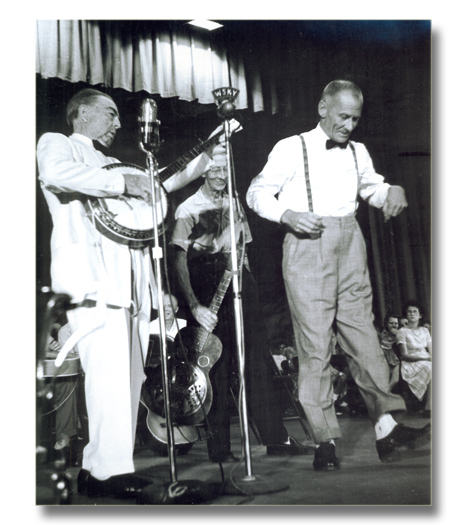
As a young man, Bascom Lamar Lunsford practiced law, sold fruit trees, managed democratic political campaigns, worked as an auctioneer, and waltzed through other professions before returning to his first love, mountain music and dancing. Ultimately he performed for both Franklin D. Roosevelt at the White House and in England for King George VI and Queen Elizabeth. He recorded his "memory collection" of some 350 songs, tunes, and stories for Columbia University in 1935 and the Library of Congress in 1949. His collection of songs (not just his own) make up the largest oral archives in the Library of Congress (The Archive of Folk Song).
“Lunsford often referred to old singers dying with their treasures of ballads, of the old ways dying out, of the progressive pushing out the traditional and of the failure of the young to appreciate the value of old ways. He started a festival to showcase traditional musicians and dancers at a time when most of his peers were clamoring for the fruits of the industrial age, and in fact, used a largely phoney tourist-attracting promotional effort to present his ‘authentic’ show. He invested in the real estate boom that was a major threat to the very traditional culture that he cherished.
“He was of the folk and yet he was also middlestream mountain gentry. True, this made him uniquely able at enlisting the participation of almost all types of people in the mountains because, in addition to his enthusiastic and engaging personality, he could converse with one and all within the framework of their interests and understanding.
“One has to remember, however, that in addition to his presenting authentic folk talent around the country, he also traveled for the Asheville Chamber of Commerce puffing the virtues of the Land of the Sky and giving a shameless argument as to why the well-to-do should spend their money in Western North Carolina. The politicians he promoted for public office were those who looked after the progressive business interests of his area.”
Minstrel of the Appalachians: The Story of Bascom Lamar Lunsford by Loyal Jones, University Press of Kentucky, 2002
“The T. stands for Taliaferro. I was named after Booker T. Washington. My people came from Sherrill's Fort in Catawba County, NC. I was brought up by my mother, but in 1920, came to Asheville to live with my father. I went to high school at Bennett in Greensboro, NC and two years at Livingston College in Salisbury. I was sorry I couldn't finish but went into the hotel work. Booker T. Washington's philosophy was ‘drop your bucket wherever you are,’ and I have done well.
“Asheville was hit hard by the Depression. Work was hard to find, but I worked in the Langren Hotel from 1930-1933 and the Battery Park from 1934 until it closed in 1972. When I worked at the Battery Park for 38 years, blacks couldn't go in the front door - now I am living here!
“I had a ‘hotel reputation.’ During those times there weren't many jobs open to blacks - chauffeuring, working at Oteen or in hotels. It was hard getting work in the railroad unless one had good connections. Many blacks were on WPA but I was always employed. Bellmen were paid $1 a day and depended on tips and didn't anticipate Social Security, where benefits were based on how much they had paid in.
“The Langren Hotel was one of the largest in the area in the 20's, catering mostly to business men. A good room cost $1.50 a night and a corner room $3. The price was comparable to the Battery Park but the clientele was different. The Vanderbilt and Battery Park catered to tourists. 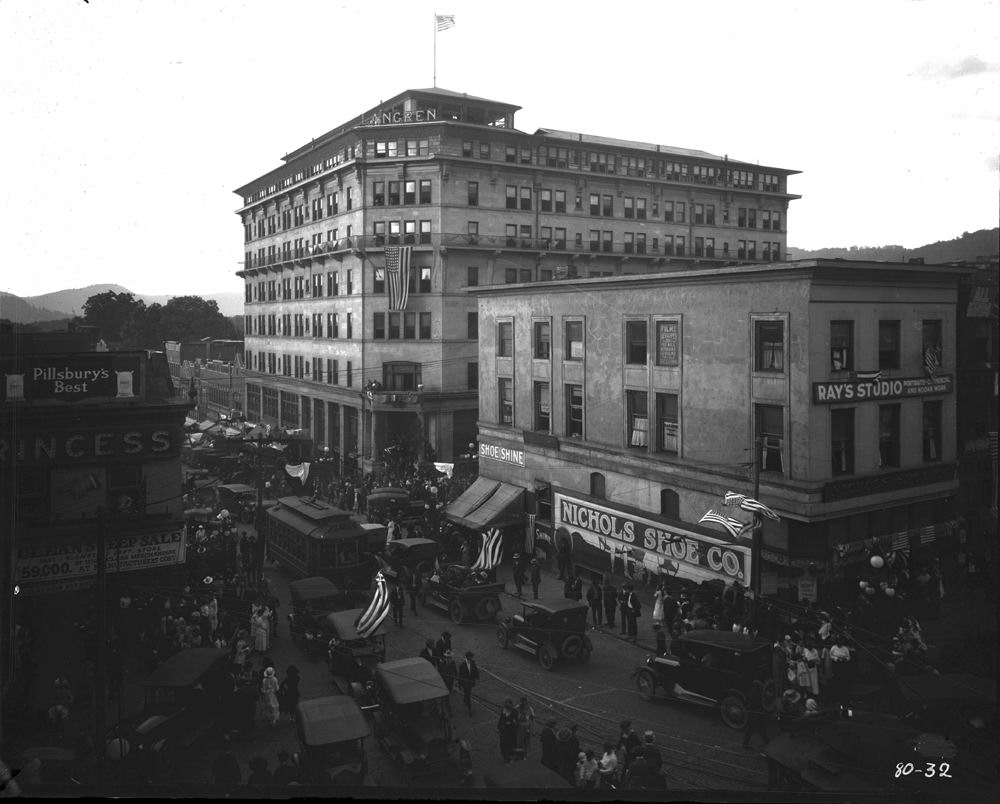
“In 1933 I lost my job at the Langren and went to Florida for the season. I returned to my wife and daughter and, after applying around, came here and worked under Charles Sisney, a famous, widely known bell man who died in 1935.
“My first wife was 16 when we married, and the marriage broke up. In 1936 I remarried a lady with the same name as a character in "Amos 'n' Andy" radio program. [Ruby Taylor]
“We were married on Saturday, August 1936, and the following day Martin Moore confessed to murdering Helen Clevenger, who was visiting the hotel with her uncle in room 224. The sheriff hired a detective from New York who found a weapon in Moore's house. Moore was tried, convicted and executed. People in the hotel were reluctant to go on the 2nd floor.
“I was off duty during the time of the 1936 murder and was not questioned but there were bad feelings about this. Some think it was never solved. Some think the son of the manager was to blame. It upset this city and it took 8-10 years for the people to relax. Room #224 was permanently blocked. Although I kept my thoughts to myself, I don't think Moore, a relatively new night janitor, had the mentality to commit the crime.”
Booker T. Sherrill
Asheville, NC
(1907-2003)
Source: http://toto.lib.unca.edu/findingaids/oralhistory/VOA/S_Z/Sherrill_B.html
Asheville+NC Langren+Hotel appalachia appalachian+history appalachia history+of+appalachia

Temple Beth-Ha-Tephila,
Asheville, NC
Leo Finkelstein's father came to Asheville, NC in 1903; Leo was born in 1905. “Kosher food and orthodox cooking was family tradition until my father died. I attended camp in Brevard and canoed on the French Broad to Arden. I left my lunch behind and ate the bacon and eggs with the rest - despite the Jewish rules. I used to take a car from the square to Biltmore and fish in the Swannanoa. The Asheville Power and Light ran an open air street car and rides cost 5 cents each way.”
“My father gave me a job in his pawn shop for 50 cents a week - out of this I was to save 25 cents. Because of the serial movie on Saturday, I did not work Saturday morning.”
Finkelstein was in the 1922 class of what is now Asheville High School. His high school principal called him into his office and said “You’re wasting tax payer's money - go out and get a job!”
“When I graduated from high school I inspected watches for the railroad. Railroad workers' watches could not vary over 30 seconds a week. They were purchased from my father’s store. There is only one person in the city who can work with wind-up watches today.”
He eventually took over the family business, and was successful during the Depression when other businesses failed. “We made smaller loans during the Depression but the same 80% of items were redeemed. Anything that had value and was portable was handled. I knew most of my customers and made about 100 loans a day - 50% black and 50% white. The most reliable were the prostitutes. A lady came to my shop to pawn something - she was drunk, offered me a drink and dropped dead.
“The customers had no credit and couldn't borrow from the bank. They needed cash for doctor bills, to buy drugs, and to eat. My father gave loans on practically nothing. He gave $5.00 with no collateral to a man who bought a portable stove and chestnuts which he roasted. The man later opened a restaurant with two sections - one black, one white.”
Finkelstein was in charge of the Jewish Aid Society. “I gave a 50 cent meal ticket to Peterson's on the Square and helped them leave town. There were no shelters. The Jewish Aid Society, later the Federated Charity, was run by women. A drive was put on every year. One man refused to give more than $5.00 and was finally induced to donate $500.00!”
Leo Finkelstein, 1905-1998
Asheville, NC
Source: http://toto.lib.unca.edu/findingaids/oralhistory/VOA/D_H/Finkelstein_L.html
Leo+Finkelstein Asheville+NC appalachian+history appalachian+culture history+of+appalachia appalachia


