
Denim Quilt, April 2007
3 months ago


Shortly after taking office in 1933, President Franklin Roosevelt announced plans for creation of a "conservation army." FDR at first saw the Civilian Conservation Corps primarily as a forestry organization -- fighting fires, planting trees, thinning timber stands, stopping soil erosion and floods -- but the field personnel of the State and Federal agencies involved soon realized that CCC labor might also be directed toward the construction of forest improvements--particularly roads, trails, buildings, and recreation sites. The CCC men literally built the foundations on which the national forests now stand.
Camp Ellison D. Smith F-l, located near the Whetstone Road in Oconee County, was the first CCC camp to be located in South Carolina. This and two others soon to follow employed approximately 800 men at their peaks, and remained operational for nearly 10 years. The men of these camps built Oconee State Park, Long Mountain Fire Tower, and Walhalla Fish Hatchery, and rebuilt Highway 107. There were many other less obvious projects. Millions of trees were planted; girdling to kill undesirable rotten trees was done on thousands of acres; growth plots for long-term forest inventory were established. Erosion control work was done on eroding fields which were on farms purchased by the Forest Service; property boundaries were surveyed, painted, and posted, in addition to wildlife being stocked.
Hard work, fresh air, and plenty of food were considered essential for CCC employees to accomplish one of the goals established by the office of education, "to develop an appreciation of nature and of country life." And to that third end, here is the 1938 Thanksgiving menu for Camp 1: OLIVES
GIBLET GRAVY
CANDIED SWEET POTATOES
GUAVA JELLY
FRIED CORN
FRUIT PUNCH
SWEET PICKLES
CREAM OF PEA SOUP
SALTINES
ROAST TURKEY
CRANBERRY SAUCE
ROAST PORK HAM
HOT ROLLS
LETTUCE SALAD
BUTTER
CELERY HEARTS
OYSTER DRESSING
CREAMED CAULIFLOWER
GRAPE JELLY
CREAMED POTATOES
PUMPKIN PIE
FRESH FRUITS
PLUM PUDDING
CIGARETTES
ICE CREAM
NUTS
COFFEE
MINCE MEAT PIE
ASSORTED CANDIES
BRANDY SAUCE
CIGARS
FRUIT CAKE
Oconee State Park was listed in the National Register of Historic Places on June 16, 2004.
sources: http://ftp.rootsweb.com/pub/usgenweb/sc/oconee/history/MR-03.txt
www.nationalregister.sc.gov/oconee/S10817737015/index_2.htm
related post: "He is now in the C.C. Camp"
CCC Oconee+State+Park Oconee+County+SC appalachia appalachia+history appalachian+culture
You can still see part of the boiler room and a few intact boilers from the old cotton mill in Mortimer if you know where to look. There's also a white maintenance building built by the CCC during the 1930s, and some other CCC building foundations remain behind it. Today these silent remnants welcome hikers and campers at the entrance to the Mortimer campground in the Pisgah National Forest. What a story they hide!
Mortimer, NC had been built rapidly to house workers for the Ritter Lumber Company, which had bought the land for timber in 1904. Ritter Lumber Company's sawmill and a small textile mill provided jobs for the community's 800 residents. Substantial logging took place between Wilson and Steel Creeks, and the trees were hauled to the mill via Ritter's narrow gauge railroad, which followed Wilson Creek much of the way before ending in the village of Edgemont. The Hutton-Bourbannis Company operated various other narrow gauge logging railroad lines fanning out from Mortimer.
There was a company store, a blacksmith's shop, a church, a school, a hotel, and numerous houses. By 1906, the newly incorporated town even had a motion-picture facility and the Laurel Inn, which Teddy Roosevelt reportedly visited. 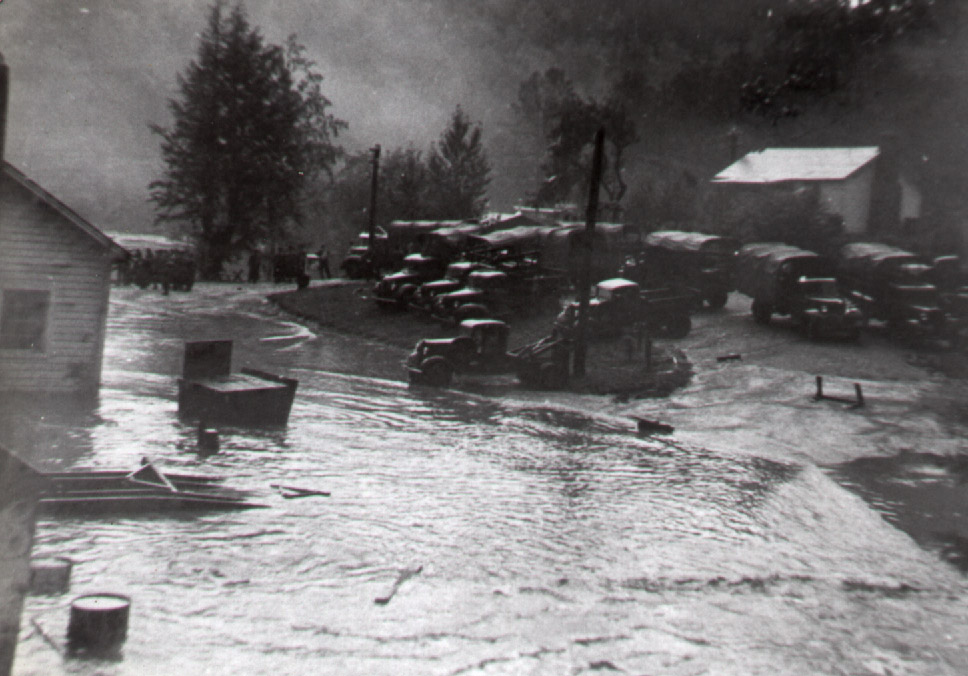 Then disaster struck. In 1916, a fire burned from Grandfather Mountain to Wilson Creek, and was immediately followed by a flood, which destroyed the logging railroad and the Lake Rhodhiss Dam, and devastated the Ritter Company's operations. The company left the town entirely about a year later. The flood is considered to be the worst in Caldwell County history.
United Mills Company, a cotton mill, opened in 1922 and revitalized the town for a brief period. The Civilian Conservation Corps opened Camp F-5 at Mortimer during the Great Depression, and by 1933, had repaired many buildings damaged in the 1916 tribulations. In 1934, O.P. Lutz started a hosiery mill in the cotton mill buildings, but it never really succeeded. The Carolina & Northwestern Railway brought in mail every other day, but closed in 1938.
Then, on August 13, 1940, Wilson Creek jumped its banks again (this time prompted by a coastal hurricane.) The creek reached a flood stage of 94 feet and engulfed the town. This second flood, coming only 24 years after Mortimer's first horrific experience, was enough to drive most remaining families from the area.
The CCC hobbled along until the arrival of World War II in the 1940s. The railroad that used to run through Mortimer was taken up during WWII and melted down for the war effort. After the railroad was removed and the CCC left, the valley was left essentially unchanged for the next several decades.
Today, there are only about 16 permanent families living along the stream. Much of the mountain property in the northwestern part of Caldwell County is public land held by the U.S. Forest Service.
sources: www.ghosttowns.com/
www.tarheelpress.com/CNW5.html
www.mountaintimes.com/summer/auto_day_trips.php3
web.utk.edu/~jeparks/HDREdgemont.pdf
www.tarheelpress.com/blacksatchel.html
Related posts: "Appalachia's Katrina"
appalachia appalachian+culture appalachian+history CCC Edgemont+NC history+of+appalachia Mortimer+NC Pisgah+National+Forest Ritter+Lumber
“Andy Orville Bozzel is the son of Mr. And Mrs. George Bozzel. He was born in Andover, VA in Wise County, November 24, 1922. His education is limited, he having completed the fourth grade. He quit school in 1937 on account of lack of money to send him on. He lives a mile from school. He has lived in Appalachia [the town in VA] for the past five years. He seems to be a bright youth but not anxious to study in order to succeed.
“He is now in the C.C. Camp and is receiving thirty dollars per month. Of that amount twenty two is sent home to his parents. He got to go to the C.C. Camp by his mother taking him to the welfare office and asking that he be signed up. Since going to camp he is completely self supporting. He has been there only a short time. I received this information from his mother. His mother told me that she asked him if signed up to go to night school in Camp and he answered, “You know I did for I want more education.”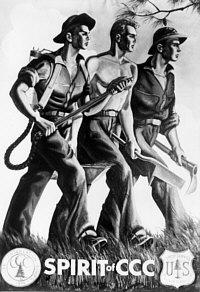 “His mother has completed the ninth grade in school and his father the fourth. Orville’s home life is not very pleasant. There are nine children two girls and seven boys. The girls are married and not living at home. The other children at home are under sixteen, all boys. They live in a run-down four-room house which has no convenience whatever. I have been in this home a number of times, knew Orville personally and know the condition of the home he came from.
“The mother works out when she can get it and is sole. The father works not at all, although he used to be a good worker and provided well for his family. He is letting drink get the best of his manhood. The father is 46 years old and the mother is 38 years old.
“There are no magazines or daily papers come to their home. I have known the children to have to go to school without breakfast. They have received aid from the Relief. He [Orville] spends his leisure time in reading, going to movies and playing ball. He is not a church member and does not attend church.
“The yearly income of family is $180.00.”
Maude R. Chandler
October 2, 1939
From a collection of approximately 1,300 Work Projects Administration/Virginia Writers’ Project life histories, social-ethnic studies, and youth studies that were written by agency staff members between 1938 and 1941.
source: http://tinyurl.com/2yb9w3
Andy+Orville+Bozzel CCC Appalachia+VA WPA +Virginia+Writers+Project appalachian+culture appalachian+history history+of+appalachia


