
Denim Quilt, April 2007
3 months ago


Hearings before the Select Committee Investigating National Defense Migration, House of Representatives, Seventy-seventh Congress, first session, pursuant to House Resolution 113, a resolution to inquire further into the interstate migration of citizens, emphasizing the present and potential consequences of the migration caused by the national defense program.
MAY 7 AND 8, 1942
Huntsville AL
Concerning CHILDERSBURG BAG-LOADING PLANT
TALLADEGA COUNTY, ALA.
Late in November of 1940 information was given out that some 27,000 acres of land in Talladega County bordering the Coosa River north and west of the small town of Childersburg (515 population in the 1940 census) were to be taken as site for a powder plant. The location was tentatively outlined in January and agricultural agencies, both Farm Security and Extension workers, were set to work warning people to vacate this property.
Because no certain information as to the location of boundaries could be obtained, the actual work of relocations did not get under way until the last of January and February. By the time Farm Security had made its original survey a good number of families had moved, both from the area finally taken and from land around it.
After this survey had been made, and after 80-odd families had been moved from land finally not included in the area, an accurate boundary line was established. While no official confirmation was made of the original territory marked out on maps used in the area, all indications pointed so clearly to its being taken that farmers in this territory decided to move while there was still time to find a new place, and to make another crop. Original caption reads: Local family moving off of government reservation to make room for bag loading plant development. May 1941
The section of land finally taken was one containing much river land. Some of this 14,000 acres was good farm land, ideal for large farm operations. Most of it was poor, carelessly operated by Negro tenants, or lying out. Of the farm operators, almost 30 percent were receiving Farm Security aid. When the final area was chosen, 210 families were displaced.
The survey revealed that the area contains very few owners who will be financially able to relocate without some assistance. The number of cash renters, sharecroppers, and cotton renters constitute the largest group in this area.
Note these things: While 39.2 percent of Talladega County's total number of farm operators are colored, 72.3 percent of the farm operators in this section were colored. Note also the comparatively large number of Negro landowners. In the county 22.3 percent of the Negro operators are landowners. In this section almost 32 percent were landowners.
In other words, about one-fifth of all Negro farm owners in Talladega County were in this section. Their holdings were small. The bulk of the land was owned in large tracts either by white resident operators or absentees. The comparatively small number of nonfarm workers is significant, especially since so many of these displaced families have gotten their first taste of "public works money" at the powder plant. Will they want to go back to this kind of marginal living again?
This was a section of old plantation holdings that had gradually been abandoned or partially abandoned by the old families who held on to them. In it, along the river and in the low places, were a few very small communities of Negro landowners who supplemented their farming income with fishing, hunting, and working for white men who came to enjoy these sports.
The average of all grants for moving totaled $37.50, which again reveals how little these people had to move.
Here, then, is a group of dislocated people who know almost nothing except farming, and of that the cruder kind. Some few of these were making a new beginning and, where they could get some of the better land, were succeeding on a very moderate scale. Some few were making a fair living from the game and sportsmen, whom the very desolation of the place had brought to the area. Only a few are going to make alone the readjustments life in a new place will call for.  Original caption reads: Local family moving off of government reservation to make room for bag loading plant development. May 1941
Few [Farm Security Administration loan] applications for next year have come in. The county supervisor expects many to come in during the next few weeks, because the powder plant job is "turning off" men at the rate of 300 to 600 a week. The full tide of applications will not come, he said, until late February, when many farmers (especially Negroes) who have had their first taste of public works wealth will suddenly realize there is little hope of getting more such work and will want to farm again.
Farm Security will, he said, get more than its share of these people because they have broken their relations with their old landlords, sometimes without ceremony, and in the middle of crop season, and will not be able — or will not want to — go back again.
About 90 percent of the Farm Security Administration borrowers have gotten at least a few weeks of work on the [bag loading plant] project. E. E. Wilson, county FSA supervisor for Talladega Countv, knew of only two who had paid back loans with defense-earned money (one paid $150, another $250). The rest have wasted some of the money. But not as much as people think. We've had practically a crop failure in here for the past 3 years. These people have gone without, all that time. They've had other debts and they've had to buy clothes and something to eat and some of the other people they've owed have put the kind of pressure on them [the FSA] can't.
Source: www.archive.org/stream/nationaldefensem32unit/nationaldefensem32unit_djvu.txt
Talladega+AL Farm+Security+Administration military+installations appalachia appalachian+history history+of+appalachia
From 1935-1943, President Franklin Roosevelt looked to the U.S. Farm Security Administration, under the direction of Roy Stryker, to photograph people in need across the country in order to help sell his New Deal programs to the public.
Ben Shahn was one of the first photographers Styker hired. Shahn worked for a part of the project called Special Skills, and also helped create posters and other graphic arts.
"It was a really tough time," remembered Shahn years later, "and when this thing came along and this idea that I must wander around the country a bit for three months. . . I just nearly jumped out of my skin with joy. And not only that, they were going to give me a salary too! I just couldn’t believe it."
In October 1935 Shahn and his wife Bernarda started out on the first trip in a Model A Ford. Heading for West Virginia, he took photographs in Monongalia County before arriving in Logan County. The couple spent a Sunday and Monday in Omar and also visited Freeze Fork before moving on through Williamson to Kentucky and Tennessee, and then into the deep South.
"I did a series of photographs on a Saturday afternoon in a small town in Tennessee, I believe, of a medicine man. He had a little dummy, ventriloquist dummy, and he had a Negro to help him and so on. It was Saturday. I don't think there were ten cars in the square, they were all mule drawn carts that had come there. This was 1935; it was incredible you see. The same was true of a lot of areas we covered. You'd have that feeling then of being way far back; but tragically enough, just about a month ago we took a train from Washington to Cincinnati. As I went throughout West Virginia, it hadn't changed. It just made me sick to see the same darn thing.
"The other thing that startled me; when I was down in the mine country, I think it was Kentucky, there was some local strike taking place and I thought I want to cover that. It was being picketed and I thought, 'Now how do you get into a conversation with a union picket? You offer him a union made cigarette.' So I bought a pack of Raleighs and I offered him a cigarette and he says, 'No, I don't smoke that awful stuff.' In stronger language than that. He says, 'Here, I've been in the union for thirty years and I won't smoke that,' and he offered me a non-union cigarette. This to me is startling you know.
"As was the fact that John L. Lewis, who was a kind of a God of theirs at that time, and you didn't dare say a word against him...if you had a copy of The Nation with you, I think they'd run you out of town. There was this incomprehensible conflict there you know.
"I got into homes. I stayed with some families. I knew how to do that pretty well, and got to know them, and we still remember their names."
sources: www.aaa.si.edu/collections/oralhistories/transcripts/shahn64.htm
www.wvculture.org/museum/omar/index.html
Ben+Shahn Farm+Security+Administration appalachia appalachia+history appalachian+culture appalachian+history appalachian+mountains+history
Sunday school picnic. Much of the food brought into abandoned mining town of Jere, West Virginia by "neighboring folk" from other parishes. There is a great deal of "hard feelings" and many fights between Catholics and Protestants. Miners as a whole are not very religious, many not having any connections with church, though they may have.
1938 Sept.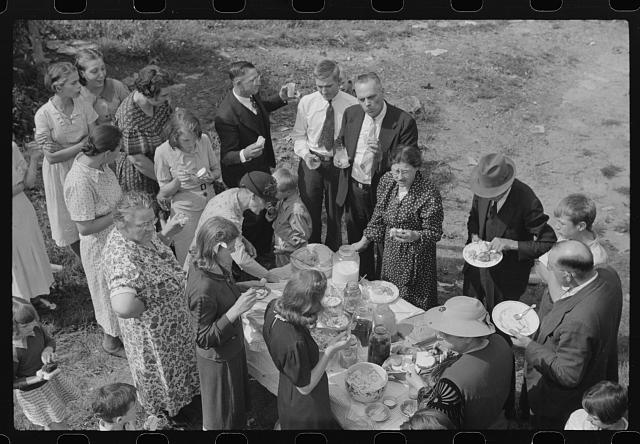
"My first assignments were very close to Washington. I think one of the first ones, if not the very first, was in the coal fields in West Virginia. That was a very short assignment, of course. And it was a very interesting one, too. I found the people not as apathetic as I had expected they might be. They weren't too beaten down. Of course, many of them were but they were people with hope and some of them still had a little drive, although, of course, their health was so bad it was telling . . . .
"I think [all the FSA photographers] did have a social consciousness definitely, perhaps more than some people have but I think they were all -- well, they were all interested in the plight of human beings and in the programs of the New Deal, and the remedial programs that the New Deal and the FSA were trying to do, I think that all these people had a lot of vigor and energy and were sensitive to their surroundings.
"[The Farm Security Administration] was one of the few places you could go where you felt that your pictures would be used and seen and that you could be honest in your reporting, whether with a camera or any other device. With your captioning you felt that any exhibits that they produced were definitely propaganda but you believed in them and you felt that they were honest, you wanted to slant them -- if you would call it slanting it -- or they were slanted, but so is any good program, an effective one.
"I never had worked in the field with handling both the captioning and the traveling and the sending back of the material, and not having my own darkroom. I wasn't sure I'd like that, and the arrangement of sending the stuff back and having them develop and print it, this worried me a little bit, but it turned out very well because Roy [Stryker, Historical Section chief, Information Division, FSA] gave us a great deal of freedom in that respect."
Interview with Marion Post Wolcott
Conducted by Richard Doud
at Artist's Home in Mill Valley, California
January 18, 1965
Source: www.aaa.si.edu/collections/oralhistories/transcripts/wolcot65.htm


