

Denim Quilt, April 2007
4 months ago


Temple Beth-Ha-Tephila,
Asheville, NC
Leo Finkelstein's father came to Asheville, NC in 1903; Leo was born in 1905. “Kosher food and orthodox cooking was family tradition until my father died. I attended camp in Brevard and canoed on the French Broad to Arden. I left my lunch behind and ate the bacon and eggs with the rest - despite the Jewish rules. I used to take a car from the square to Biltmore and fish in the Swannanoa. The Asheville Power and Light ran an open air street car and rides cost 5 cents each way.”
“My father gave me a job in his pawn shop for 50 cents a week - out of this I was to save 25 cents. Because of the serial movie on Saturday, I did not work Saturday morning.”
Finkelstein was in the 1922 class of what is now Asheville High School. His high school principal called him into his office and said “You’re wasting tax payer's money - go out and get a job!”
“When I graduated from high school I inspected watches for the railroad. Railroad workers' watches could not vary over 30 seconds a week. They were purchased from my father’s store. There is only one person in the city who can work with wind-up watches today.”
He eventually took over the family business, and was successful during the Depression when other businesses failed. “We made smaller loans during the Depression but the same 80% of items were redeemed. Anything that had value and was portable was handled. I knew most of my customers and made about 100 loans a day - 50% black and 50% white. The most reliable were the prostitutes. A lady came to my shop to pawn something - she was drunk, offered me a drink and dropped dead.
“The customers had no credit and couldn't borrow from the bank. They needed cash for doctor bills, to buy drugs, and to eat. My father gave loans on practically nothing. He gave $5.00 with no collateral to a man who bought a portable stove and chestnuts which he roasted. The man later opened a restaurant with two sections - one black, one white.”
Finkelstein was in charge of the Jewish Aid Society. “I gave a 50 cent meal ticket to Peterson's on the Square and helped them leave town. There were no shelters. The Jewish Aid Society, later the Federated Charity, was run by women. A drive was put on every year. One man refused to give more than $5.00 and was finally induced to donate $500.00!”
Leo Finkelstein, 1905-1998
Asheville, NC
Source: http://toto.lib.unca.edu/findingaids/oralhistory/VOA/D_H/Finkelstein_L.html
Leo+Finkelstein Asheville+NC appalachian+history appalachian+culture history+of+appalachia appalachia
 "Tarnation!" reads the title at the bottom of the Aug 1922 National Sportsman cover.
"What in tarnation?" is one of a wide variety of euphemistic expressions of surprise, bewilderment or anger that arose in 18th and 19th century America. Perhaps due to our Puritan legacy, Americans were, during this period, especially creative in devising oaths that allowed us to express strong emotions while still skirting blasphemy.
Such inventions as "heck," "drat," "darn," "gosh," "jiminy," "gee-whiz" and "goldarn" were all devised to disguise exclamations that would have been considered shocking in polite society. "Sam Hill," for example, is simply an early 19th century euphemism for "hell" (and while there have been many people named Sam Hill throughout history, the expression does not come from the name of any particular Sam Hill).
"Tarnation," which dates back to the late 18th century, is an interesting example of this generation of euphemisms because it's actually two euphemisms rolled into one word. The root of "tarnation" is "darnation," a euphemistic modification of the word "damnation," which at that time was considered unfit for polite conversation. "Darnation" became "tarnation" by being associated in popular speech with "tarnal," an aphetic, or clipped, form of "eternal."
It may seem odd that "eternal" would ever have been considered a curse word, but to speak of "the Eternal" at that time was often to invoke a religious context (God, Heaven, etc.), and thus to label something or someone "eternal" in a disparaging sense ("You eternal villain!") was considered a mild oath. Shakespeare, for example, used "eternal" in this way in at least two of his plays.
So at some point someone, probably in a moment of exasperation, mixed "darnation" with "tarnal," and we ended up with "tarnation."
Source: www.word-detective.com/050404.html
tarnation appalachian+language appalachian+culture appalachian+history history+of+appalachia appalachia
Molly Vaunder went a walking, when a shower came on;
She went under a birch tree the shower to shun.
Jimmie Randells was a hunting, a hunting in the dark.
He shot at his true love and he missed not his mark.
He picked up his gun, to his uncle did run
Saying, "Uncle, dearest uncle, I have killed Molly Vaughn!
I've killed that fair damsel, the joy of my life,
And I always intended to make her my wife."
Up stepped Jimmie's father, with his locks turning gray
Saying, "Jimmie, dearest Jimmie, do not run away.
Stay in your country till your trial comes on;
You ne'er shall be hurt for killing Mollie Vaughn."
On the day of Jimmie's trial, Mollie's ghost did appear.
"Say, ye gentlemen of the jury, young Jimmie goes clear.
With a white apron round me, he took me for a swan
And Jimmie shall ne'er be hurt for killing Mollie Vaughn."
This ballad exists in many versions. In America the heroine is known as Molly Vaughn, Polly Van, Molly Banding, Molly Vaunders, Polly Bon, and Polly Bond, but often the ballad is called “Molly Bawn” or “Shooting of his Dear.”
source: http://www.ferrum.edu/applit/studyg/West/htm/molvau.htm
Molly+Vaughn appalachian+ballads appalachian+culture appalachian+history history+of+appalachia appalachia
By the mid 1920s Appalachia, land of farms and farmers, had been crisscrossed by railroad tracks and dotted with mill villages, and the Piedmont had eclipsed New England as the world's leading producer of yarn and cloth. But along with the promise of new jobs came intense competition in the decentralized textile industry, depressing wages, and faster mill machines, which with each new technological advance threatened to further exhaust their operators.  These developments inevitably put labor and management on a collision course. Charlie Chaplin’s film Modern Times (1936) captured perfectly the panic of the average millhand caught in the cross-fire of the “stretch-out”: sped up machinery and ever expanding work quotas.
In October 1926 American Bemberg began the manufacture of "artificial silk," or rayon, at its new plant in Elizabethton, TN. The parent company, J. P. Bemberg, was the German affiliate of Vereinigte Glanzstoff Fabriken (VGF), one of the international giants in the production of rayon. Two years later, in August 1928, VGF opened another rayon plant in the small East Tennessee town. Visions of economic growth encouraged government officials in Elizabethton to make concessions to VGF concerning property taxes and charges for the huge volumes of water needed to make rayon. They also promised the German industrialists that they would have an abundant supply of docile and cheap--that is, nonunion-- labor. 
John Fred Holly, who grew up in Elizabethton and worked at the plant during the 1930s, reported that local banker E. Crawford (E.C.) Alexander showed him a copy of an agreement between the company and the Elizabethton Chamber of Commerce assuring the rayon concerns that they would never have to pay weekly wages in excess of ten dollars and that no labor unions would be allowed to operate in the town.
The stage was set for one of the first, if not THE first, strikes in the Southern textile field. On March 12, 1929, 800 employees of American Bemberg walked out in a fumbling strike, poorly organized and not under union leadership. They demanded wage increases; the company ordered the plant closed the following day. On March 19 the adjoining plant, under the same management, was also closed and its 3,000 employees joined the ranks of the strikers, all native Americans. The courts quickly granted injunctions against the strikers and two companies of National Guardsmen were rushed to Elizabethton by Governor Henry Horton. 
“The employers utilize various devices to put the militia under obligations to them. During the Elizabethton, Tennessee, rayon strike, the Glanzstoff-Bemberg Corporation not only provided barracks but served free refreshments, provided music and furnished dancing partners to the men on duty,” noted the New International magazine.
On March 22, after the strikers had joined the A. F. of L., a settlement was reached and the mills reopened.
Sources: New International, New York City, Vol.IV No.6, June 1938, pp. 189-190
http://newdeal.feri.org/guides/tnguide/ch07.htm
http://www.press.uillinois.edu/epub/books/waldrep/02.html
http://www.ibiblio.org/sohp/laf/protest.html
http://www.etsu.edu/cass/Archives/Collections/afindaid/a243.html
Elizabethton+strike American+Bemberg Appalachian+history Appalachian+culture history+of+Appalachia Appalachia

CEDAR BLUFF "REBEL" SOLDIER HALE AND HEARTY AND NEARING 100. -- Cedar Bluff, May 19 - Today, in our town, one of our grand old veterans of the '61 gang passed the 96th milestone of his journey through this ever-changing world. "Uncle George" ---as he is familiarly known--- Burnett, one of the few remaining veterans of the Civil War, is still hale and hearty at this ripe old age, and says "temperance in all things, faith, hard work, lots of patience, and the goodness of the Almighty Father" are some of the main reasons he has attained this age.
He is, possibly, one of the oldest veterans left in our county, and is still active taking long daily walks. His vision is not quite as keen as the day near Petersburg he spied the "Yank" nestled close up against a log as the boys in grey had 'em on the run. He walked over to this "Yank," who was trembling with fear, and poked him in the ribs with his old trusty rifle and said, "Come out of there, Yank, and get behind these columns of grey, and we'll not kill you for sometime yet."
He is still able to read the Clinch Valley News and looks forward to this paper. He is known all over the western end of the county, and his honesty, straight forwardness, and sincere dealing with all of his fellow men is a known trait. He owes no man and says when the Master of all things calls him to a better world, he is ready to go. His home is located near the top of Claypool Hill, and his towering figure, now slightly stooped, is often seen along the road, taking his daily walks.
As we see that sparkle in his eyes, we wonder if he isn't happy basking in this sunset time of life, with memories of a well-spent life, and hope of a glorious future in that "purple valley" beyond. His many friends wish for him many more happy birthdays; tho' there may not be "many" these friends want to see Uncle George reach that one hundred mark. 'Tis fine to live by a fine old neighbor like you, Uncle George, and we want you to stick around for several more years.
Clinch Valley News
Tazewell County, Virginia
May 19, 1936
civil+war+veteran confederate+veteran appalachian+culture appalachian+history history+of+appalachia appalachia
Perry and Emma Gatewood’s oldest daughter Helen was already 20 years old in 1928, and the other children weren’t far behind. So Emma Gatewood became “Grandma Gatewood” to her immediate family long before the rest of the world knew her by that title.
Throughout the 30s, 40s and 50s she continued raising her 11 children and four of her grandchildren at the family farm in Gallia County, Ohio. With no means of transportation, Grandma Gatewood would simply walk two, three, four or five miles for her visits.  Then in 1955 at the age of 67, Grandma Gatewood made a journey that gained nationwide attention. Seeing a "National Geographic" article about the Appalachian Trail, and discovering that no woman had ever hiked its entire length, Grandma Gatewood decided to set out on an adventure. Amazingly, she made her arrangements and started in Maine on the hike without as much as a word to her family about her plans.
Unfortunately this first try ended abruptly when her glasses were accidentally broken, forcing her to return home. "I thought it would be a nice lark," she said, adding "It wasn't."
But finally, in 1957, she successfully hiked the trail all the way from Maine to Georgia, and if that wasn't enough she hiked it again in 1960, and then again at age 75 in 1963, making her the first person to hike the trail three times (though her final hike was completed in sections).
Gatewood never carried more than 20 lbs of gear and food during her hikes. She simply did not believe in expensive state of the art paraphernalia. "Most people today are pantywaist," she observed. Grandma G. traveled light, toting simply a blanket, plastic sheet, cup, first aid kit, raincoat, and one change of clothes. Her footgear was also plain, just an old pair of tennis shoes: "Head is more important than heel." And there were no freeze dried hiker meals for her. Her hiking diet consisted mainly of dried beef, cheese and nuts, supplemented by wild food she would find along the way.
On the design of the Appalachian Trail: "For some fool reason, they always lead you right up over the biggest rock to the top of the biggest mountain they can find."
sources:
www.answers.com/topic/grandma-gatewood
en.wikipedia.org/wiki/Grandma_Gatewood
http://www.hockinghills.com/i_grandm.htm
Grandma+Gatewood Appalachian+Trail Appalachian+History Appalachian+Culture History+of+Appalachia

"I came from the Georges Creek coal-mining region of western Maryland. Every male member of my family began his working life as a miner. I remember my father being on a number of bitter strikes because the fight over wages and safe working conditions was an every-day struggle.
"I graduated from high school in 1930 at the height of the Great Depression. After three years of looking I finally got hired as a spinner in the Celanese Corporation's huge rayon plant near Cumberland, Maryland.
"Working conditions were brutal. A 56-hour week with even more forced overtime - all for a straight-time wage of twenty-two-and-a-half cents an hour. The workload was a killer, the heat intense and the air badly polluted.
"A substantial minority of Celanese workers came from union families, mainly coal miners and railroad workers. So it wasn't very long before we began talking union. By 1936, after three year's of intense struggle that included several plant-wide strikes and a number of sit-downs, we forced the company to grudgingly recognize the union and we became Local 1874 of the Textile Workers affiliated with the Committee of Industrial Organizations led by John L. Lewis. "In our first contract, won after a lengthy strike, we got a raise in wages, a cut in the workload and a procedure for settling grievances.
"Most all of the 10,000 production workers were elated. "Hooray! Now with a union we are on an equal footing with the company." Sure, we knew every contract would be a battle and there were endless grievances to settle.
"But soon I began to notice that while things were a lot better than before the union, what we won didn't "stay won." The company would find new ways of piling on the work and wage increases were quickly swallowed up by an endless rise in the cost of living.
"It was the same on the political front. Early in the New Deal we won some real victories: the Wagner Act, the forty- hour week, Social Security. But it wasn't long before the politicians and judges friendly to the corporations began chipping away."
George A. Meyers was a founding organizer of the Congress of Industrial Organizations (CIO). He worked closely with John L. Lewis, President of the United Mine Workers, Phillip Murray of the United Steelworkers and other CIO leaders during the organizing drives that brought millions of workers into the labor movement during the 1930s.
source: http://www.pww.org/archives97/97-08-30-3.html
George+A+Meyers CIO Cumberland appalachia appalachian+culture appalachian+history history+of+appalachia
Oh come all you Virginia girls and listen to my noise
Don't you court no West Virginia boys
If you do your fortune'll be
Johnny cake and venison and sassafras tea
Johnny cake and venison and sassafras tea
Well, when they come a courtin' I'll tell you what they'll wear
Old black suit just about to tear
Old straw hat more brim than crown
A pair of woolen socks they wear the whole year round
A pair of woolen socks they wear the whole year round 
And when they come a courtin' I'll tell you what they'll say
First they'll say, has your daddy shot a bear?
Then they'll say as they sit down,
Honey can you bake your Johnny cake brown
Honey can you bake your Johnny cake brown
Oh come all you Virginia girls and listen to my noise
Don't you court no West Virginia boys
If you do your fortune'll be
Johnny cake and venison and sassafras tea
Johnny cake and venison and sassafras tea
---folksinger Elizabeth LaPrelle
Rural Retreat, VA
From her CD “Rain & Snow”
Based on ballads and old-time songs from the Appalachians
 Calhoun, Ga. 1934. Mrs. Ralph Haney poses for a photograph in her kimono. The peacock design was made of chenille.
Imagine: you’ve piled the family into the car and are driving south for a Florida vacation. You’re traveling along U.S. Highway 41 in northwest Georgia, when suddenly both sides of the road become flanked by row after row of clotheslines chock full of stunning chenille bedspreads. Congratulations! You’re in the thick of “Peacock Alley.” And most likely you’re in downtown Dalton, GA as well. 1930s travelers often stopped and bought these bedspreads, and of the many designs adorning the spreads, the most popular among tourists was the peacock. Hence the nickname.
Sometimes the bedspread buyers believed their purchases to be examples of authentic American folk crafts, when in fact by that decade a well organized industry had formed around the tufted beauties. Catherine Evans (later Catherine Evans Whitener) revived the handcraft technique of tufting in the 1890s near Dalton. Tufted bedspreads consisted of cotton sheeting to which Evans and (later) others would apply designs with raised "tufts" of thick yarn. These tufted bedspreads were often referred to as chenille products. Chenille, the French word for "caterpillar," is generally used to describe fabrics that have a thick pile (raised yarn ends) protruding all around at right angles.
By the 1920s merchants had organized a vast "putting out" system to fill the growing demand. They established "spread houses," usually small warehouses (or homes) where patterns were stamped onto sheets. Men called haulers would deliver the stamped sheets and yarn to thousands of rural homes in north Georgia, Tennessee, and the Carolinas. Families then sewed in the patterns. The hauler would make another round of visits to pick up the spreads, pay the tufters (or "turfers," as they sometimes called themselves), and return the products to the spread houses for finishing. Finishing involved washing the spreads in hot water to shrink them and lock in the yarn tufts. The tufted spreads could also be dyed in a variety of colors.
The participation of farm families in this industry provided badly needed cash incomes and helped these families weather the Great Depression. It also produced fortunes for some. Dalton's B. J. Bandy (aided by his wife, Dicksie Bradley Bandy) was reputedly the first man to make $1 million in the bedspread business by the late 1930s, but many others followed.
Also in the 1930s such companies as Cabin Crafts began to bring the handwork from the farms into factories. The bedspread manufacturers sought greater productivity and control over the work process and were also encouraged to pursue centralized production by the wage and hour provisions of the National Recovery Administration's tufted bedspread code. These new firms also began mechanizing the industry by adapting sewing machines to the task of inserting raised yarn tufts.
Today, Dalton remains the tufted bedspread capital of the world.
Source: http://tinyurl.com/2yvllg
Chenille+bedspreads Dalton Catherine+Evans appalachia appalachian+culture appalachian+history history+of+appalachia

Their scientific name is Morchella esculenta, but to mushroom fans in Appalachia they’re dry land fish (yes, they do taste fishy when fried up) or molly moochers. Elsewhere in North America the hard-to-find morel mushroom is also known as a yellow morel, common morel, sponge mushroom, honeycomb morel, or haystack. Many European languages share similar names for our English morel, such as the Bulgarian morchella, the Danish morkel, the French motile and the German morchel. As morels are choice edibles, they are sought out by mushroom foragers throughout the world.
Shroom hunters claim you can sometimes actually hear the molly moochers grow as they push their way through dried leaves on still chilly ground in early spring.
Morel mushroom hunting attracts novices as well as expert searchers. The best time for morels is May but with more than 100 different types of mushroom, mushroom hunting is a summer-long activity.
The scarcity of molly moochers has made the “patches” of the mushrooms to be a highly guarded secret in many vicinities. Patches may be found under tulip poplars, white and green ash, hickory, elm, striped maple, sycamore, in abandoned apple orchards, and, most significantly, in burned areas after a fire. In some parts of Europe, laws were passed to prevent the burning of forests that had previously been set to promote morel growth the following year. The lack of consistency in morel fruiting has been a deterrent to commercial cultivation.
Molly moochers contain more protein than most vegetables, are rich in vitamins E, D, K and the B group, and their fiber is conducive to proper intestinal function.
Get out and look around for some of the best dining pleasure to be had anywhere!
sources:
www.mwrop.org/W_Needham/h_notebook.html
www.wild-harvest.com/pages/morel.htm
thegreatmorel.com
molly+moochers, dry+land+fishing appalachian+culture appalachian+history history+of+appalachia appalachia
Sunday school picnic. Much of the food brought into abandoned mining town of Jere, West Virginia by "neighboring folk" from other parishes. There is a great deal of "hard feelings" and many fights between Catholics and Protestants. Miners as a whole are not very religious, many not having any connections with church, though they may have.
1938 Sept.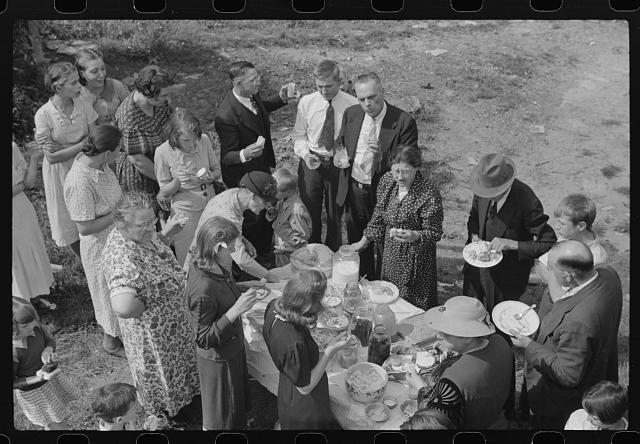
"My first assignments were very close to Washington. I think one of the first ones, if not the very first, was in the coal fields in West Virginia. That was a very short assignment, of course. And it was a very interesting one, too. I found the people not as apathetic as I had expected they might be. They weren't too beaten down. Of course, many of them were but they were people with hope and some of them still had a little drive, although, of course, their health was so bad it was telling . . . .
"I think [all the FSA photographers] did have a social consciousness definitely, perhaps more than some people have but I think they were all -- well, they were all interested in the plight of human beings and in the programs of the New Deal, and the remedial programs that the New Deal and the FSA were trying to do, I think that all these people had a lot of vigor and energy and were sensitive to their surroundings.
"[The Farm Security Administration] was one of the few places you could go where you felt that your pictures would be used and seen and that you could be honest in your reporting, whether with a camera or any other device. With your captioning you felt that any exhibits that they produced were definitely propaganda but you believed in them and you felt that they were honest, you wanted to slant them -- if you would call it slanting it -- or they were slanted, but so is any good program, an effective one.
"I never had worked in the field with handling both the captioning and the traveling and the sending back of the material, and not having my own darkroom. I wasn't sure I'd like that, and the arrangement of sending the stuff back and having them develop and print it, this worried me a little bit, but it turned out very well because Roy [Stryker, Historical Section chief, Information Division, FSA] gave us a great deal of freedom in that respect."
Interview with Marion Post Wolcott
Conducted by Richard Doud
at Artist's Home in Mill Valley, California
January 18, 1965
Source: www.aaa.si.edu/collections/oralhistories/transcripts/wolcot65.htm

On June 29, 1941, Charles Jones, C.A. Cecil and eight other young Jehovah’s Witnesses from Mt. Lookout, WV drove to nearby Richwood, WV “to distribute literature of the said religious sect.” Three of the Witnesses stopped off at the Town Hall to inform the mayor of the nature of their work and to request police protection. Instead of the mayor, they were met by an angry reception committee from the Richwood American Legion Post, among whom were Martin L. Catlette, a deputy sheriff, and Bert Stewart, the chief of police. A mob of 1,500 people gathered outside the Town Hall, in the meantime, and soon other members of the American Legion post, headed by one Louis Baber, had rounded up seven Witnesses and brought them to the mayor’s office.
Catlette then took charge. He produced several quart bottles of castor oil, and in the best Mussolini tradition, forced the Witnesses to drink eight ounces each. One Witness, who protested, was made to drink a double dose. While the Witnesses squirmed in agony, they were then tied to a long rope and marched by the hoodlum mob to the Richwood post office. In a touchingly patriotic ceremony, Catlette thereupon recited the preamble to the American Legion Constitution, and everybody present was forced to salute the flag. An hour or so later as the resultant circuit court decision goes on to say, “the Jehovah’s Witnesses were marched through the streets of the town of Richwood and out of its corporate limits, yet attached to the rope. The mob piled their stuff in their cars, poured castor oil over it, deflated their tires and painted 'Nazi' and 'Commie' on the cars."
The case attracted the attention of U.S. Attorney General Frank Murphy, who had recently established the Department of Justice's Civil Rights Section.
Catlette was hauled before a federal court and sentenced to twelve months in jail plus a thousand dollar fine, while Stewart, the chief of police, was fined $250.
This was the only federal conviction in the hundreds of brutal assaults on Jehovah's Witnesses that swept America that year. It was the Civil Rights Section's first interpretation that law enforcement officers were required to protect the civil rights of citizens. The Richwood case also marked the first time that Department of Justice's Civil Rights Section proceeded with an indictment by information after a grand jury failed to indict. This case expanded legal protection for religious liberties in the United States.
Sources: ‘Jehovah’s Traveling Salesmen” by Bill Davidson, Collier’s
Nov 2, 1946
http://tinyurl.com/293p6f
http://www.wvhumanities.org/catlette.htm
Jehovah's+Witnesses, appalachian+history appalachian+culture appalachia history+of+appalachia
The 125-student Vardy School. Vardy Church is in right foreground; Powell Mountain rises behind.
The Vardy School, completed in 1929 and in operation until the 1970s, was a mission school that offered educational opportunities to members of one of America's least-known ethnic groups: the Melungeons.
The Melungeons often faced discrimination, both legal and social, and tended to settle in isolated communities such as Newman's Ridge in Hancock County, Tennessee. The Vardy Community is at the foot of Newman's Ridge. The district was named after Vardemon Collins, one of the first recorded Melungeon inhabitants, and was first settled around 1780. Batey Collins and his immediate family, circa 1890s. He gave the land for the development of Vardy education.
The locals worked with the Presbyterian Church to establish the Vardy School Community in 1892. The resulting Vardy School and a neighboring church became the focal points of life for the eight-mile Vardy Valley along Blackwater Creek, on the Tennessee-Virginia state line. By the 1930s and ’40s, when the school was run by Reverend Chester Leonard and Mary Rankin, it was likely the best in Hancock County. Miss Rankin was educated in Scotland, and possessed a nursing degree and a master's degree in education. She delivered all the babies in the community and conducted home health visits.
Until 1973, the Vardy School provided educational opportunities for students from Vardy, Blackwater Creek, and Newman's Ridge, as well as in neighboring Lee County, Virginia. Individualized instruction was used in most of the teaching. Students traveled at their own pace. The Geography, History, Bible and Health classes were all illustrated and accompanied with slides and filmstrips. There were movies at night for entertainment.
Writer Libby Killebrew describes Vardy as "a model community, whose
citizens learned strong values from close-knit families, and good skills from a fine school." Those citizens, Killebrew writes, have been "maligned in the past by journalists exploiting Appalachian stereotypes and myths, and the legend of the 'mysterious' Melungeons. Contrary to popular myths, Vardy was actually one of the most progressive communities in our region. [On] average, children graduating from Vardy were ahead of their peers academically."
The Vardy School Community was the first site in Hancock County to be placed on the National Register of Historic Places.
Sources: http://tinyurl.com/3y2vqd
http://tinyurl.com/36dy2j
Vardy+School Melungeons appalachia appalachian+culture appalachian+history history+of+appalachia

"Aunt Betty Arnett lived 87 years of her life unable to read or write; she lives far back at the headwaters of Licking River in Magoffin County, KY. She is now doing well in the first grade in literacy classes offered in the mountains."
Photo caption by George Goodman
1939 photo describes 'The Education Project,' a WPA sponsored literacy program.

The movement to put anti-lynching legislation in place gained new momentum with the election of Franklin D. Roosevelt in 1932. The president's wife Eleanor had been a long-time opponent of lynching. During that year, lynchings had decreased to a new low of ten incidents and during the entire decade "only" 88 blacks were lynched.
Appalachia, though hardly immune to race hatred, was not cursed with the higher number of lynchings to be found in the Plantation South. W. Fitzhugh Brundage, of the University of North Carolina, Chapel Hill, explains:
“Only a small portion of Appalachia, specifically the area along the borders within the foothills, was devoted to monocultural agriculture with all of its attendant evils, including lynching. In rough proportion to the degree that a particular region diverged from the plantation South, the likelihood of habitual mob violence in that region shrank. Of course, neither the pursuit of economic justice nor the rejection of violence lay behind the absence of violence in agricultural labor relations in Appalachia.
Mountain landlords simply devised a system of labor that was exploitative, stable and lucrative but that did not rest upon the steady application of coercive methods. They showed little interest in mimicking their low country counterparts, who assumed the prerogative to regulate violently all aspects of black life.
Thus, the enduring stimuli for lynching that were so abundant in the plantation districts of the South were largely absent from rural Appalachia. The point is that although the color line was etched into the day-to-day reality of race relations in Appalachia during the twentieth century, few whites believed that the the upheavals of the late nineteenth century required them to defend violently and habitually their property, livelihood, rights, or status from a black threat.”
‘Appalachians and Race: The Mountain South from Slavery to Segregation’ Lexington: University Press of Kentucky, 2001. John Inscoe, ed.

Back in the hollers lived an old woodsman in a one-room cabin with his three dogs. After a day of hunting, the old man finds only a small rabbit to feed himself and his three dogs. Still hungry, the old woodsman begins to doze off. Just as he is about to fall asleep, the awfulest critter he ever did see in his life creeps through a crack between the logs in the wall. The old man cuts off the creature's long tail, cooks and eats it, and goes to bed with a full stomach.
He is awakened several times throughout the night when the strange creature comes looking for its tail. Finally, the furry creature sneaks into the old man's bed, and tears the man all to pieces. Nothing remains of the old man's house except the chimney. At night, when the moon shines and the wind blows, you can hear a voice say: 'Tailypo, tailypo, now I've got my tailypo.'
--- Appalachian children's folktale
tailypo, appalachian ghost stories, appalachian culture, appalachian history, history of appalachia, appalachia
“[The farm was] wedged in . . . there's a branch . . . a big branch come down, and it's clean up on both sides of the hollow. That was just a holler, see. And a hillside. It run up on each side of the hill. I believe it was about a hundred and sixty acres. It was woodland, and . . . and [Daddy] owned another farm. I guess it was, maybe, a hundred. He owned about three hundred acres in both. They joined. He didn't do much to one of 'em. The one farm that he didn't work much was mostly in timber. And he pastured it. He'd get a little hay off of the back. Growing mostly on the place I was raised up.
“My daddy, he . . . people back then didn't have nothing to cut hay with, only just an old mowing blade. He had a cow or two, milked, and had hogs. Killed his own hogs, and then raised enough corn on that farm to feed 'em. But he'd . . . he was poor . . . pretty poor, but we'd get by on it. And then ha-. . . raise corn and hay. Maybe had an old mule he'd farm with.

“We raised [our food] mostly. Raised a big garden and we'd put it up. And he'd grow a cane patch and make molasses. And we had an orchard there. Put lots of apples and growed potatoes and dried beans and . . . put up was what people lived on back then. [We’d sell] maybe a calf or a cow every once in awhile. And maybe some pigs. We had our own chickens, and we didn't have to buy much. Didn't grow tobacco back then. Daddy, he made . . . made whiskey, too, back then. Moonshine. And he'd . . . he'd sell that to raise a family. Just enough to get by on.
“He used to ha-. . . everybody used to . . . down in here used to make whiskey. When I was a . . . I hunted when I was smaller. Had a little dog, and I'd go out hunt and . . . and I'd run into . . . used to, plenty of stills, just out a hunting.”
Interview with Elmer McKinney, June 11th, 1991
Family Farm Oral History Project
University of Kentucky
Steve Mooney; Interviewer
appalachian+history appalachian+culture history+of+appalachia appalachia

“Men in room at Mrs. Jones's boardinghouse. Six men live in this room. Three beds, pay eight to ten dollars a week rent. Most of them have families they left behind in Bluefield, West Virginia; Bristol, Tennessee; or High Point, North Carolina. They are carpenters, carpenters' assistants, riggers and laborers. They make sixty cents to one dollar and twenty-five cents per hour.”
Photographer John Vashon's photo caption
Radford, Virginia, December 1940.
appalachian+history appalachian+culture history+of+appalachia appalachia
FDR’s government found itself in the business of real estate development during the early New Deal years. In 1933 Eleanor Roosevelt came to Scotts Run, WV to assess what she might do to improve living conditions of out-of-work miners and enable them to become self-sufficient. Two months later, The Resettlement Administration, Division of Subsistence Homesteads purchased the Arthur family farm in Preston County, and the first of the nation’s “stranded communities” projects was born.
The homes were built to three basic patterns and each one had its own land for gardens, with outbuildings and a root cellar. Arthurdale survives in remarkably good condition. A number of houses are still lived in by the families for whom they were built. Based on the success of Arthurdale, WV, over 100 such communities were developed across the country.
The Tygart Valley Homesteads at Valley Bend, WV and Dailey, WV were built in 1934-35 for workers likewise laid off from local mining and lumbering jobs. In Dailey there are several New Deal-era structures, including craft buildings and the stone trade center building, which was the community center for the homestead’s 160 or so homes. The lumber mill was constructed by the government and operated by the Kenoweth Corporation, to provide jobs for those living in the homestead dwellings.  The Homestead School built for the project is still in service as the elementary school for the area between Beverly and Mill Creek. Some of the homes can be seen on the west side of the road across from the community buildings. The largest concentration is at Valley Bend, on the east side of the Pike.
Two other Appalachian projects listed in the same “stranded communities” category as Arthurdale and Tygart were Cumberland Homesteads at Crossville, TN and Red House at Red House, WV. The first class passengers all sit still,
Second class passengers walk up the hill,
But the poor third class have fallen behind.
They push like the devil on the Coal and Coke Line.
"The Coal and Coke Line"
sung by Addison Boserman,
recorded at Tygart Valley Homesteads
April 1939
Sources: http://tinyurl.com/2ycto8
http://tinyurl.com/yt2rf2
appalachian+history appalachian+culture history+of+appalachia appalachia
Clogging is an expressive style of American dance with origins in the folk dances of the British Isles, Africa, and pre-Columbian America. Settlers in the American South took elements of these styles to form a unique American dance style, Appalachian clog dancing.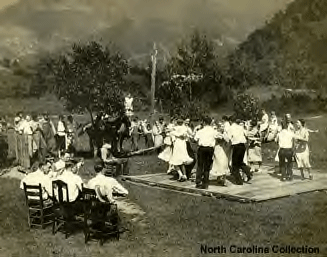
Though the eighteenth-century Scottish and Irish settlers brought with them the clog, a step dance characterized by a very erect upper body, the additional influences of the traditional dance of Native Americans with its toe-heel, toe-heel movement and African American buck dancing, in which the arms hang loosely at the dancer's sides, made for a distinctly American style. The basic clogging and buckdancing step consists of a double toe shuffle, where the dancer brushes forward the toe and then the heel of the free foot, shifts his or her weight to that foot, then rocks onto the other foot, before stepping back onto the foot that had originally been free. The leg is generally raised a little more than six inches off the ground in clogging, while the feet stay close to the ground in traditional buckdancing.
Team clogging, coupled dancers executing individual step dances together in group configurations, is a relatively new composite dance form that began in the 1920s in western North Carolina. In was initiated when The Smokey Mountain Dancers first performed at the Bascom Lamar Lunsford Festival in 1927 in Asheville. By 1938, team clogging had its own competition at the Lunsford Festival, and it was won by the well known Soco Gap Dancers from the Maggie Valley area.
They performed freestyle buck dance steps continuously while doing mountain style square dance figures called by one of the dancers. In freestyle (or traditional) clogging, the dancers perform spontaneous footwork, which allows them to improvise while moving about the dance floor in time to live music provided usually by string bands. Team clogging won more widespread respect and recognition when the Soco Gap Team performed at the White House in 1939 for an audience including the Queen of England. Queen Elizabeth was said to have remarked "that's just like our clogging."
sources: www.doubletoe.com/About.htm
http://tennesseeencyclopedia.net/imagegallery.php?EntryID=D002
http://canecreekcloggers.org/backintime.html
appalachian+history appalachian+culture history+of+appalachia appalachia

This year marks the 80th anniversary of the Shenandoah Valley Apple Blossom Festival, one of the oldest civic celebrations in Virginia. During the 1930s interest in the Apple Blossom Festival was declining and profits were in the red. A decision had to be made whether to continue the Festival or drop it completely. The turning point came in 1938, when Mr. Tom Baldridge was appointed Executive Director of the Festival.
Baldridge, born 1909 in Jackson, Tn., had come to Winchester, Va. to manage the Capitol and Colonial theaters. At the same time, he also held a full-time job as a promoter for Metro-Goldwyn-Mayer, organizing promotional events and movie premieres on the East Coast. With his Hollywood connections, Baldridge was instrumental in bringing stars such as Bob Hope, Bing Crosby, and Lucille Ball to Winchester, and the festival has never looked back since.
“I’ve been in the celebrity business,” Baldridge told The Winchester Star in 1997. “Celebrities would thank me for the publicity, but I was just doing what my boss paid me to do. They thought I was being special to them, so I asked them to be a part of the festival. No one turned me down.”
Working with Baldridge was “an experience,” said Ginny Trenary, who worked at festival headquarters for 34 years before retiring in 1998.
“If you didn’t work with Mr. Baldridge, you really missed out,” she said.
Baldridge would work all night and through weekends for the festival “with maybe a catnap every now and then,” she said.
“It was nothing to have a meeting at 11 o’clock at night,” Dutton added.
Some late nights, a crack could be heard in the office, Trenary said. Baldridge was smacking himself to keep himself awake.
“That was a Mr. Baldridge thing,” she said.
Baldridge retired as executive director in 1968.
Source: http://tinyurl.com/38exzy
Shenandoah+Valley+Apple+Blossom+Festival appalachian+history appalachian+culture appalachia history+of+appalachia


“The population of this vast mountain region is divided into two distinct classes, as far removed in character and environment as it is possible for people to be. First, there are those who live in fertile valleys along the rivers and the railways, with the very best religious and educational advantages, and who are equal in intelligence and refinement to any people in America.
"[People of the second group] do not live in these favored valleys, but far back from the main lines of travel in small clearings by the watercourses, almost entirely removed from the outside world, with few advantages for learning and few opportunities for improvement. The extreme poor live ‘back of beyond,’ beyond the towering mountains, locked in narrow coves, without teachers, without physicians, without comforts and conveniences.”
Rev. Homer McMillan
"Unfinished Tasks of the Southern Presbyterian Church"
Richmond, VA, Presbyterian Committee of Publication, 1922
appalachian+history, appalachia, appalachian+culture, history+of+appalachia

In light of the horrific shootings yesterday at Virginia Tech, today's entry is suspended as we take a moment to pray for the victims' families and friends.
He was born in Indiana, not Appalachia, and for the first 39 years of his life he stumbled around from one job to the next: insurance salesman, steamboat ferry operator, gas lamp manufacturer, railroad man, even justice of the peace.
But in 1929 Harlan Sanders finally found his life’s calling. That was the year he moved to Corbin, Kentucky and opened a gas station along U.S. Route 25. When tourists and traveling salespeople asked Sanders where they could get something to eat nearby, he got the idea of opening a small restaurant next to the gas station. He invented what's called "home meal replacement" - selling complete meals to busy, time-strapped families. He called it, "Sunday Dinner, Seven Days a Week." 
The restaurant had one table and six chairs and specialized in Southern cooking such as pan fried chicken, ham, vegetables, and biscuits. Sanders moved his establishment across the street to a bigger location, with room for 142 seats, a motel and a service station. He took an eight-week course in restaurant and hotel management from Cornell University to learn more about the business. Sanders' café had a homey atmosphere, with no menu, but good food. When restaurant critic Duncan Hines listed Sanders' place in Adventures in Good Eating in 1935, its fame increased.
The popular café impressed Governor Ruby Laffoon. That same year he made Sanders an honorary Kentucky colonel for his contribution to state cuisine. In 1937, Sanders tried to start a restaurant chain in Kentucky, but his attempt failed. Two years later, he opened another motel and restaurant in Asheville, North Carolina, but this too failed.
Sanders continued to alter his chicken recipe to get the seasonings just right. In 1939, he devised a method to cook chicken quickly because customers would not wait 45 minutes for a batch to be fried up in an iron pan. Sanders used a pressure cooker, a new invention at the time, to cook chicken in nine minutes. He found that chicken cooked in this manner turned out to be moist and flavorful. Over the next decade, he perfected his secret blend of 11 herbs and spices and the basic cooking technique that is still used today.
Sources: www.answers.com/topic/harland-sanders
www.kfc.com/about/colonel.asp
www.tvacres.com/admascots_colonel.htm
appalachian+history appalachian+culture colonel+sanders kfc appalachia history+of+appalachia
Nearly every day my mother or my aunt took me "down the street," by which they meant downtown. Murphy's Five and Dime was usually on our itinerary. Another stop was the Corinne Shop, where the proprietor, Marie Hiltie, indulged me by calling me "Mrs. Jones" and pretending I was a grown-up.
On Saturday mornings my uncle would put me in the car and take me to Brown's Creek to feed sugar cubes to the mules that worked in the mines. But my happiest moments were spent in the Citizen's Drug. They would hoist me up to the soda fountain and let me mix my own fountain Coca-Colas with enough Coca-Cola syrup in each for a whole six pack of today's Coke. In the afternoons when classes ended at Welch High School, the store would fill with noisy teens having Cokes and Nabs. My aunt's teacher friends would gather there, too, to visit and chat. To my child's eyes, far the most glamorous denizens were several women who used to drift in for a Coke around mid-afternoon some days. They had flawless, heavily powdered complexions and brilliantly colored lipstick and nail polish. Much later I learned how they earned their living at a neighboring hotel.
Sammie Wade,
Memories of Welch [WV], interviewed by Betty Dotson Lewis
http://appalachiacoal.com/welch1.htm
appalachian+culture appalachian+history appalachia history+of+appalachia
“The French Broad is a river and a watershed and a way of life where day-before-yesterday and day-after-tomorrow exist in odd and fascinating harmony. Beneath the deepest waters impounded by Douglas Dam lies buried the largest untouched Indian mound of the French Broad country. Our most ancient relic of man and our most recent trophy of his scientific skill rest practically side by side.
“There is the same coexistence of past and present within the people. It helps explain how they may be at once so maddening and so charming, wrong about so many things and yet fundamentally right so often. This living past and present is my story of the French Broad. I should like to think that by some unmerited but longed-for magic I have spoken for a few of the anonymous dead along its banks and up its mountains. For the Negro baby drowned in the river when its mother tried to swim from slavery and bring it into freedom. For the sheriff who was shot in the back from a laurel-thicket ambush as he picked his way along a fog-blanketed early-morning trail. For the minister in a windowless log church who made foot washing a symbolic ceremony of humbleness and brotherhood.
“For the old taletellers around country stores and the urbane newcomers who seek but have not found as yet. For these and for the river itself, mountains, lowlands, woods, gullies, springs and ponds and brooks I should like to speak, to quicken understanding. For the French Broad is above all a live country. The Cherokees said, ‘We have set our names upon your waters and you cannot wash them out.’ They were right - the Nolichucky and the Swannanoa and the Estatoe - but they might also have said, for all of us, ‘We have lived our lives along your rivers and you cannot wash the memory of us out.’ ”

Mrs. Riddle raises and sells vegetables, and keeps bees, but the real business of the family is raising beef cattle. Jim rents 120 acres from the Middletons and pays them a flat sum of $300 a year for the house and lot and the farm land. Jane seems to think this a profitable bargain and, while noncommital about gains, intimates they are prospering. They have 25 full-blooded Herefords, several full-blooded Jerseys, and other cattle of mixed breed. Those lying in the shade of the trees adjoining the lot looked rather gaunt. There were no stalls for them. Evidently they sleep in the grove.
Part of the land is wooded, part is pasturage, and about half of it is arable bottom land, already green with springing grain. They also raise corn, peas, beans, and hay, and although Jim, 55 years old, is small and thin, and does not appear to have much strength, he can plow all day without excessive fatigue.
"All our folks was farmers," said Mrs. Riddle, "back up in the mountains. No, I don't know when they settled there, or where they come from. Jim's people and my people lived in the same cove. I've known him all my life. His brothers and my brothers all farm. Most of 'em are back up there where we come from. I've got one married sister living in Fielding."
"Did you and Jim go to school?"
"Yes & I finished the school - went through the seventh grade - but Jim dropped out. They was only one teacher - it was a little log school - and we didn't have grades like they got now, but they told me I went through the seventh grade. I don't know how far Jim got - he's older'n me, and dropped out before I started."
Jim owns 102 acres of land back in the mountains, but, "It's so steep," he said, "it ain't fit for farmin'." He raises apples on this land, and pastures cattle on the hillsides. He tried renting the place, "But the tenants," Jane put in, "let the cows get into the orchard and break limbs offen the apple trees. They run down the property, so we just locked up the house and let it stand."
"We've lived here about three year," Jim added, "but we ain't brought our best things here. We sort of feel like we're camping out."
Anne Winn Stevens interviews Jane & Jim Riddle
for the Federal Writer’s Project 1936-1940
March 27, 1939 in Fletcher, NC
source: http://tinyurl.com/2nnfz3
appalachian+history appalachian+culture history+of+appalachia appalachia
"You had to work. It was hard work. From the time we was five years old we worked in the corn fields. From the time you was able to count to three you started working. Every day. Except Sundays. My dad didn’t believe in working on Sundays. It was raising corn, wheat, and potatoes, and a big garden. It was all strawberries. Anything you could raise, we raised it. Tobacco, we raised tobacco.
"Where did I go to school? West Virginia, Pleasant Valley. Forest Home. One room. With a pot-bellied stove in it. We carried wood to keep the fire going. It was fun. It really was. Because, the teacher - we had from the first grade to the eighth grade, and from then on you went into town. You was bussed into town. But we walked to school. We walked a mile and a half to school. We didn’t have no busses. The kids walked then. The teachers was good. I had two men teachers in my lifetime and one woman. What I remember most about them is, I don’t know, getting the switch used on you. The punishment was a hickory switch or the razor strap.
"We had reading, arithmetic, geography, and history, and writing, and spelling. It wasn’t like it is today. They have different subjects I think today, don’t they? Or is it everyday? Now we had it every day. I run off one time. I run from my dad one time. I never did that no more, never. And you know I can’t remember ever getting into real bad trouble. The way we had to work and go to school. We didn’t have time."
Pauline Riley, Pomeroy, Ohio
Source: http://home.frognet.net/~cntdown/OralHistoryPages/PaulineRiley.htm
appalachian+history appalachian+culture history+of+appalachia appalachia
A king is curious to know which of his daughters loves him the most, so he asks them. The first two claim to love him more than anything else, but the youngest simply says, "as meat loves salt." The king is so angered but what he thinks is her flippancy that he banishes her.
She packs up her three prettiest dresses, hides them in a marsh, makes herself a dress and cap of rushes, and travels around to find work. After working as a kitchen maid for awhile in the house of a rich man, the rich man throws a series of parties for his son. The youngest princess / kitchen maid dresses up in her dresses and attends the gala each of the three nights, and the master’s son falls in love with her.
After searching in vain to find her, he begins to pine away for her. She makes him soup and drops the ring he gave her into the soup, which is delivered by the First Cook, who hopes to take credit for the soup. The master’s son recognizes the ring and vows to marry the woman who made the soup, who then reveals that she is the princess.
At the wedding feast, the bride instructs that her father be served meat without salt, thus revealing her identity to her father as she explains what she meant when she told him she loved him “as meat loves salt” – i.e. that he was and is the spice of her life.
---Appalachian folktale “As Meat Loves Salt,” based on similar English & Greek folktales
appalachian+history appalachian+culture history+of+appalachia appalachia
"I lived down in Beulah Land, and times were hard on black people back then," said John Easter. "A lot of times we had to quit school to chop cotton while the white man's children kept going. It hurts me to talk about it, but I tell people bygones should be bygones."
Easter was born Aug. 7, 1914, in the Limestone (AL) County community of Coxey near the Elk River, but spent most of his life close to Tanner. He recalls that they could hardly get through the dirt roads, because the wagons would mire down and get stuck in the mud.
He attended a country school through the sixth grade, and then the closest school for upper grades was in Athens. "I didn't have no way of going and no place to stay." Some students boarded, and some lived close enough to walk, but he didn't have any money to pay the tuition.  From his cotton-chopping days, he recalls that the field workers "couldn't get nothing unless you went to the white boss man; you couldn't see a doctor unless the boss man said you could."
He chopped cotton many days for 50 cents a day. "Now it's gone to $50 a day, and stuff's high now. Back then nothing was that high; you could get a cold drink for a nickel."
Bologna sausage used to come in a waxed paper bag, and there were no refrigerators, he said. "You'd buy a nickel's worth of bologna and they'd give you the crackers and a 'big lunch cake' that had five small cakes in chocolate and vanilla flavors." The soft drink — a strong Double Cola — was another nickel.
He and other country boys played on baseball teams; his was the Beulah Land team. While they couldn't play baseball with whites, they did play a little unofficial basketball together.
In the 1930s, when he had a break between chopping cotton and picking cotton, he'd head to Evansville, Ind., or Louisville, Ky.
"They'd hire Alabama boys when they saw them coming down the street, because they knew they'd work hard," Easter said.
interviewed in The Decatur Daily
Sept 10, 2004
http://tinyurl.com/2k7cpz
appalachian+history appalachian+culture appalachia history+of+appalachia
"From 'middle class gentility to scrabble-ass poor,' the undiscriminating Great Depression forced 4,000,000 Americans away from their homes and onto the tracks in search of food and lodging. Of this number, a disturbing 250,000 of the transients were children. Some left home because they felt they were a burden to their families; some fled homes shattered by the shame of unemployment and poverty. Some left because it seemed a great adventure. With the blessing of parents or as runaways, they hit the road and went in search of a better life.
"Public perceptions of the road kids differed. There were people who saw the American pioneer spirit embodied in the young wanderers. There were others who feared them as the vanguard of an American rabble potentially as dangerous as the young Fascists then on the march in Germany.
"For most of the young transients, riding the rails would not become a way of life. "After a while," Jim Mitchell remarks," you knew you had to get on with your life." Those who found steady work abandoned the trains. Mitchell and many other young men got jobs with the CCC. Most teens returned home, and for some, transition was difficult. Their time on the rails marked a coming of age, a turning point when they moved out of childhood and became aware of the world. Some became advocates for social change. For teen rail rider John Fawcett, raised in a middle-class family in West Virginia, his experiences during the Great Depression shaped his perceptions of the world, leading to his involvement in the labor and antiwar movements. But for many others, the pain, uncertainty, and loneliness of life on the road fostered in them a strong, but conservative, desire for steady employment and the security of home and family."
RIDING THE RAILS: Teenagers on the Move During the Great Depression (Routledge, New York, 2003)
appalachian+history appalachian+culture appalachia history+of+appalachia
Go to Harrisonburg, Virginia and you’ll find them in just about any of the numerous old, old Mennonite churches in the area. They’re “Old Folks Singings,” an event unique to that religious group in that region. People filter in and out of the one-room churches, picnic in the church yard, rub tombstones if the church has a cemetery. And sing hymns. In some communities there is 100 per cent participation in the singing. Their songbook is and has been since 1832 The Harmonia Sacra. No other hymnal in the English language has had such a long lifespan of constant use in any Christian denomination. Indeed, many of the families of Harrisonburg have also been in the area since the mid-1800’s --- Buckwalters and Hosslers, Stutzmans and Brubakers.
The original Harmonia Sacra was a "four-shape" shape note book using the shapes and syllables "faw, sol, law, and mi." Joseph Funk designed A Compilation of Genuine Church Music for use in singing schools. It contained 208 pages, including rudiments of music and tunes harmonized for three voices. In the early 20th century the singing consisted primarily of German hymns; however, not the slow tunes used in the church services. The 17th edition of 1878 was the one widely in use during the Depression era. “The different musical grammar of these hymns makes them sound fresh, rugged, and often rough-hewn. As the layout suggests, this music is written as melodic parts, not in chords. Each line is an individual composition against the principal melody… In this style of hymnody each singer chooses any line which is comfortable, and then focuses on expressing that part, that personalized manifestation of the words. The parts do not necessarily form the identifiable and static chords which a modern congregation might encounter together in an improvised harmonization.”
---Review of The Harmonia Sacra, 25th ed.
Bradley Lehman, 1995 for Mennonite Quarterly Review
Sources: http://www.sci.edu/classes/ellertsen/harplinks.html
http://www.mcusa-archives.org/MennObits/40/jul1940.html
http://www.mcusa-archives.org/MennObits/43/oct1943.html
http://www.gameo.org/?content=encyclopedia/contents/S5676ME.html&breakout=yes
http://en.wikipedia.org/wiki/Harmonia_Sacra
http://www-personal.umich.edu/~bpl/hsreview.html
http://www.blueridge.net/~larryb/larryxh.html
appalachian+history appalachian+culture appalachia history+of+appalachia


