
Denim Quilt, April 2007
4 months ago


"Another Floyd County murder-victim, his skull crushed, the body of 20-year-old Wilson Kidd, of Mud Creek, was hauled from the Big Sandy River at Harold, Sunday.
"Because of renovation started this week on the circuit courtroom, the September term of that court may have to be held in some other building, Circuit Judge John W. Caudill said this week.  Floyd County, Kentucky - Prestonsburg Court House 1942
"Green Castle, 35, of Hueysville, was shot and instantly killed by three blasts from an automatic shotgun, Sunday, at Hueysville, when a neighbor objected to Castle's killing of a snake on the Sabbath.
"Congressman A. J. May informed County Judge W. L. Stumbo, Monday, that federal aid in the restoration of roads in flooded sections is now available through the state highway department.
"Fire destroyed the Floyd County relief office and all its records in the Fitzpatrick building on the Mayo Trail, here, Wednesday morning.
"Raids made on three West Prestonsburg establishments, Saturday night, by Deputy Constable Ike Fitzpatrick and Dave Horn, netted several gallons of whiskey.
"Wielding a red-hot putter, E. E. Clark won the Abbott Heights golf club championship, Sunday, and is now set to compete for the Big Sandy title, presently held by Dr. Paul B. Hall, of Paintsville.
"Approximately 1,000 employees of the Kentucky West Virginia Gas Company, and members of their families, enjoyed the Company's annual picnic at Maytown recently."
Floyd County Times,
Prestonsburg, KY
August 24, 1934
Source: http://www.rootsweb.com/~kyfloyd/our_yesterdays/our_yesterdays_70.htm
Related post: "The cake was emblazoned with illuminated candles"
Floyd+County+KY Floyd+County+Times Prestonsburg+KY appalachia appalachian+culture appalachian+history history+of+appalachia
Ah, southern Appalachian ‘balds,’ those curious subalpine meadows. From northern Georgia to southwestern Virginia, there are scores of such grassy peaks sprinkled along the Appalachian mountain chain. They are an enigma, being largely devoid of trees and other woody vegetation where one would normally expect to see a continuation of the surrounding forest.
In places, these balds are expansive, measured in the hundreds of acres. Elsewhere they are tiny summit caps. Some 90 are cloaked in grasses and sedges. These so-called grass balds are especially rich in botanical finds.
Researchers have looked for evidence of bald creation through climatic factors related to the Wisconsin glaciation and the effects of mega-fauna during the last ice age. Wood bison, deer, and other native grazers also contributed to keeping the balds cleared.
Native Americans probably used the balds as hunting areas and lookouts and may have used fire to maintain them, says Kristine Johnson, supervisory forester and vegetation management specialist for Great Smoky Mountains National Park. The Cherokee name for Gregory Bald was "Tsistu'yi," or "Rabbit Place." According to tribal lore, the chief of all rabbits— known simply as the Great Rabbit— lived at the summit. The rabbit, considered by the Cherokee to be sly and mischievous, was a key figure in tribal legends, showing the importance the tribe placed upon the mountain.
Gregory Bald, famous for its wealth of hybrid azaleas (some azalea hybrids occur only here), is located about five miles south of Cades Cove. Its grassy slopes sustain a variety of rare and endangered wildflowers, native grasses, and a rare, dwarf willow.
Gregory Bald was documented by the region’s earliest white explorers in the Davenport survey of 1821, which covered the area now comprising GSMNP. The mountain was listed by Arnold Guyot in his 1856 survey of the Smokies, although Guyot gave it the name "Great Bald's Central Peak", and measured its elevation at 4,922 feet.
In the Smokies, as well as other areas, farmers would drive their livestock to the highest balds in the summer. Livestock thus avoided ‘milk sickness’ that resulted when they consumed low elevation plants. This also freed up lower fields, such as Cades Cove, to be used for crops.
The name "Gregory Bald" was given to the mountain by Cades Cove residents in honor of Russell Gregory (1805-1864), a prominent Cades Cove settler. Gregory used the mountain to graze cattle during the spring and summer, when the fields in the cove were needed for growing crops. He lived atop the mountain during this part of the year in a circular stone house near the mountain's summit (the house is no longer standing).
Today, maintenance of the balds is sometimes the only reason that some of these balds still exist. The origin of balds remains a mystery, and balds management issues are continually debated.
Sources: www.state.tn.us/environment/tn_consv/archive/roane.htm
audubonmagazine.org/truenature/truenature0209.html
eerc.ra.utk.edu/sightline/V3N2/bald.html
Gregory+Bald Appalachian+balds Tsistu'yi Cades+Cove Russell+Gregory appalachia +appalachia+history appalachian+culture history+of+appalachia
 For all the jokes about KFC's Colonel Harlan Sanders or the ABA's "Kentucky Colonels," the Honorable Order of Kentucky Colonels is for real. It is also not very Kentuckian anymore.
Once upon a time it was common throughout the region for a governor to reward political supporters with a glamorous title via an appointment in the state militia. In Kentucky this tradition began in 1813 during the second term of Governor Isaac Shelby. Shelby had just returned from leading the Kentucky Militia on a highly successful “War of 1812” campaign. He named one of his officers, son-in-law Charles Todd, an “Aid-De-Camp” on the governor’s staff with the rank and grade of Colonel. Local notables were often "majors" or "colonels" who had never and would never lead troops. Kentucky was no exception, but the state took the idea a step further. In 1885, Governor William Bradley appointed the first "Honorary" Kentucky Colonel, making the military standing even more tenuous.
In 1928, an effort began to organize the Colonels into “A great non-political brotherhood for the advancement of Kentucky and Kentuckians.” The "Honorable Order of Kentucky Colonels was founded in 1932 by Governor Ruby Laffoon and has since been officially incorporated as a charitable organization. In 1935, the Colonels suffered a brief official setback, when Governor A.B "Happy" Chandler announced that he would appoint no new colonels, and that the commission for all existing colonels had expired when the previous governor (who bestowed a commission on Harland Sanders) left office.
The Colonels continued to operate privately, and in 1937 gathered funds from around the country to support victims of the great 1937 flood. Public attention surrounding the charitable activities of the Colonels caused Chandler to capitulate in 1938, and he began appointing new Colonels, and re-instated those who had been appointed by previous governors.
Inductees are nominated by an existing Colonel, approved by the Governor, and go on the rolls that year as an "Honorary Adviser." There are no requirements that an inductee be either from Kentucky or even be living there at the time of his/her nomination.
The Colonels descend upon Louisville from around the globe each year for the Kentucky Derby. Mint juleps are familiar sights that weekend; an official dinner one day before the Derby and a barbecue the day after are two main items on the agenda.
In addition to well-known Colonel Harlan Sanders, some very non-Kentuckians like Bob Hope, Omar Bradley, Joan Crawford, Pope John Paul II, and Mae West are all Kentucky Colonels.
Sources: www.kycolonels.org/
www.sos.ky.gov/executive/kentuckycolonels.htm
http://everything2.com/index.pl?node_id=1363496
Related posts: "Finger Lickin Good"
Honorable+Order+of+Kentucky+Colonels appalachia+history appalachian+culture appalachian+history history+of+appalachia
If butterflies are about this week, you can be sure you will find them on the heads of sweet Joe-Pye-weed (Eupatorium purpureum). This perennial herb, found in moist woods and fields throughout Appalachia, is at its height of bloom right now through September. Atop each stem is a rose pink to whitish domed cluster of flowers, about 1 foot in diameter. Gardeners delight in this towering, showy plant, as another common name for it, ‘Queen of the Meadow’, clearly suggests.
However, the plant’s name is the first clue that we’re dealing with far more than just another pretty flower. It’s named after a New England American Indian named Joe Pye, who was said to have cured typhus with it. Tea made from the dried root and flowers can still be used to induce sweating and break a high fever. The entire plant, in fact, is used in native medicine, with the roots being the strongest part. Crushed leaves have an apple scent and can be dried, then burned to repel flies. Joe Pye was used by the Iroquois and Cherokees as a diuretic, who infused dried root and flowers for a tea to relieve kidney and urinary problems. They also used this tea for rheumatism, gravel (gallstones), and dropsy (fluid retention).
The Cherokee used the stems of Joe-Pye Weeds to suck water from shallow springs, which was convenient since they are often found in wet areas. They also referred to it as Blow Gun Weed, and used it in the way suggested by the name to administer throat medicine.
The Ojibwa used Joe Pye to strengthen a child. They would wash the child with a strong solution for first 6 years of its life. The Chippewa used a decoction of the root as a warm wash for inflammation of the joints, or in a child's bath to induce sleep.
Huron H. Smith, an ethnobotanist who worked with several North American tribes during the nineteen-twenties and thirties, was told that the Meskwaki used the root as a sort of "love medicine," nibbling it when speaking to an intended.
“Fresh leaves of Joe-Pye weed are used by the Potawatomi to make poultices for healing burns. Mrs. Spoon used the root under the name “maskwano'kûk” [red top] as a medicine to clear up after-birth. Among the whites, the root and the herb have both been used for medicines. The root is said to have diuretic, stimulant, astringent and tonic properties, while the plant itself is diuretic and tonic.
“The Herbalist says that the root has diuretic, astringent and tonic properties and has been used by eclectic practitioners in the treatment of chronic urinary disorders, hematuria, gout and rheumatism. The Forest Potawatomi use the flowering tops of the Joe Pye Weed as a good luck talisman. When one is going to gamble he places the tops in his pocket and then is sure to win a lot of money.”
“Ethnobotany of the Forest Potawatomi” by HH Smith
“We didn't even know what a union was. We'd never heard tell of a union. But we just decided that we wasn't going to work for this wage. We just wasn't going to work for $10.08 a week. But as it happened, there was a carpenter and a union man, John Penix. He called someone that he knew in the labor movement, and they came here and organized, and it was just one big mess, and they just panicked. [Everyone else in the plant was] getting the same wages, and I imagine that they decided that if we were going to quit, they'd quit, too.
“At that time they paid a flat scale. You started out at $8.96 a week; $10.08; $11.20. I don't know whether you got past $11.20 or not. I never did hear any man say how much they made, but I don't think they paid them more. If they did, they didn't pay them much more. [The supervisors] were American, most of the people from up close by, the close counties. A lot of people worked there from Johnson City and way back up in Pogey. One time, I think we went to Pogey. There wasn't a thing on earth but just mountains with rocks sticking out. And people worked from up in Butler. Oh, just all around. “Fifty-six hours [a week], they didn't seem to pay any attention to it. People had never been nowhere, and they'd never done anything. Maybe go to a movie on Saturday night. So I don't guess the hours made that much difference. I don't remember, except I know you'd get awfully tired.
“I went to the washroom when I wanted to. I went by my own rules, if you needed to go to the washroom. Oh, you worked so hard, you didn't fudge on them any. They didn't take any breaks. They were just supposed to go to the washroom and back.
“I don't remember who did the talking. You see, they selected the one to do the talking, and they passed the word around they was going to ask for a raise. Said, ‘If they don't give us that raise, we'll just quit work.’ And that was it.
“It just got in a bigger and a bigger and a bigger mess. Other people kept joining us, first from North American and then Bemberg, because everybody wanted a raise anyway, until that John Penix got in touch with somebody in labor, and an organizer came here and organized.
“There was five thousand people out. And we had asked for an $11.20 raise! We were arrested twice, on those picket lines. It was over here on the old State Line Road. They brought out the National Guard. In the meantime, my daddy cooked down there at the plant during that time. Some of them stayed in there, I reckon, to take care of the machinery and things that had to be looked after, and he cooked for them.”
Christine Galliher
Interview August 8, 1979
Discusses plant strike at North American Rayon Corp.
In Johnson City, TN on March 12, 1929
Southern Oral History Program Collection
http://docsouth.unc.edu/sohp/H-314/H-314.html
Related posts: “The stretch-out and the strike”
Christine+Galliher North+American+Rayon American+Bemberg labor+strike Johnson+City+TN appalachia appalachia+history appalachian+history history+of+appalachia
If you’re an Ohio briar and you’re in Dayton this weekend, stop by the 21st annual Mountain Days Festival, a local celebration of the culture and heritage of Appalachian people. Those not familiar with the connection between Dayton and the official center of Appalachia might find it puzzling to encounter an Appalachian celebration in that city, and therein hangs the tale of the Appalachian Diaspora.
"Briars," first off, are what (some) Ohioans call migrant workers from Appalachia, and the term refers almost exclusively to Kentuckians and West Virginians, as Michael Ralstin recently explained in an excellent commentary on the Rednecromancer blog.
"It has been said that all mountain regions must import capital or export people," says John Alexander Williams in his thoughtful Appalachia: A History. "During most of the twentieth century, Appalachia did both. 
Photo: Women workers making sparkplugs at the Firestone Tire & Rubber Company, Akron, Ohio, ca. 1930.
"With only their labor to invest and in numbers that exceeded the region's capacity to support its population through agriculture, forestry, and mining, most Appalachian migrants had little choice but to go wherever work could be found. Local leaders never willingly embraced a solution that deprived mountain localities of workers and voters.
"Nevertheless, migration remained a fact of Appalachian life throughout the 20th century. The Appalachian core sustained a net population loss through migration as early as 1910, but such losses were disguised, up until the 1950 census, by a relatively high birthrate and by the seemingly temporary nature of war-related migration during the two world wars."
"The impact of out-migration was particularly pronounced in West Virginia, which sent generation after generation of young adults to other states," Paul Salstrom tells us in Appalachia's Path to Dependency. "One study, a 1941 survey of Lewis County, West Virginia, noted that 'the principal export product of this area appears to be children.'"
And Mary Hufford observes in From Landscape and History at the Headwaters of the Big Coal River Valley: "Between 1935 and 1955, the introduction of mechanical loaders revolutionized deep mining. Nationwide, in the 1950s, some 250,000 miners (60 percent of the workforce) lost their jobs, overwhelming their pension fund.
"In addition, small operators unable to afford the industry-wide standard were driven out of business. Fifteen mines on Coal River (WV) shut down, and between 1951 and 1961 coal production declined dramatically. The roads leading out of Coal River to the factory towns in the north received a new name: Hillbilly Highways. 'You had to learn the three r's,' said Shorty Bongalis, 'Reading, Writing, and Route 21. And if you couldn’t swim, you better have help crossing the Ohio River.'"
Dayton, Detroit, Columbus, Ashtabula. One thing they all have in common: they’re at the end of the Hillbilly Highway.
Sources:
Paul Salstrom, Appalachia's Path to Dependency: Rethinking a Region's Economic History, 1730-1940 (Lexington: University Press of Kentucky, 1994), p. 117.
Mary Hufford, From Landscape and History at the Headwaters of the Big Coal River Valley /An Overview at http://memory.loc.gov/ammem/collections/tending/essay5.pdf
John Alexander Williams, Appalachia: A History (UNC Press, 2002)
Dayton+OH Mountain+Days+Festival briars Appalachian+diaspora hillbilly+highway appalachia appalachian+culture appalachian+history appalachia+history history+of+appalachia
“They brought their produce into town on wagons and they brought hallows to trade horses and all that kind of stuff and vegetables like string beans, tomatoes, corn, watermelons and all that stuff. Bring down and set it right down there on that shelf on the trading ground. And they would sell and people would come and buy stuff just like you were going to the Farmer's Market. And all that produce was traded right there and once a month on the first Monday of the month they had what they called a Court Day.  Photo: Court Day in Franklin County, VA
“And that was the day that the farmers would come into town to trade horses, cattle, sheep or whatever they had that they wanted to trade or what they wanted to sell. And my father and his uncle they were horse traders. Out of all the peddlers he used to feed them baking soda in order to make them look like they were fat. Take them home and two days later he had a skinny little horse already.
"But there was all kinds of tricking in those times you know it. And then you would look at a horse to see how old it was and the first thing he would ask is how old is the horse. And they would say well he's four years old. Ray would look up and say "Uh, huh. He's more than four years old." He'd go, "He's about ten years old." He could tell by looking at the teeth.
"They would call it the Coat Round - the Coat Round they called it. And even back before then there was a lady who is living in Charlottesville right now. Her mother was sold off the block right down there on Water Street. Sold to somebody somewhere down the way. Rebecca McGinnis. You could still see them in the pavement not too long ago.
"One of the oldest flagstones in Charlottesville I believe. But anyway, her mother was sold off the block, you know, they put them on the block and they walked by and she looked like a pretty good old - just like the same as with a horse. You know, people had pretty good horses. They had good shoulder variety - good shoulders."
Walter A. Payne Sr.
Charlottesville, VA
Interviewed July 26 and August 22, 1994
Ridge Street Oral History Project
Virginia Center for Digital History, University of Virginia
Source: www.vcdh.virginia.edu/afam/raceandplace/transcripts/payne.html
Walter+A.+Payne+Sr Charlottesville+VA Court+Day +Coat+Round appalachia +appalachian+culture appalachian+history appalchia+history history+of+appalachia
Twelve-year old William P. “Punch” Jones and his father, Grover C. Jones, Sr. were pitching horseshoes in Peterstown, WV one day in April 1928 when one of the shoes landed on an unusually beautiful stone. Believing the item to be simply a piece of shiny quartz common to the area, the family kept it in a wooden cigar box inside a tool shed for fourteen years, throughout the Depression. Punch Jones, meantime, worked his way through college during that time while his father struggled as a county school teacher to provide for his large family.
On May 5, 1943, Punch brought the stone to Dr. Roy J. Holden, a geology professor at Virginia Polytechnic Institute in nearby Blacksburg, Virginia. Holden, shocked at Punch’s discovery, authenticated the find as a diamond. The “Jones Diamond,” also known as the “Punch Jones Diamond,” "The Grover Jones Diamond," or "The Horseshoe Diamond," is an 34.48 carat alluvial diamond. It's the largest alluvial diamond, and the third largest diamond overall, ever discovered in North America. 
Illustration: Crystalline Structure of a Diamond
Professor Richard Zallen
Virginia Tech Department of Physics
The bluish-white diamond measures 5/8 of an inch across and possesses 12 diamond-shaped faces. No other precious gems are known to have been found in West Virginia. Dr. Holden speculated that due to its “carry impact marks” and the size of the stone it had probably been washed down the New River into Rich Creek from a source in Virginia, North Carolina or Tennessee.
He sent it to the Smithsonian Institution, where it remained for many years for display and safekeeping. In February of 1964, the Jones family brought the diamond back and placed it in a safe deposit box in the First Valley National Bank in Rich Creek, Virginia.
When Grover died in 1976 his widow Grace and grandson Robert became owners of the diamond (Punch had been killed in World War II.) In 1984, Robert sold the diamond through Sotheby's auction house in New York to an agent representing a lawyer in the Orient, for $74,250. "I wish they'd a threw it in the New River sometimes," Grace Jones observed over all the controversy. She passed away in 1992.
Sources: www.geocities.com/Heartland/Hills/3402/diamond.html
www.mirolcentre.com/mirol/diamond/famous_diamond.html
dmme.virginia.gov/DMR3/dmrpdfs/vamin/VAMIN_VOL42_NO04.pdf
Grover+Jones Punch+Jones Jones+Diamond Horseshoe+Diamond Peterstown+WV alluvial+diamond appalachia appalachian+culture appalachian+history appalchia+history history+of+appalachia
She had hosted Susan Steele Sampson, wife of Kentucky’s governor, the previous year at her first American Folk Song Festival, held at the Traipsin' Woman Cabin. Now, in August 1931, Jean Thomas found herself invited to the Governor's mansion in Frankfort to discuss the creation of an American Folk Song Society and an annual festival open to the public. How did Thomas get to this point, and why did she call herself the “Traipsin’ Woman?”Photo: Jean Thomas and Susan Steele Sampson at Governor's mansion, Frankfort, Kentucky, August 1931. Thomas presents Mrs. Sampson a copy of her newly published book, “Devil’s Ditties.”
Jean Thomas was born Jeanette Mary Francis de Assisi Aloysius Marcissum Garfield Bell in Ashland, Kentucky in 1881. She earned the nickname "Traipsin' Woman" when, as a teenager in the 1890s, she defied convention to attend business school, learn stenography, and become a court reporter, traveling by jolt wagon to courts in the mountains of eastern Kentucky.
Using money saved from her court reporter wages, Thomas moved to New York, where she attended Hunter College and the Pulitzer School of Journalism. She married accountant Albert Thomas in 1913, a marriage which lasted only one year. She then held a variety of jobs, including work as a script girl for Cecil B. de Mille's The Ten Commandments, as secretary to the owner of the Columbus Senators of the National League and as press agent for Ruby "Texas" Guinan, the notorious entertainer and owner of prohibition-era speakeasies.
In 1926 Jean Thomas met William Day, a blind fiddler from Rowan County. Using the skills she had acquired as press agent and manager, she changed his name to Jilson Settles, secured recording contracts and booked him (as the "Singin Fiddler from Lost Hope Hollow") in theaters. Day eventually played in London's Royal Albert Hall. He was the subject of Thomas' first book, Devil's Ditties (1931). Thomas went on to author another seven books including the semi-autobiographical The Traipsin' Woman (1933), The Singing Fiddler of Lost Hollow (1938), and The Sun Shines Bright (1940).
The first American Folk Song Festival was held in 1932 in Jean Thomas’ home town of Ashland, and featured 18 acts. During the early years of the American Folk Song Festival, Jean Thomas carried a camera wherever she went as she sought out musicians who would perform at the annual event.
At the 8th festival, TIME magazine (June 30, 1938) noted with amusement that the musicians were presenting not only “ballads and hymns that can be traced to Elizabethan England,” but also “ballads from yesterday's newspaper headlines.” One such example, titled “Franklin Delano Roosevelt, the Brave Engineer (to the tune of Casey Jones)” [musician not cited in article]:
Now some folks kick, say he didn't cut his pay
Remember, he's not fishing, he's working every day
He gave the Republicans a mighty slam
He didn't take twelve years to start the Coal Creek Dam
He sent word to foreign countries, both near and far
Just what to expect if they started to war
He put the mills to working under the N. R. A.
Which means shorter hours, and much more pay
He's made his stand, and you know he's tried
He's made many friends on the Republican side
He's balanced the budget with revenue
He's brought back whiskey and the three point two
You can still see part of the boiler room and a few intact boilers from the old cotton mill in Mortimer if you know where to look. There's also a white maintenance building built by the CCC during the 1930s, and some other CCC building foundations remain behind it. Today these silent remnants welcome hikers and campers at the entrance to the Mortimer campground in the Pisgah National Forest. What a story they hide!
Mortimer, NC had been built rapidly to house workers for the Ritter Lumber Company, which had bought the land for timber in 1904. Ritter Lumber Company's sawmill and a small textile mill provided jobs for the community's 800 residents. Substantial logging took place between Wilson and Steel Creeks, and the trees were hauled to the mill via Ritter's narrow gauge railroad, which followed Wilson Creek much of the way before ending in the village of Edgemont. The Hutton-Bourbannis Company operated various other narrow gauge logging railroad lines fanning out from Mortimer.
There was a company store, a blacksmith's shop, a church, a school, a hotel, and numerous houses. By 1906, the newly incorporated town even had a motion-picture facility and the Laurel Inn, which Teddy Roosevelt reportedly visited. 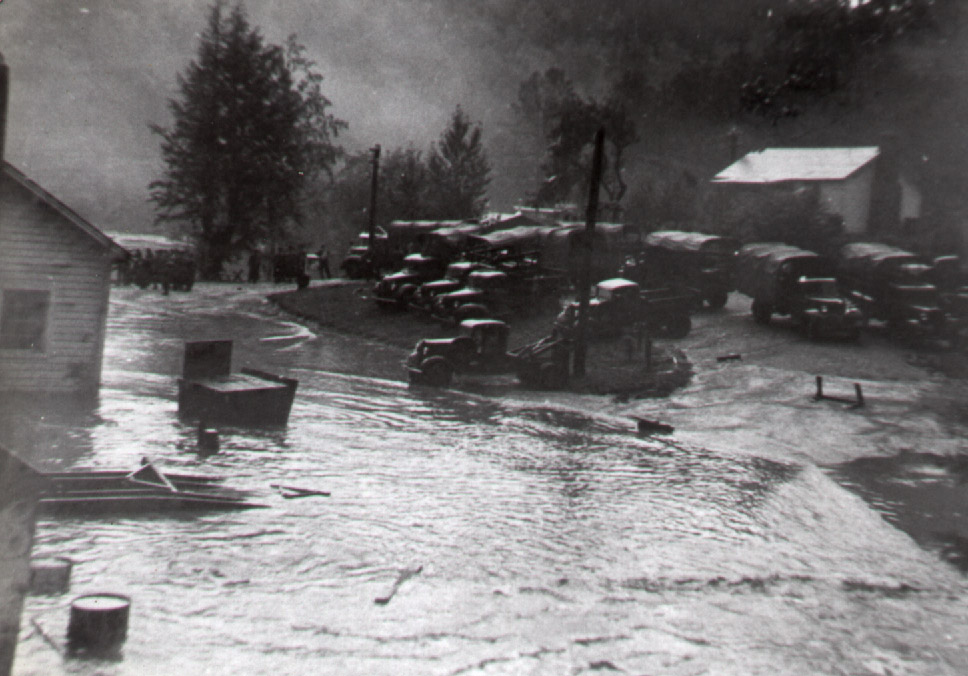 Then disaster struck. In 1916, a fire burned from Grandfather Mountain to Wilson Creek, and was immediately followed by a flood, which destroyed the logging railroad and the Lake Rhodhiss Dam, and devastated the Ritter Company's operations. The company left the town entirely about a year later. The flood is considered to be the worst in Caldwell County history.
United Mills Company, a cotton mill, opened in 1922 and revitalized the town for a brief period. The Civilian Conservation Corps opened Camp F-5 at Mortimer during the Great Depression, and by 1933, had repaired many buildings damaged in the 1916 tribulations. In 1934, O.P. Lutz started a hosiery mill in the cotton mill buildings, but it never really succeeded. The Carolina & Northwestern Railway brought in mail every other day, but closed in 1938.
Then, on August 13, 1940, Wilson Creek jumped its banks again (this time prompted by a coastal hurricane.) The creek reached a flood stage of 94 feet and engulfed the town. This second flood, coming only 24 years after Mortimer's first horrific experience, was enough to drive most remaining families from the area.
The CCC hobbled along until the arrival of World War II in the 1940s. The railroad that used to run through Mortimer was taken up during WWII and melted down for the war effort. After the railroad was removed and the CCC left, the valley was left essentially unchanged for the next several decades.
Today, there are only about 16 permanent families living along the stream. Much of the mountain property in the northwestern part of Caldwell County is public land held by the U.S. Forest Service.
sources: www.ghosttowns.com/
www.tarheelpress.com/CNW5.html
www.mountaintimes.com/summer/auto_day_trips.php3
web.utk.edu/~jeparks/HDREdgemont.pdf
www.tarheelpress.com/blacksatchel.html
Related posts: "Appalachia's Katrina"
appalachia appalachian+culture appalachian+history CCC Edgemont+NC history+of+appalachia Mortimer+NC Pisgah+National+Forest Ritter+Lumber
Got in a little trouble at the county seat
Lord they put me in the jailhouse for loafing on the street
When the judge heard the verdict I was a guilty man
He said forty five dollars or thirty days in the can
That'll be cash on the barrelhead son you can make your choice you're twenty one
No money down no credit plan no time to chase you cause I'm a busy man Found a telephone number on a laundry slip
I had a good hearted jailer with a six gun hip
He let me call long distance she said number please
And no sooner than I told her she shouted out at me
That'll be cash on the barrelhead son not parting cash but the entire sum
No money down no credit plan cause a little bird tells me you're a travelling man
Thirty days in the jailhouse four days on the road
I was feeling mighty hungry my feet a heavy load
Saw a greyhound coming stuck up my thumb
Just as I was being seated the driver caught my arm
That'll be cash on the barrelhead son this old grey dog is paid to run
When the engine stops and the wheels won't roll
Give me cash on the barrelhead I'll take you down the road
"Cash on the Barrelhead"
The Louvin Brothers
Ira Louvin vocals, mandolin
Charlie Louvin vocals, guitar
recorded May 4, 1956
Born and raised in Alabama's northeastern sliver of the Appalachian mountains, both Charlie (born Charlie Elzer Loudermilk, July 7, 1927) and Ira (born Lonnie Ira Loudermilk, April 21, 1924; d. June 20, 1965) were attracted to the close-harmony country brother duets of the Blue Sky Boys, the Delmore Brothers, the Callahans Brothers and the Monroe Brothers. Their group, formed in Knoxville, TN in 1940, built a reputation for unexcelled gospel singing by the early 1950s.
The minor hit "The Get Acquainted Waltz" (recorded with Chet Atkins) was their first foray into secular music. In 1955, after ten unsuccessful auditions, they finally joined the Grand Ole Opry, where they performed to great acclaim until 1963, when they broke up. They had a number of hits, including the much-covered "When I Stop Dreaming" and "Cash on the Barrel Head." In 2001, the Louvin brothers were inducted into the Country Music Hall of Fame.
sources: http://www.alamhof.org/louvin.htm
http://music.yahoo.com/ar-256404-bio--The-Louvin-Brothers
Related posts: "How-DEE! I'm just so proud to be here"
Louvin+Brothers Ira+Louvin Charlie+Louvin Cash+on+the+Barrelheard Grand+Ole+Opry appalachia Appalachian+ballads appalachian+culture appalachian+history history+of+appalachia
“When Kentucky was first being settled, emigrants from either North Carolina or Tennessee, headed by a man named Cornett, reached the Kentucky River late one evening. They decided to camp and wait until daylight before crossing the river. They had wives, children, livestock and equipment with them. After supper they were sitting around their campfire talking, when suddenly Indians [ed. -thought to be Creek] dashed into camp and captured two of the girls.  "Three of the white men saddled horses and went after the Indians. Late in the night they caught up with the Indians, who were not expecting pursuit and had made camp. The men advanced near enough to see the girls asleep on pallets near the fire. Each man agreed to dash in and grab one of the girls. This they did and got away without a fight. When they came to their camp the men discovered that they had also captured a little Indian girl. The next morning, after crossing the river, the emigrants decided to keep the Indian girl. Mr. Cornett agreed to take her and raise her.
"In the meantime, in another part of the area, the Cherokee [ed. Whitetop Laurel Band of Cherokees] Indians had also captured a white girl. One Indian Chief, seeing her beauty, became desirous of possessing her for his own, and took her into his teepee. However, his love was short-lived, for the girl's brothers made pursuit and brought the girl back to her own people, but under her heart she carried the child of the Indian Chief. This child was given the name of George All Sizemore. (Information from Pleasie Woods, deceased.)
"When George All grew to manhood he married the Indian girl whom Mr. Cornett had raised. George All and Agnes Shepherd thus became the progenitors of the Leslie County Sizemores. Shepherd was Agnes' Indian name. She was sometimes called Shepherd and sometimes Cornett.”
Taken from the book "The Rugged Trails of Appalachia" by Mary Brewer. This tidbit was generously provided by Pam Powell PamPowell28@myfamily.com
sources:http://freepages.genealogy.rootsweb.com/~sizemoregenealogy/tidbits/tidbits.html
http://multiracial.com/site/content/view/284/27/
Related posts: "Indian tales told by firelight"
Mary+Brewer The+Rugged+Trails+of+Appalachia Sizemore+family appalachia appalachian+culture appalachian+history appalchia+history history+of+appalachia
“So many outside writers had come in and . . . and given such a terrible account of the people. They had put 'em down a lot in their articles that I didn't think this was true, because the people that I met were very intelligent and they were very civilized. They were not like they were pictured in these articles at all. And I thought that somebody ought to come through here and give the true picture of them. Left: 1937 LIFE magazine article profiling Mary Breckinridge's Frontier Nursing Service, for which Mary Brewer worked at the time.
"And, you know, the Mary Breckinridge . . . the hospital. Mary Breckinridge, of course, was the first one, I guess, that put the people in this area on the map by going out and soliciting aid, and naturally most of their material was slanted toward the poorer class of people. They didn't tell anything about the fine homes that were here. It was always the little shacks on the hillsides and people going without clothing and half-starved and barefoot. So that most people in . . . outside of Kentucky, they got the wrong idea, and I . . . I thought that ought to be corrected.
“Well, in 1958, the . . . Berea College had asked me to do some research for the Ford Foundation. And I started out in the field, traveling with Rufus Fugate and Ruth Baker, who was a home agent at that time, and I began to find all these old people that had these interesting stories to tell me and I began writing them down. And it just grew and grew from that until I got a good collection and I thought well, it ought to be shared with others and I decided then to have it published. And Vernon Baker came to see me then. He knew that I had this material and said he was interested in publishing it. And he published it under the title Of Bolder Men, but it fell apart. It was just a disaster. [Chuckle]
“So I quit selling the book because it did fall apart. It wouldn't stay together. And then I decided there were so many requests for it that I would write it over again. And they decided to use it as a part of the centennial celebrations for Leslie County then. So I did it over for that purpose mostly, that it might be used for that. [A large part of it is sort of a genealogy] of people who live in Leslie County. I got the history from Leslie County by going to the courthouse and talking to old people who were here, you know, and knew the history of it. The first part of it is involved with the history and development of Leslie County itself, and . . . and the second part of it contains the genealogical history of about forty families.”
Part 1 of 2; tomorrow- one of the stories from "The Rugged Trails of Appalachia"
1978 interview with Mary Brewer,
author of "The Rugged Trails of Appalachia"
Oral History Project, Frontier Nursing Service, Kentucky Virtual Library
http://tinyurl.com/3axr6o
Mary+Brewer The+Rugged+Trails+of+Appalachia Frontier+Nursing+Service Mary+Breckinridge appalachia appalachian+culture appalachian+history appalchia+history history+of+appalachia
America’s most sociable bird is getting ready to pack up and head south for the winter in the next couple of weeks. That would be the purple martin (Progne subis), whose usefulness was already recognized in Appalachia by the early Cherokees, who hung bottle gourds horizontally on long poles to attract them. Not only did the birds eat prodigious amounts of insects, but they also (and still do!) drove crows away from cornfields and vultures away from meat and hides hung out to dry.  Purple martins are the largest member of the swallow family in North America and the only species of martins on the continent. Worldwide, there are more than 70 kinds of swallows and martins. Appalachia has six kinds: purple martin, and barn, cliff, tree, northern rough-wing, and bank swallows.
One of the great myths, one of the things that makes the uninitiated want to attract martins to their land, is that each bird can eat 2,000 mosquitoes a day. Martins, like all swallows, are indeed aerial insectivores. They eat only flying insects, which they catch in flight. They are not, however, prodigious consumers of mosquitoes. Martins are daytime feeders, and feed high in the sky; mosquitoes, on the other hand, stay low in damp places during daylight hours, or only come out at night.
Purple martin pest control efforts are impressive nonetheless: their diet includes dragonflies, damselflies, flies, midges, mayflies, stinkbugs, leafhoppers, Japanese beetles, June bugs, butterflies, moths, grasshoppers, cicadas, bees, wasps, flying ants, and ballooning spiders.
Did you know that purple martins in Appalachia are completely dependent on humans to supply their nestboxes (birdhouses) in order to breed today?
Fortunately there are groups such as The Purple Martin Society or The Purple Martin Conservation Association to help martin fanciers get started.
So while the martins are spending the non-breeding season in Brazil molting and gaining a new set of feathers, perhaps you’ll consider reading up on how to house them and how to care for them come next spring?
sources: http://www.wvu.edu/~agexten/wildlife/seasons.pdf
http://purplemartin.org/main/mgt.html
http://www.wildbirds.com/dnn/Favorites/PurpleMartins/tabid/697/Default.aspx
purple+martins progne+subis appalachia appalachian+culture appalachian+history history+of+appalachia
On January 1, 1863, the Emancipation Proclamation declared that all slaves held in locations in conflict with the United States were henceforth free. Black communities in Virginia, Georgia and North Carolina have observed Emancipation Day on that day ever since. Not so elsewhere in Appalachia.
When Union soldiers took control of an area, they would, amongst other things, read the proclamation and enforce it. Because of this, various states, territories, and municipalities celebrate emancipation on the day when the law was enforced in their region.
Tennessee and Kentucky, for example, have long informally recognized August 8 as the day. As early as 1875, the African American community in the vicinity of Greene County, TN had begun to hold annual celebrations on August 8th, known as the "Eighth of August Celebration" according to local accounts in The Greeneville American. Last April Tennessee governor Phil Bredesen went a step further and signed House Bill No. 207 into law, officially recognizing August 8 as “Emancipation Day” in that state. Photo: Emancipation Day parade in Jenkins, KY. August 8, 1924.
"… to honor and recognize the celebration of the action of Andrew Johnson, seventeenth president of the United States and then military governor of Tennessee, in freeing his personal slaves on August 8, 1863, and the significance of emancipation in the history of Tennessee.”
The Gallia County (Ohio) Emancipation Day Celebration, held September 22, claims itself to be the longest continuous running celebration of the kind. An Ohio Department of Development brochure provides more details: “Students were dismissed from school and people attended dressed in their very best clothes. It was conducted in a religious atmosphere. However, such fun activities as baseball, sack racing, hog calling and greasy pole climbing were also introduced to stimulate the interest and maintain the enthusiasm. Bands, famous orators, politicians, parades, dances and queen contests were also included in the celebration.”
West Virginia also recognized September 22. “At the fair grounds, ex-United States Senator B. K. Bruce, of Mississippi, will speak in the afternoon at two o'clock,” announced the Wheeling Daily Intelligencer in 1891. “Then will follow the singing by the states, forty-four girls and forty-four boys, Our Nation's day, reading of the Proclamation by Queen of the Day, singing by William Turner's quartette, thence to the general amusements of the day.”
In late nineteenth and early twentieth century Kentucky, Emancipation Day fairs (as in Tennessee, August 8) were popular among the state's black citizens. Cash prizes were awarded winners in categories from livestock and racing to music and floral display.
sources: www.odod.state.oh.us/cdd/ohcp/FairHousingHistory.pdf
www.kentucky.gov/kyhs/hmdb/MarkerSearch.aspx?mode=Subject&subject=3
wheeling.weirton.lib.wv.us/history/afr-am/EMAN91A.HTM
Emancipation+Day appalachia appalachian+culture appalachian+history history+of+appalachia
The 80th annual Mountain Dance and Folk Festival got underway last night in Asheville, NC. It’s the oldest continuously running folk festival in the United States. "Even the moon came out over Beaucatcher Mountain and laughed in the spirit of the occasion," said one of the local newspapers at the inaguaral festival in 1928.
What started as the Rhododendron Festival of 1927 was transformed into what we today recognize as a ‘folk festival’ by Bascom Lamar Lunsford (1882-1972). Lunsford was a superb mountain musician who spent his life hunting down the songs, dances and unknown performers of the Appalachian region. Friends said he would cross hell on a rotten rail to get a folk song. He performed at the festival every year until he suffered a stroke in 1965. 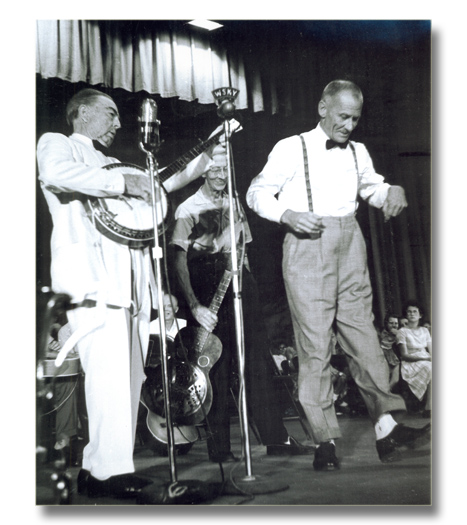
As a young man, Bascom Lamar Lunsford practiced law, sold fruit trees, managed democratic political campaigns, worked as an auctioneer, and waltzed through other professions before returning to his first love, mountain music and dancing. Ultimately he performed for both Franklin D. Roosevelt at the White House and in England for King George VI and Queen Elizabeth. He recorded his "memory collection" of some 350 songs, tunes, and stories for Columbia University in 1935 and the Library of Congress in 1949. His collection of songs (not just his own) make up the largest oral archives in the Library of Congress (The Archive of Folk Song).
“Lunsford often referred to old singers dying with their treasures of ballads, of the old ways dying out, of the progressive pushing out the traditional and of the failure of the young to appreciate the value of old ways. He started a festival to showcase traditional musicians and dancers at a time when most of his peers were clamoring for the fruits of the industrial age, and in fact, used a largely phoney tourist-attracting promotional effort to present his ‘authentic’ show. He invested in the real estate boom that was a major threat to the very traditional culture that he cherished.
“He was of the folk and yet he was also middlestream mountain gentry. True, this made him uniquely able at enlisting the participation of almost all types of people in the mountains because, in addition to his enthusiastic and engaging personality, he could converse with one and all within the framework of their interests and understanding.
“One has to remember, however, that in addition to his presenting authentic folk talent around the country, he also traveled for the Asheville Chamber of Commerce puffing the virtues of the Land of the Sky and giving a shameless argument as to why the well-to-do should spend their money in Western North Carolina. The politicians he promoted for public office were those who looked after the progressive business interests of his area.”
Minstrel of the Appalachians: The Story of Bascom Lamar Lunsford by Loyal Jones, University Press of Kentucky, 2002
I said T for Texas
T for Tennessee
Oh, yeah, I said T for Texas
T for Tennessee
Said, T for old Thelma
The gal who made a wreck out of me
Well, if you don't want me momma
You sure don't have to start
Ah, if you don't want me momma
You sure don't have to start
'Cause I can get more women
Than a passenger train car
Yeah, I said T for Texas
T for Tennessee
Whoa, T for Texas
T for Tennessee
I said, T for old Thelma
The gal who made a wreck out of me
I'm gonna buy me a pistol
Just as long as I am tall
I'm going to buy me a pistol
Just as long as I am tall
I'm gonna shoot down old mean Thelma
Just to watch her jump and fall
I said T for Texas
T for Tennessee
I said T for Texas
T for Tennessee
T for old Thelma
The gal who made a wreck out of me
Gonna buy me a shotgun
With a great long shiny barrel, oh yeah
I'm gonna buy me a shotgun
With a great long shiny barrel
Gonna shoot down that rounder
That stole away my girl
I'm going where the water
Tastes like cherry wine
Yeah, I'm going where the water
Tastes like cherry wine
'Cause the water down here in Georgia
Tastes like turpentine
I said T for Texas
T for Tennessee
Oh I said, T for Texas
T for Tennessee
I said T for old Thelma
The gal who made a wreck out of me
Oh yeah, women make a fool out of me
Jimmie "The Singing Brakeman" Rodgers was born outside Meridian, MS, but he staked his claim to country music fame smack dab in the middle of Appalachia. In 1924 Rodgers started singing in traveling shows, vaudeville shows, medicine shows, and various other productions. Radio listeners in Asheville, NC heard his first performances in that medium in 1927, and he recorded his first songs in Bristol, VA.
Although he made records for only six years, between 1927 and his death at age 36 from tuberculosis in 1933, Rodgers recorded more than 100 songs. “T for Texas,” also known as “Blue Yodel No. 1,” became his signature tune and was the first of 13 tunes in his "Blue Yodel" series. Rodgers was the first inductee into the "Country Music Hall Of Fame” in 1961.
Sources: www.geocities.com/ajsblue/country/country_b.html
mshistory.k12.ms.us/features/feature54/rodgers.htm
Related posts: "You've been fooling me, baby"
"Carolina Sunshine Girl"
T+for+Texas The+Singing+Brakeman Jimmie+Rodgers country+music appalachia Appalachian+ballads appalachian+culture appalachian+history history+of+appalachia
Before there were Transformer action figures, digital cameras, or Playstations, there were Tinkertoys. These and a host of other construction toys in the early 20th century, including Lincoln Logs and Erector Sets, helped kids throughout Appalachia learn by exercising what we now think of as "spatial intelligence."
Charles Pajeau, a stonemason from Evanston, Illinois invented Tinkertoy Construction Sets. He proposed the idea in 1913 on a commuter train to Chicago Board of Trade trader Robert Pettit, and together they started The Toy Tinkers Company. Pajeau designed his first set in his garage. Inspired by watching children play with pencils, sticks and empty spools of thread, Pajeau developed several basic wooden parts which children could assemble in a variety of three dimensional abstract ways. They consisted of spools with eight holes around the edge and one through the center to fit quarter-inch diameter rods of different lengths.
With high hopes, the duo displayed the toy at the 1914 American Toy Fair in New York City. But nobody was interested. On his way back to his hotel, Pajeau convinced two drugstores in Grand Central Terminal to carry his toy, in exchange for a hefty commission. Next came window displays that involved complex creations made of these spools and rods. He even placed fans nearby to move framework windmills with bladed tops.
Pajeau and Pettit tried their marketing skills again at Christmas time. They hired several midgets, dressed them in elf costumes, and had them play with tinker toys in a display window at a Chicago department store. This publicity stunt made all the difference in the world. A year later, over a million sets had been sold. The toys even came with instructions for creating elaborate mechanical tools, such as printing presses, lathes, airplanes, and power saws. The company added an electric motor to the set in 1919 and Pajeau and Pettit continued their partnership until Pettit's death in 1943.
sources: http://inventors.about.com/library/inventors/bltinkertoy.htm
http://www.answers.com/topic/1914?cat=technology
http://www.chicagohs.org/kidsfamilies/artifacts
Related posts: "America loves the yo-yo"
"All I want for Christmas is a whimmy diddle"
tinkertoys Charles+Pajeau Robert+Pettit American+Toy+Fair appalachia appalachian+culture appalachian+history history+of+appalachia
"Nancy Ward, where are you?" It's getting late. A sudden turn in the road and we've reached the place; the cabin is on the right across this rocky ditch. And on the narrow porch sits Nancy herself, most venerable of midwives, respected by all because of her calling.
The old woman rises with the quiet dignity of the hill people. Pride, sorrow, mirth, are written in her rugged features. Her skin might be envied by many a Park Avenue debutante. Her soft black eyes glow with pleasure. A ten-cent store red necklace graces her neck. On her feet are men's shoes, much too large. On her head is a red felt hat.
"Come in, sweetheart. Hist youreself right over my doorstep and gab a spell." She greets Miss Lester. "Now I ain't caught no babies come two month tomorrow. I aims to quit my traipsing round and set my bones by my own fire. But let me try to quit and some woman's man will come arunning from yan way, and afore I knows it I'm a'tagging at his heels to help, jest like Jake's old hound dog, or some such critter too dumb to rest." "Come to the meeting at Brushy Fork," Miss Lester says, "and learn the best new ways to save your patient and yourself. The young doctor has studied and will be there to teach and help us all. We'll all learn about cleanliness together, won't we?"
"Yes'm, we will and that's the truth. It's the truth and I'll be there with my bag and soap. Just count on me like us folks has counted on you for many a year."
"Fine," says Miss Lester. "That's the kind of talk I like to hear. Now we must go."
"Don't hurry off."
But go we must. The cabin seems a dim speck now far on the trail above. Below the little dusky stars came out and shine like symbols of the understanding of these mountain people.
"It was real nice of you all to ride by." The dim sweet chorus of the hidden friendly army of the hills has remained with me and always will.
A DAY WITH THE BOONE DISTRICT NURSE
By Katherine Palmer
Notes gathered in 1935 Federal Writers' Project, revised December, 1938
http://tinyurl.com/3xmlf9
Related Posts: "Granny Women"
Nancy+Ward Miss+Lester Boone+district+nurse appalachia appalachian+culture appalachian+history history+of+appalachia
It’s tent revival season throughout Appalachia! Last week the Voice of the Word Ministries tent revival took place in Johnson City, TN. Later this week the Blue Ridge Foothills annual tent revival kicks off in Wolftown, VA. You can bet there are hundreds more throughout the region – the region that invented the tent revival.
The first camp meeting took place in July 1800 at Gasper River Church in southwestern Kentucky. A much larger one was held at Cane Ridge, Kentucky, in August 1801, where between 10,000 and 25,000 people attended, and Presbyterian, Baptist and Methodist ministers participated. It was this event that stamped the organized revival as the major mode of church expansion for denominations such as the Methodists and Baptists, who were newly converted by the teachings of John Wesley.
“The significant and most recurring theme in mountain preaching,” according to Deborah McCauley, author of Appalachian Mountain Religion, “is that of a broken heart, tenderness of heart, a heart not hardened to the Spirit and the Word of God. Mountain people teach through their churches that the image of God in each person lives in the heart, that the Word of God lodges itself in the heart, and the heart is meant to guide the head, not the other way around.”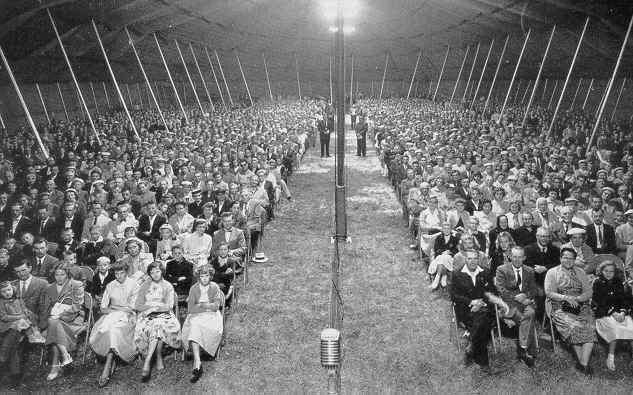
“God led me into the Free Methodist Church when in 1935 I was sanctified in a revival preached by Brother Albert Faust from Pittsburgh,” said West Virginian Dewilla Lemmon of her revival experiences. “Melrose Uphold, a neighbor, and Sister Eva Young, a local Free Methodist preacher, arranged for a meeting in a vacant building near my home. This came as an answer to prayer for me because I had been privately seeking holiness, not really knowing what it was, only that for many months I had craved a pure, perfect condition of heart with God, notwithstanding the knowledge that I had been born again.”
One of Lemmon’s fellow worshipers, “Sister Uphold,” explained to her that the experience she sought was “sanctification.” “So I went to the altar and prayed for it. I also made various restitutions. Brother Faust quoted the Scripture: ‘The Lord whom ye seek, shall suddenly come to his temple.’ And Jesus did just that for me on the night of September 22, 1935 after Brother Faust had delivered his sermon and while Sister Young walked up and down behind me at the altar quoting in a strong voice: ‘This is the will of God, even your sanctification.’”
Sources: http://are.as.wvu.edu/ferber.htm#_edn24
Lemmon, Dewilla. “Camp Memories” journal exercise recorded by Pauline Shahan. July 6, 1980
Appalachian Mountain Religion. University of Illinois Press: Chicago; 1995
http://www.theopedia.com/Great_awakenings
Related Posts: "Warmly Tactile Worship Behavior"
tent+revival camp+meeting mountain+preaching appalachia appalachian+culture appalachian+history history+of+appalachia


