

Denim Quilt, April 2007
4 months ago


 Lorenzo & Eleanor Fugate
Around the world there are legends of human beings who have skin of a unusual shades, folk whose skin color wasn't some variation on brown or pink. These people, as they are remembered by their neighbor's descendants, were usually of a supernatural ilk - elves or gods or some other genre of sentient being. More often than not, these legends have been explained in our oh-so-enlightened civilization as the product of imaginative storytellers, bad translations, and artistic flourishes. Yet, in the relatively recent past, in the hills of eastern Kentucky, there was a clan of folk who seem to have shared a genetic anomaly that, in effect, rendered them blue.(Image from Hazard, Kentucky &
Perry County: A Photographic History)
Madison Cawein began hearing rumors about the blue people when he went to work at the University of Kentucky's Lexington medical clinic in 1960. "I'm a hematologist, so something like that perks up my ears," Cawein says, sipping on whiskey sours and letting his mind slip back to the summer he spent "tromping around the hills looking for blue people."Okay - that is only a slice of the article - - - you should really read the entire bit, frankly - it'll be well worth your time. When you've reached the end you'll understand why, even with diligent searches of the internet, you're unlikely to find many pictures of blue men or women, Kentuckian or otherwise - because those people affected with this genetic anomaly (I won't call it a defect or even a handicap, because I haven't read of any disabling physiological effects) fear, quite logically, that society would drag them out for public exposition. It is sad, really - a physical trait that could add to someone's uniqueness has had to be hidden out of fear that it will be exploited by the foulest pimps of the entertainment and yellow journalism - both printed and video tabloids. Indeed, I find it interesting that most of those folks interacting with the blue Fugates blame the geography of east Kentucky alone for their genetic inbreeding - I can't remember that any of them make the connection between their hesitancy to leave their family connections and the fact that these people, rational beings all, knew how they would be insulted, feared, abused, and most likely, very, very lonely. Ah well.
Cawein is no stranger to eccentricities of the body. He helped isolate an antidote for cholera, and he did some of the early work on L-dopa, the drug for Parkinson's disease. But his first love, which he developed as an Army medical technician in World War II, was hematology. "Blood cells always looked so beautiful to me," he says.
Cawein would drive back and forth between Lexington and Hazard an eight-hour ordeal before the tollway was built and scour the hills looking for the blue people he'd heard rumors about. The American Heart Association had a clinic in Hazard, and it was there that Cawein met "a great big nurse" who offered to help.
Her name was Ruth Pendergrass, and she had been trying to stir up medical interest in the blue people ever since a dark blue woman walked into the county health department one bitterly cold afternoon and asked for a blood test.
"She had been out in the cold and she was just blue!" recalls Pendergrass, who is now 69 and retired from nursing. "Her face and her fingernails were almost indigo blue. It like to scared me to death! She looked like she was having a heart attack. I just knew that patient was going to die right there in the health department, but she wasn't a'tall alarmed. She told me that her family was the blue Combses who lived up on Ball Creek. She was a sister to one of the Fugate women." About this same time, another of the blue Combses, named Luke, had taken his sick wife up to the clinic at Lexington. One look at Luke was enough to "get those doctors down here in a hurry," says Pendergrass, who joined Cawein to look for more blue people.
Trudging up and down the hollows, fending off "the two mean dogs that everyone had in their front yard," the doctor and the nurse would spot someone at the top of a hill who looked blue and take off in wild pursuit. By the time they'd get to the top, the person would be gone. Finally, one day when the frustrated doctor was idling inside the Hazard clinic, Patrick and Rachel Ritchie walked in.
"They were bluer'n hell," Cawein says. "Well, as you can imagine, I really examined them. After concluding that there was no evidence of heart disease, I said 'Aha!' I started asking them questions: 'Do you have any relatives who are blue?' then I sat down and we began to chart the family."
Cawein remembers the pain that showed on the Ritchie brother's and sister's faces. "They were really embarrassed about being blue," he said. "Patrick was all hunched down in the hall. Rachel was leaning against the wall. They wouldn't come into the waiting room. You could tell how much it bothered them to be blue."
After ruling out heart and lung diseases, the doctor suspected methemoglobinemia, a rare hereditary blood disorder that results from excess levels of methemoglobin in the blood. Methemoglobin which is blue, is a nonfunctional form of the red hemoglobin that carries oxygen. It is the color of oxygen-depleted blood seen in the blue veins just below the skin.
I'll be on vacation June 25 - June 29. While I'm away please welcome guest blogger Eric Drummond Smith, of Hillbilly Savants. He'll be serving up some tasty posts for your consideration!
“I’ve been all over Europe, Stirrup, Asia, Africa and parts of Hell, but Braxton County is the best God damned state in the university.” (said after he returned from the longest trip of his life, to the 1893 Chicago World’s Fair).
“Bread is potato’s mother.”
“I could eat soup even it was made over a lizard.”
“It’s just my luck that if it was raining soup, I’d have a fork instead of a spoon.”
“In the old days we did everything by hand-power and awkwardness.”
“They say that money talks, but all it ever said to me was goodbye.”
“I’ve been as lucky as a one-legged man at an ass-kicking!”
“You have to believe in yourself, even if you know you’re wrong.” Shelt Carpenter was an early 20th century fixture as a guide to fisherman on WV’s Elk River. He also entertained at the fishing camps with his fiddle and his tales. He was well known by the professional class of doctors and lawyers from Charleston who brought him to their fishing camps. He showed them where to fish, when to fish, and what bait to use. He told tales, played music, and drank their whiskey.
Family lore has it that Shelton’s great grandfather Jeremiah and his son Solomon were fiddlers. Certainly Shelton’s father Squirrely Bill was, and Shelton passed the tradition down to his son Ernie.
"My father was a good old-time fiddler," said Ernie. He used to keep that fiddle in a large safe that we had. The safe was never locked. He kept that fiddle on the top shelf. Just kept it laying in there on a cloth, never had a case for it. Not a kid on the place ever touched that fiddle or ever even went close to it. I was the first one to take an interest in it when I got big enough. As soon as I hit my first note on the fiddle, he said, ‘The fiddle is yours. I’m through. I won’t be a-playin’ no more. You’re going to do the playing from now on.'"
Ernie Carpenter was awarded the Vandalia Award, WV’s highest folklife honor, at age 80.
From "Play of a Fiddle" by Gerald Milnes
1999, University Press of Kentucky
Appalachia Appalachian+ballads appalachian+culture appalachian+history Elk+River+WV history+of+appalachia old+time+fiddlers Shelt+Carpenter
Probably the most famous boat ever built at Clarington, OH was the Liberty, being the last in the line of packet boats of that name (a packet boat is generally described as a steam boat for conveying cargo, mail, and passengers on a regular schedule.) Way’s Packet Directory 1848-1994 lists an earlier Liberty built in 1857 at Wheeling, WV but "snagged and lost at Twelve Pole Creek, WV, Dec 27, 1862."
The final Liberty was built in 1912 to run from Clarington to Wheeling. It made a round trip a day and whistled each morning about 5:00 AM so that prospective passengers would get up and board the craft for a day's shopping. The Liberty remained in Wheeling several hours each day and brought its passengers back home in the evening.
A change in the Liberty's route marked the decline of packet boating. As people traveled more by rail, then by motor car, the vessel's route was lengthened from this short daily run to a weekly trip between Pittsburgh, PA, and Charleston, WV. At the last, it towed a showboat with the Major Bowes Amateur Hour aboard. It also served as a rescue boat on the lower Ohio River in the famous flood of 1937. Oddly enough, Captain Walter C. Booth was aboard the Liberty when it launched as a brand new boat, and he also rang the last bell to the engineer when it ended its career as a packet boat after its service in the flood rescues.
The Liberty’s whistle was fashioned by a farmer living near Grape Island, WV. It had been previously used on two packet boats, the Ben Hur, and then the Bessie Smith, before being installed on the Liberty. After the Liberty was dismantled in 1938, the whistle went to the towboat Mildred and where it is today is anybody's guess. “It was probably one of the nicest sounding whistles ever to echo among the hills of the upper Ohio Valley,” said The Intelligencer (Wheeling, WV), on Aug. 4, 1960.
sources: http://members.aol.com/RYouCuz/monroeco.htm#fifteen
http://members.tripod.com/~Write4801/riverboats/l.html
Related post: "They'd get up and swing around on the trapeze"
The+Liberty packet+boats Wheeling+WV Clarington+OH appalachia +appalachian+history history+of+appalachia
“Coal is like layers in a layer cake. And where you’ve got it cut by erosion by the valleys, why, it’s just in fingers, and these fingers went miles and miles back in there. Six or seven miles to the back side of the property. And then they retreated the mine back almost to the drift mouth, to the entrance of the mine, so [the Blue Diamond Mine, near Hazard, KY] was quite a successful. We left it hand-loaded, because you know the old say saying, 'If it ain’t broke, don’t fix it.' 
“So this was probably as efficient a hand-loaded mine as you could have. Looking back, it probably wasn’t terribly efficient, but still … for its time it was highly efficient. The secret to hand-loading was to have good haulage. If you could deliver the cars to the hand-loader, and he was reasonably productive. Now, there were certain areas where the people just didn’t like to work particularly, but up around Hazard, they were very motivated people, and they would do very well….
“At that time, most of the people were on piecework. The haulage people weren’t, but the preparation of the coal—what they’d do is they would send the preparation crew in and they would cut, drill, and shoot the coal, … and they would start on the—they would use black powder in that mine and it brought out tremendous lumps of coal, the size of these chairs. And that was where the market was. People wanted lump coal, and … they gave them nothing like the stuff that they burn in power plants today, which is where most of the market is.
“Some of it was given away. It was just sold for nothing. So they made their money on the big chunks of coal. But anyway, what they would do is they would start on the ventilation system at the exhaust end and they’d move on up the current of fresh air so that the black powder smoke would always be blowing away from them. So they would cut, drill, and shoot the thing, and the cutting crews would go in about two o’clock in the afternoon, and they’d be through work by six o’clock that night…. Instead of working an eight hour shift, they would get it done in about four hours. That was the advantage of piecework. You know, they got paid so much for each place they cut, and so … they cut a lot of coal that way. The hand-loaders got paid based on the amount that they loaded, and they were very productive that way.”
G. Gordon Bonnyman
(1919- 2004)
born Knoxville, TN
source: http://tinyurl.com/2hj624
G.+Gordon+Bonnyman Blue+Diamond+Mine Harlan+KY appalachia appalachian+culture appalachian+history history+of+appalachia
Get the ice cream maker out! It’s summer, and there’s nothing so fine as freshly made rock salt ice cream. Just make sure you gather every kid in the neighborhood to take a turn cranking the dang thing.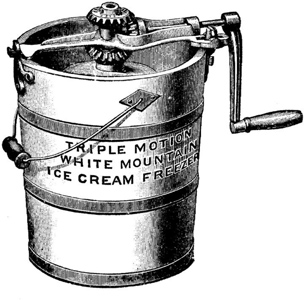 In 1843 Nancy Johnson developed the first hand-crank ice cream maker (her basic design of the freezer is still used today), and received Patent No. 3254 for it. Much of the confusion (and lack of credit) to Ms. Johnson comes from the fact that she sold her rights to William Young for just $200 (still a pretty good sum in those days.) He at least had the courtesy to call the machine the “Johnson Patent Ice-Cream Freezer.”
Johnson’s invention simplified the process of making ice cream, marking a revolution in the history of the dessert. From this time on, anyone could make the very best quality ice cream at home (especially since rock salt, which came to be commonly called "ice cream salt" until the early 20th century, had became a cheap commodity).
The inner can was placed in the outer bucket, and ice and salt were placed between the inner can and outer bucket. The salt lowered the freezing point of the ice, and contact with the inner bucket made a thin layer of milk freeze on the inside of the inner can. The rotating paddle, turned by a crank, scraped off the frozen milk, and let a new layer freeze.
Meantime, by 1919 the ice cream industry was churning out (NOT by hand!) 150 million gallons a year, so if you really didn’t want to wait the time it took to hand-crank your own, you could probably scoot down to the general store for a cup or a cone.
However you take your ice cream, can Ice Cream Socials be far away?
Sources: http://www.zingersicecream.com/history.htm
http://whatscookingamerica.net/History/IceCream/IceCreamHistory.htm
Ice+cream+maker ice+cream+socials appalachia appalachian+culture appalachian+history history+of+appalachia
Shivaree was a nineteenth and early twentieth century Appalachian custom (originally dating back to sixteenth-century France) of teasing a married couple on their wedding night or shortly thereafter. The bride was carried around in a tub at times, and the groom was ridden on a rail. In Tennessee the custom was more commonly called “serenading,” and in West Virginia and western Virginia the term “belling” also referred to this raucous, spontaneous celebration.
"One of the things that people really looked forward to was when a couple got married, they would have what they called shivaree. Everybody that was going to take part in it, they would slip right easy, and nobody would know they was anywhere about until the guns went to shootin'.
They would just march around the house shooting guns one right after another. When they would go so many rounds around the house shooting their guns, and then they would go to the door and stick a fence rail through the door and the man would get on the rail and they would ride him around the house on the rail or down the road.
Sometimes the women would join in and push the man's wife in a tub and carry her. I was shivareed. They put me on a rail and rode me around, and I fell off of it and I just got up and went in the house and told them that was all the riding on a rail I was going to do."
Oral Page, Monroe County, KY
Rosa Walden, Pi Beta Phi Settlement School (Gatlinburg, TN) teacher and Tacoma, Washington native Ruth Sturley participated in a serenade in September 1919, and described the event in a letter to her family: “One of my girls Flora Reagan has a sister who was married . . . and the young people got up the affair in their honor. Abbie [Runyan], Evelyn [Bishop] and I went with three of the school girls and a dozen more youths. Lillard Maples took us girls in his Ford three miles up to the Forks of the river [to the newlyweds’ home]. . . .
We stopped and assembling our forces proceeded to march round and round shouting--blowing ox horns--ring cow bells--sheep bells and I know not what. My noise was produced by clapping together two tin pan covers--then some sticks of dynamite were set off--by this time strange to say the cabin was astir.”
sources: "Monroe County Folklife," Lynwood Montell Ed. Monroe County, KY: privately published, 1975. p 72
http://xroads.virginia.edu/~UG97/albion/cumb2.html#wedding
http://www.lib.utk.edu/arrowmont/Steve/Southern%20Appalachian%20Culture.pdf
Shivaree Belling Serenading appalachian+culture appalachian+history history+of+appalachia appalachia
An important tradition symbolic of the vital place of family in Appalachian life is Decoration Day, usually held on a Sunday in June. Families gather at rural churches and cemeteries to honor the memory of deceased family members. A few days earlier, neighbors and kin gather to mow the cemetery grass, clean the graves, and prepare flowers. Homes are opened to accommodate family members returning from far and wide, communal meals are prepared, and folks gather to make a little music. On Decoration Day, special preaching and church singing pay homage to the dead and bring families and communities closer together. The service is followed by "dinner on the grounds," with large quantities of food cooked by local community members. Graves are decorated with flowers, visited, and stories told of humor, love, and remembrance about family members buried there.
Timing of the event reflects Appalachia's agrarian heritage. Mid-June was a time when crops were planted and growing, but long before harvest, mountain weather allowed for outdoor activity and made travel easier, and flowers were in bloom for decorating graves. It was a betwixt and between time when mountain folk could reflect on their shared family and community heritage. Decoration Day is also a ritual for healing rifts and wounds among living family members. For all families, Decoration Day is a time and place for reconnecting kinship networks and remembering core family values. The tradition of Decoration Day in Appalachia is an old one, but it is a living tradition.
Smithsonian Center for Folklife & Cultural Heritage
Source: http://tinyurl.com/27wzpu
Decoration+Day appalachia appalachian+culture appalachian+history history+of+appalachia
ONE TIME away back years ago there was a boy named Jack. He and his folks lived off in the mountains somewhere and they were awful poor, just didn't have a thing. Jack had two brothers, Will and Tom, and they are in some of the Jack Tales, but this one I'm fixin' to tell you now, there's mostly just Jack in it.
Jack was awful lazy sometimes, just wouldn't do ary lick of work. His mother and his daddy kept tryin' to get him to help, but they couldn't do a thing with him when he took a lazy spell.
Well, Jack decided one time he'd pull out from there and try his luck in some other section of the country. So his mother fixed him up a little snack of dinner, and he put on his old raggedy coat and lit out. …
--from Jack in the Giants' Newground!
 Jack is a kind of trickster-hero, one who is successful through his cleverness. Certainly he is not the admirable prince of fairy tales, but rather a quick witted and not always too scrupulous farm boy. In these tales as told in Appalachia Jack is an ordinary poor boy who achieves success in only one of two ways: either by his wits, or by sheer luck --- and the latter predominates. Quite a contradiction to the “American fairy tale” mythos that honesty and hard work are the means to success!

Caption to the photo reads: "Pike County, Kentucky. Mother of two children (husband is tubercular and bed ridden) supports her family and buys necessary medical supplies with her WPA wages."
Goodman-Paxton Photographic Collection, 1934-1942
University of Kentucky
Digital ID: kukav:64m1:833
Pike+County Kentucky WPA +appalachia appalachian+history history+of+appalachia
"I started working at tanning when I was fifteen years old and I'm 63 now. It's hot. Like putting your nose right on the grindstone all the time-- day in and day out like taxidermy. Deer hides, deer skin products, clothes, bags, coats --- we do the whole thing right from the rawhide to the finished garment. Most of it's deerskin and some cowhide. We don't manufacture anything from cowhide. Deer hide. Everybody wants deer hide. It's softer and has a better feel, but they're hard contemptible things to tan. The enamel in the grain is so easily damaged it's hard to tan them and get a glaze on the finished product. Much more so than cow. But there's no leather that can be made to feel like deerskin. That had that soft suppleness that deerskin has.
"[We sell] locally mostly. To tourists and people who come into the store. Oh, we sell some to other craftsmen. Well, I call them hippie clothes that they make. It varies from year to year, but on an average [we process] about a thousand [hides a year]. Equivalent to a thousand deerskin. We have a fleshing machine and we have power drums. The hides are seldom ever touched by hands. The paddle wheel, all that's necessary to . . . The broiler, hot water. There's very little handwork to it. Splitting machines that split them to a uniform thickness after they're tanned. This day and time, handwork don't count. In this kind of work. There's too much to be done.
"We just, I used to flesh them by hand, used to air 'em by hand. I used to do everything by hand. If I counted my time at normal wages, I'd have to have two or three hundred dollars per hide to come out and make wages. I used to flesh cowhides by hand with a sharp knife about two feet long. Handles on each end. Sharpen it up just sharp as a razor and actually shave that flesh, fat and membrane from the hide . . . hide after hide I shaved that way. Now we can put them through the flesh machine that takes about 30 seconds to clean one up and do a better job than I can do it.
"The little man hasn't much chance now. He can't operate with the big man. No use to try. Getting worse every day. The little man. They're going to push him out. We bought dyes from DuPont for 35 years. Until two years ago. We called them in Philadelphia and they wouldn't sell us a thing."
Kerth Snyder
Greenbank, WV
(1913-1995)
Source: http://www.marshall.edu/library/speccoll/cass/html/kerth_snyder.asp
Kerth+Snyder Deerhide+tanning appalachia appalachian+culture appalachian+history history+of+appalachia
Tennesseans called it the “la-la.” Elsewhere known as the john, the shanty, the shack, the throne, the shed, the relief office—it was the humble outhouse. The little buildings "out back" were as important as any building built before indoor plumbing. This was the building you located as soon as possible when you came to visit, and if your guest was the preacher, you invited him outside on some pretext so he could spot "the necessary room" without asking.
During the 1930s the WPA built thousands of outhouses across America. Three-man teams would spend an average of twenty hours on the construction of each one. Where possible the farm family receiving the new outhouse would pay for the materials (about $17 per outhouse), while the WPA supplied the labor free.
These were outhouses like America had never seen before. The American Red Cross developed the basic design. This design featured an enclosed, vented pit for the waste, was fly and vermin proof, and afforded a standard of cleanliness and sanitation that earlier generations would have considered effete. The building had a concrete floor and a carefully carpentered seat with a close fitting lid to exclude flies. Although many design variations existed, the two basic designs were single seater and two seater.
The two seater was preferred by large families---the second seat had a smaller hole to prevent children from falling through---by those who liked company, and by those who needed a place to set their lantern at night.
“To the right of the narrow entrance was a complete collection of fishing equipment ranging from rods and reels to every size, shape and color of lure imaginable. Directly above these hung an array of ingenious traps which proved to be the scourge of every muskrat and mink for five miles up or down river. In the rear of the little edifice stood two tall bushel baskets containing an endless conglomeration of treasures ranging from outdated articles of clothing to ancient magazines.
“The latter provided amusement and literary driblets for the perusal of the lackadaisical visitor who wished to bide his time informatively. And we must not overlook that standard piece of equipment without which the outhouse would not have been an outhouse--that savior of the toilet-paper-destitute family--the good old catalog. Where would we have been without it? Why do you think the mail-order house was such a thriving success?”
Robert E. Dalton
born Robert E. Lee Dalton, 1938,
in Itman, Wyoming County, WV
In October 1960, Dr. Bernice Eddy gave a talk to the Cancer Society in New York without warning her employer, the National Institutes of Health, in advance. She startled the attendees by announcing that she had examined cells from monkey’s kidneys in which the polio virus to be used in polio vaccines was grown, and had found they were infected with cancer causing viruses. 
She had decided on her own initiative to test extracts by innoculating newborn hamsters, since these animals developed tumors with a type of virus she and Dr. Sarah Stewart had previously discovered in mice and named polyoma virus (one of the early known cancer-causing viruses, it was later named the SE (Stewart-Eddy) Polyoma Virus in their honor.)
The inoculated hamsters developed tumors similar to those induced with polyoma virus. Her inference was clear: There were cancer-causing monkey viruses in the polio vaccine. She warned an epidemic of cancer in America was in the making. When the word got back to her NIH bosses, they exploded in anger.  When the cussing stopped, her superiors crushed Bernice Eddy professionally. Any mention of cancer-causing monkey viruses in the polio vaccine was not welcomed by NIH. They took away her lab, destroyed her animals, put her under a gag order, prevented her from attending professional meetings, and delayed publication of her scientific paper. In the words of Edward Shorter, author of The Health Century, ‘Her treatment became a scandal within the scientific community.’
Later, it became the subject of a congressional inquiry. In the words of Dr. Lawrence Kilham, a fellow NIH researcher who wrote a latter of protest to the Surgeon General’s office, ‘the presence of a cancer virus in the polio virus vaccine is the matter demanding full investigation.’ Her discovery was in fact subsequently validated by Drs. Maurice Hilliman and Benjamin Sweet of Merck. After additional studies, the vaccine was found to not cause tumors in humans, but Dr. Eddy was still restricted by the government from publishing anything about her work.
The work of Dr. Eddy and others led to safe polio vaccines through thorough testing, and provided a major impetus for further research on cancer viruses. The United States Department of Health, Education and Welfare awarded her a Superior Service Medal in 1967.
Bernice Eddy Wooley, Ph.D
(1903-1989)
born Glendale, WV
http://epics.ecn.purdue.edu/abiwt/work/GAW/westvirginia.html
http://www.sv40foundation.org/
http://www.vaccinetruth.org/page_13.htm
Dr.+Bernice+Eddy SE+Polyoma+virus appalachia appalachian+history history+of+appalachia
“The T. stands for Taliaferro. I was named after Booker T. Washington. My people came from Sherrill's Fort in Catawba County, NC. I was brought up by my mother, but in 1920, came to Asheville to live with my father. I went to high school at Bennett in Greensboro, NC and two years at Livingston College in Salisbury. I was sorry I couldn't finish but went into the hotel work. Booker T. Washington's philosophy was ‘drop your bucket wherever you are,’ and I have done well.
“Asheville was hit hard by the Depression. Work was hard to find, but I worked in the Langren Hotel from 1930-1933 and the Battery Park from 1934 until it closed in 1972. When I worked at the Battery Park for 38 years, blacks couldn't go in the front door - now I am living here!
“I had a ‘hotel reputation.’ During those times there weren't many jobs open to blacks - chauffeuring, working at Oteen or in hotels. It was hard getting work in the railroad unless one had good connections. Many blacks were on WPA but I was always employed. Bellmen were paid $1 a day and depended on tips and didn't anticipate Social Security, where benefits were based on how much they had paid in.
“The Langren Hotel was one of the largest in the area in the 20's, catering mostly to business men. A good room cost $1.50 a night and a corner room $3. The price was comparable to the Battery Park but the clientele was different. The Vanderbilt and Battery Park catered to tourists. 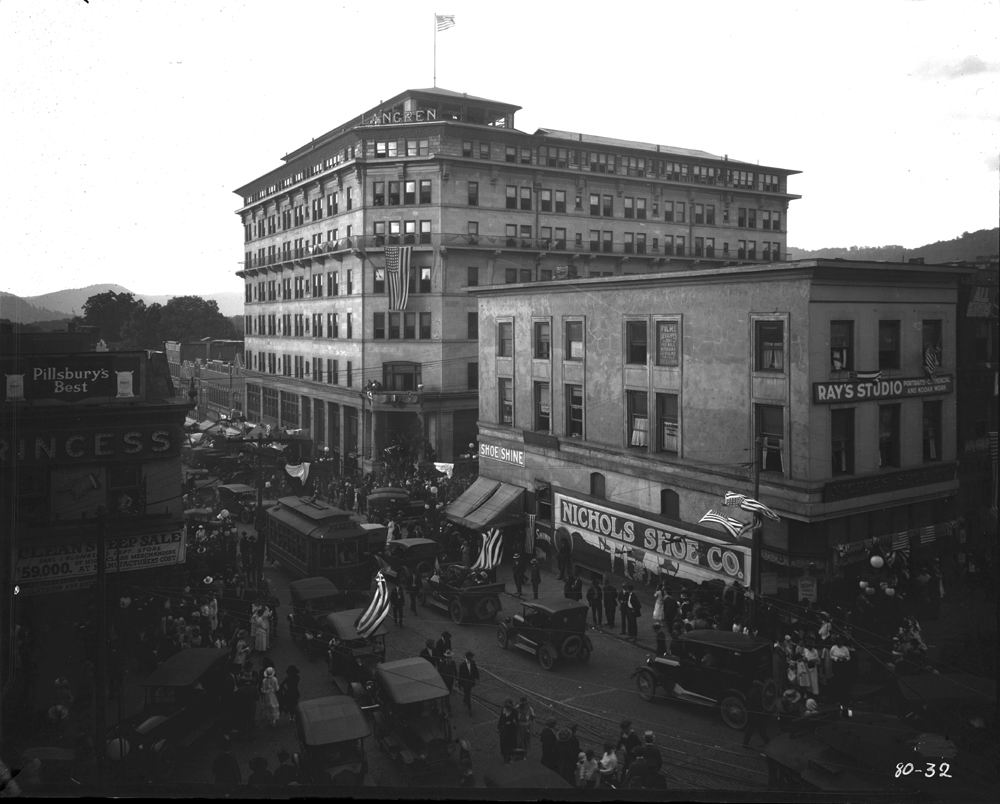
“In 1933 I lost my job at the Langren and went to Florida for the season. I returned to my wife and daughter and, after applying around, came here and worked under Charles Sisney, a famous, widely known bell man who died in 1935.
“My first wife was 16 when we married, and the marriage broke up. In 1936 I remarried a lady with the same name as a character in "Amos 'n' Andy" radio program. [Ruby Taylor]
“We were married on Saturday, August 1936, and the following day Martin Moore confessed to murdering Helen Clevenger, who was visiting the hotel with her uncle in room 224. The sheriff hired a detective from New York who found a weapon in Moore's house. Moore was tried, convicted and executed. People in the hotel were reluctant to go on the 2nd floor.
“I was off duty during the time of the 1936 murder and was not questioned but there were bad feelings about this. Some think it was never solved. Some think the son of the manager was to blame. It upset this city and it took 8-10 years for the people to relax. Room #224 was permanently blocked. Although I kept my thoughts to myself, I don't think Moore, a relatively new night janitor, had the mentality to commit the crime.”
Booker T. Sherrill
Asheville, NC
(1907-2003)
Source: http://toto.lib.unca.edu/findingaids/oralhistory/VOA/S_Z/Sherrill_B.html
Asheville+NC Langren+Hotel appalachia appalachian+history appalachia history+of+appalachia
Ahhhh, dandelion wine! The popular name comes from dent de lion, French for "lion's tooth," referring to the teeth on the leaves. Wine is made from the heads. Choose dandelions from an open field far from any insecticide spraying. Pick early in the season when the leaves of the plant are still tender. Flowers that have just opened are best. To make dandelion wine: "Four good quarts of dandelion blossoms, four pounds of sugar, six oranges, five lemons. Wash dandelion blossoms and place them in an earthenware crock. Pour five quarts of boiling water over them and let stand 36 hours. Then strain through a muslin bag, squeezing out all moisture from dandelions. Put the strained juice in a deep stone crock or jug and add to it the grated rind and juice of the six oranges and five lemons.
Tie a piece of cheese-cloth over the top of jug and stand it in a warm kitchen about one week, until it begins to ferment. Then stand away from stove in an outer kitchen or cooler place, not in the cellar, for three months. At the end of three months put in bottles. This is a clear, amber, almost colorless liquid. A pleasant drink of medicinal value. Aunt Sarah always used this recipe for making dandelion wine, but Mary preferred a recipe in which yeast was used, as the wine could be used a short time after making."
For dandelion wine made with yeast: "Four quarts of dandelion blossoms. Pour over them four quarts of boiling water; let stand 24 hours, strain and add grated rind and juice of two oranges and two lemons, four pounds of granulated sugar and two tablespoonfuls of home-made yeast. Let stand one week, then strain and fill bottles."
Source: "Mary at the Farm and Book of Recipes Compiled During Her Visit Among the "Pennsylvania Germans," by Edith M. Thomas, 1915.
http://fohn.net/dandelion-pictures/dandelion-wine-recipe.html
http://enature.com/fieldguides
dandelion+wine appalachian+culture appalachian+history history+of+appalachia appalachia
"Here are some of the Indian tales I have heard. I don't remember the names of any of the whites or Indians involved in these stories. The old folks used to tell us children these tales while we sat before the fireplace at night. "In Indian times, the whites would put pickets out about the camp or fort to keep the Indians from slipping upon them. At one place, several of the pickets had disappeared. The officers placed a man on duty on night, with orders to shoot anything he saw moving. Pretty soon he noticed an old sow rooting in the leaves under the trees and it came closer and closer. He hated to shoot an old sow that would later make good meat. But he had his orders to shoot, which he did. At the crack of his rifle, the saw r'ared upon its hind feet and feel over backwards. It proved to be an Indian in an old sow's skin, and this was the way the Indians had been slipping up and killing and carrying away the other pickets.
"Another Indian story was often told to us by the older folks. The Indians took a woman captive and took her into Kentucky. After a few days, they let her go and get firewood in the evenings. Each day she went further and further. Finally, she ran into the woods and tried to get back to her old home. At night, she hid in a hollow log. The Indians followed her with a dog. The dog got ahead of the Indians and went into the log after her, but she choked it to death. Spiders wove a web over the open end of the log. The Indians came and saw the spider web. They were so mad they struck the log with their tomahawks and went away. She got out next morning and found her way back to the settlements. She had little to eat in her travels. At one place, the path forked and while she was debating which way to go, a little bird fluttered in front of her and darted up stream. She was still undecided which way to go. The bird came back and fluttered away in the same direction. She followed the bird and got home safely."
Interview with Nannie Sykes Kerr Dotson
on Oct. 11, 1951 at Millard, VA
(born 1882 in what is now Clinchco, Dickenson County, VA)
http://ftp.rootsweb.com/pub/usgenweb/ky/pike/misc/sykesetc.txt
Related posts: "The Jack Tales. Not just beanstalks."
"Now I've got my Tailypo!"
Nannie+Sykes+Kerr+Dotson Indian+tales appalachia Appalachian+tales,appalachian+culture appalachian+history
I don't want you any more, mama
Ain't no use in you hanging around
For I found another mama,
And now I am Chicago bound
You've been fooling me, baby
You've been telling me your lies
When I thought you were an angel
Just sent down from the skies
 Sing those parting blues to me, sweet Nell
When you leave you'll leave me sad
'Cause my daddy's gone and left me
I just wouldn't treat him right
You've been fooling me, baby
You've been telling me your lies
When I thought you were an angel
Just sent down from the skies
I wouldn't give him much loving
Wouldn't stay home at night
Now I hear the train a-coming
He has gone out of sight
You've been fooling me, baby
You've been telling me your lies
When I thought you were an angel
Just sent down from the skies
In the late 1920's, A.P. Carter, his wife Sara, and his brother's wife Maybelle came together to make music as The Carter Family. Their music, a composite of traditional ballads, blues songs, gospel numbers, heart songs, and instrumentals both reflected and shaped the tastes of the rural south. Together, their career spanned a little over two decades and nearly 300 recordings. Maybelle became the matriarch of a great country music dynasty as the mother of the Carter Sisters.
Despite dying in relative obscurity, A. P. Carter was inducted into the Nashville Songwriters Hall of Fame in 1970. In 1993, his image appeared on a U.S. postage stamp honoring the Carter Family. In 2001 he was inducted into the International Bluegrass Music Hall of Honor. Today there are Carters in the very veins of country music.
sources: http://countrymusic.about.com/od/cdreviewsmz/gr/blunbrkncircle.htm
http://www.bluegrasswest.com/ideas/carter.htm
http://famouslikeme.com/35061/article.html
AP+Carter Carter+Family bluegrass Appalachian+history Appalachian+culture Appalachia history+of+Appalachia
“Such things as shelling peas or shucking corn took place on the front porch when friends and relatives came over to help. During the hottest time of the summer, some front porches that were screened, contained beds to sleep in. These were called "sleeping porches." The residents of the home would escape the heat of the upstairs bedrooms by sleeping on the porch in the summer. “Families spent time on porches in the evenings watching other people going for strolls, or waiting to see if someone would drop by. Everyone knew who their neighbor was. If someone moved in, neighbors knew who they were, who their kin were, and where they were from. New neighbors expected the old neighbors to drop by and would have felt very unwelcome if they didn't.
“You could tell who was visiting who and who was courting who, by walking past the front porches of the houses. Some people think that the arrival of the automobile moved socialization from the front porch to the front seat of a car, and caused the demise of front porch life, and the front porch itself. With the arrival of the 20th century, many new houses were built completely without front porches. It is a pity, because the front porch allowed everyone to see what was going on in the neighborhoods. Young and old alike were entertained, and everyone was included in activities.”
Lady Lydia Speaks, Homeliving Helper blog
http://homeliving.blogspot.com/search?q=shelling+peas
Front+portch appalachia appalachian+culture appalachian+history history+of+appalachia
They’ll have plenty of time to regroup during the slow months of July and August, but right now it’s the end of the spring honey flow, and apiarists throughout Appalachia are knee-deep in the golden goo.
Beekeeping is an age old, and surprisingly little changed, ritual. Here’s an early 1930s ad for AG Woodman Co. that could’ve easily appeared in Grit newspaper or the Farmer’s Almanac of that era. The beekeepers reading this ad would have been almost as familiar with the smokers, supers and frames we use today as they would’ve been with bee equipment from 75 years prior to their own time. That’s because the really big innovations that moved bee culture from hunting to cultivating all clustered around the 1850s & 1860s.
The “father of modern beekeeping,” Rev LL Langstroth, published “The Hive and the Honeybee” in 1853. In it he explained how his patented movable frame hive took advantage of the principles of Bee Space. That "magical space" is defined as "greater than 1/4 inch, but smaller than 3/8 inch", and is recognized by the bees as OPEN space for occupation by bees only. Any spaces smaller or larger are subject to having comb built in them.
By utilizing this new finding, Langstroth was able to design a hive where the bees did not seal parts together by burr comb, hence allowing frames to be removed one by one, inner covers not sealed down to frame tops, and bee walk space on the tops of frames that had another hive body with frames on top of the lower hive body. A Langstroth hive filled with bees could be disassembled, each part inspected for status or disease, and reassembled without damage to comb or bees. This could NOT be done with any other "housing" for bees that existed in 1851!
The honey flavors of Appalachia draw from an amazingly broad list of nectar sources: alfalfa, apple blossom, aster, basswood, black locust, blackberry, buckwheat, Canadian thistle, clover, sweet clover, white dutch clover, corn, dandelion, goldenrod, Japanese knotweed, milkweed, paulownia, prickly ash, pussy willow, red maple, redbud, Russian sage, sourwood, starhorn sumac, sunflower, tree of heaven, tulip poplar, and witch hazel.
But don’t go looking in the supermarket for some such construct as “Appalachian Honey.” Commercial producers often mix honey imported from Canada, Argentina, Mexico, Brazil, and elsewhere to achieve the final “genuine pure natural honey” you see labeled in stores. Identifying the regional flavors in commercial honey is further complicated by the fact that apiaries break down their product into three general categories of white honey, extra light amber, or light amber, usually without regard to the nectar source (clover honey & orange blossom being two obvious exceptions.) Best to keep a few hives out back of the place and literally taste the micro-flora of your own little piece of Appalachia.
sources: "The Hive and the Honeybee" LL Langstroth, 1853
www.ams.usda.gov/fv/mncs/honey.pdf
http://tinyurl.com/2evare
LL+Langstroth beekeeping Appalachian+history Appalachian+culture history+of+Appalachia Appalachia
Home-Coming (1946)
And I've come back to you,
Mountain Earth--
Come to laugh
And sorrow
And sing--
To dig my songs up
From your soil
And spin a melody
Of corn blades,
Top-fodder,
Crab-grass,
And a clean-plowed furrow.
I've come to sing and grope--
With a people who know
Deep songs,
Who stumble up
A long crooked road....
I've come because
Your great silent agony
Echoed everywhere
And the weary foot-steps
Of my old Dad
Still sound upon the mountain
Where his sweat dripped down
To water your dirt....
Don West achieved success as one of the foremost southern regional poets of the twentieth century. He was at different times a labor organizer, political radical, preacher, progressive educator, and outspoken spokesperson for human equality in the generation before the civil rights movement. Although he is best known for his literary works, West was also an effective proponent of the Social Gospel, embraced by some of the South's most dedicated religious reformers. Born in 1906 in Devil's Hollow, near Ellijay in Gilmer County, Donald L. West grew to young adulthood in the north Georgia mountains. The eldest son of a farmer, he took pride in the independent spirit that had made his forebears nonconformists who opposed slavery in the antebellum years. This heritage of independence expressed itself in West's career, during which he often found himself at odds with the folkways and beliefs of the communities in which he lived and worked. Throughout his life he remained committed to a progressive view of ethnic and racial harmony, which linked him with his personal family history.
In 1964 West and his wife helped to open the Appalachian South Folklife Center at Pipestem, West Virginia, where West worked until his death in 1992.
Source: http://www.georgiaencyclopedia.org/nge/Article.jsp?id=h-2569&hl=y
Don+West Georgia+poets appalachia appalachian+culture appalachian+history appalachian+language history+of+appalachia
"Long ago -- hilahiyu jigesv -- when the Sun became angry at the people on earth and sent a sickness to destroy them, the Little Men changed a man into a monster snake, which they called Uktena, "The Keen-Eyed," and sent him to kill her (the Sun). He failed to do the work, and the Rattlesnake had to be sent instead, which made the Uktena so jealous and angry that the people were afraid of him and had him taken up to Galunlati, to stay with the other dangerous things. He left others behind him, though, nearly as large and dangerous as himself, and they hide now in deep pools in the river and about lonely passes in the high mountains, the places the Cherokees call "Where the Uktena stays." Those who know say the Uktena is a great snake, as large around as a tree trunk, with horns on its head, and a bright blazing crest like a diamond on its forehead, and scales glowing like sparks of fire. It has rings or spots of color along its whole length, and can not be wounded except by shooting in the seventh spot from the head, because under this spot are its heart and its life. The blazing diamond is called Ulun'suti -- "Transparent" -- and he who can win it may become the greatest wonder worker of the tribe. But it is worth a man's life to attempt it, for whoever is seen by the Uktena is so dazed by the bright light that he runs toward the snake instead of trying to escape. Even to see the Uktena asleep is death, not to the hunter himself, but to his family.
Of all the daring warriors who have started out in search of the Ulun'suti only Aganunitsi ever came back successful. The East Cherokee still keep the one that he brought."
In his quest, Aganunitsi searches distant gaps and peaks in the Smokies before he "went on to Duniskwalgunyi, the Gap of the Forked Antler, and to the enchanted lake of Atagahi, and at each found monstrous reptiles, but he said they were nothing." Today we know Duniskwalgunyi as "Chimney Tops," one of the few instances of a bare rock summit in the Smokies.
sources: (From "Myths of the Cherokee" by James Mooney,
Nineteenth Annual Report of the Bureau of American Ethnology 1897-98, Part I. [1900])
www.answers.com/topic/chimney-tops
Cherokee+myths Uktena Aganunitsi Chimney+Tops Smokies appalachia appalachian+culture appalachian+history history+of+appalachia
The United States of Appalachia is now in paperback!
"Biggers has fashioned a masterpiece of popular history."
--Citizen-Times, North Carolina
“Jeff Biggers opens a new window on the complex history of the region called Appalachia. He takes a hard but affectionate look at both the myths and the facts, and what he finds is by turns sobering and thrilling. Drawing on the contradictions, layers, and range of what is known as mountain culture, he shows that nothing is quite what it seems, and that to understand American history it is essential to know Appalachian history. Biggers tells his story with verve and vivid detail, a story that will at once provoke and inspire.”
-- Robert Morgan, author of Gap Creek and Brave Enemies
Excerpt: The United States of Appalachia:
How Southern Mountaineers Brought Independence, Culture
and Enlightenment to America (Shoemaker and Hoard)
by Jeff Biggers
INTRODUCTION
Appalachia needs no defense—it needs more defenders
Beyond its mythology as a quaint backwater in the American imagination, Appalachia also needs to be embraced for its historic role as a vanguard region in the United States.
Vanguard Appalachia? The very word--vanguard--conjures up a plethora of images, though none in Appalachia. It’s Thomas Jefferson at the Continental Congress in Philadelphia; it’s George Washington plotting his campaign at Yorktown. William Lloyd Garrison, the great New England abolitionist, was in the vanguard of the antislavery movement; his transcendentalist Boston neighbors stood in the forefront of nineteenth-century American literature. The New York Times, in an era of yellow journalism, typified the vanguard press; the Village Vanguard jazz club in New York City provided the nation’s music innovators with its hallowed stage. Martin Luther King, Jr., at the front of the civil rights movement, would be its modern political symbol. Expatriate Gertrude Stein might be its literary icon.
These are all reasonable examples, of course. And yet, would you believe me if I said an Appalachian preceded, led or influenced every one of these historic events or gatherings? That years before Jefferson completed the first draft of the Declaration of Independence, a backwoods settlement had already stunned the British Crown with its independence as a "dangerous example for the people of America." That an alliance of Southern Appalachian insurgents orchestrated their own attacks on British-led troops and turned the tide of the American Revolution. That a humble band of mountain preachers and writers published the first abolitionist newspaper in the nation and trained the radical Garrison. That a Cherokee mountaineer invented the first syllabary in modern times. That a back-hills young woman astounded the Boston literary circles in 1861, with the first American short story of working-class realism to be published in the Atlantic Monthly. That a young publisher from Chattanooga actually took over the New York Times and set its course for world acclaim. That the "high priestess of soul" put a spell on an audience at the Village Vanguard in 1959, with her blend of folk, jazz, gospel, country, and Bach-motif riffs she had learned in her Southern Appalachian hamlet. That a self-proclaimed "radical hillbilly" galvanized the shock troops of the civil rights movement and returned an African spiritual and labor song as its anthem. That the first American woman ever awarded the Nobel Prize for Literature was recognized for her family memoirs of West Virginia as much as for her literary contributions to the Far East.
Few regions in the United States confound and fascinate Americans like Appalachia. No other region has been so misrepresented by the mass media. Four paradoxical images have enjoyed incredible staying power: pristine Appalachia, the unspoiled mountains and hills along the Appalachian Trail, notwithstanding centuries of warfare, the wholesale destruction of the virgin forests by the timber industry, and the continual bane of strip mining; backwater Appalachia, home of the "strange land and peculiar people" in thousands of stories, novels, radio and TV programs and films, even though the region has produced some of the most important writers, artists, scientists, and politicians in the country; Anglo-Saxon Appalachia, once defined by Merriam-Webster’s Collegiate Dictionary as a mountain region of "white natives," despite its role as a crossroads of indigenous cultures and vast immigrant and African American migrations for centuries; and pitiful Appalachia, the poster region of welfare and privation, the haggard faces greeting Charles Kuralt on CBS News on Christmas 1964, regardless of the tremendous wealth generated by the mountain range’s mineral resources, timber, and labor force in the mines, mills, and factories, and today’s tourist industry.
Untouched wilderness, poor white backward hillbillies.
In his best-selling analysis of the Buffalo Creek mining dam disaster in the 1970s, Everything in Its Path, eminent Yale sociologist Kai Erikson captured these stereotypes in an enduring judgment of Appalachian mountain culture: "It helps breed a social order without philosophy or art or even the rudest form of letters. It brings out whatever capacity for superstition and credulity a people come endowed with, and it encourages an almost reckless individualism."
For most readers, the blood-curdling acts of Appalachian man’s inhumanity to civilized man in the mountains, replete with inbred banjo pickers, violent feuds, moonshine, sexual deviltry, and miasmic gorges, have been put to rest. We are savvy enough to refrain from uttering "hillbilly" in mixed company. Li'l Abner, Barney Google and Snuffy Smith, Hee Haw, and The Andy Griffith Show are out; best-selling authors Barbara Kingsolver, Charles Frazier, Homer Hickam, and Robert Morgan are in. Sure, bizarre and offensive portrayals of Appalachians occasionally take place--during the research and writing of this book, CBS talent scouts combed the Southern mountains for corncob-piped rubes to participate in a proposed reality-TV show based on The Beverly Hillbillies; Abercrombie & Fitch dressed their manikins with a "West Virginia, It’s All Relative" T-shirt; and a horror film, Wrong Turn, featured a promo about "six young people who find themselves being hunted by inbred cannibals in the woods of West Virginia" -- but we’ve come a long way from the time of literary critic H. L. Mencken, who openly discussed reducing the birthrate of "inferior orders, for example, the hillbillies of Appalachia."
Still, the region’s fame or infamy has forced writers and critics to dwell on what has been done to Appalachia, rather than what Appalachia has contributed to the world. For every Deliverance and its sodomites, we are quick to recall The Waltons in our collective memory, or more recently, the best-selling novel and Oscar-nominated Cold Mountain film. Or, in more tragic terms, for every Private Lynndie England, the defamed cigarette-lipped scapegoat of the Abu Ghraib prison scandal in Iraq, who hails from Fort Ashby, West Virginia, there is a heroic Private Jessica Lynch, from Palestine, West Virginia, molded into the image of Sergeant Alvin York, the Tennessee mountaineer and America's most famous soldier.
Appalachia, as author Wallace Stegner once remarked about the American Southwest, has been more a process than a place. Some critics would even say it has become an invention of its own. Sociologist Allen Batteau once voiced a common feeling that "Appalachia is a creature of the urban imagination." Since the first Spanish conquistador was informed of its existence in 1528 by distant tribes in Florida, Appalachia has certainly bewildered its explorers and inhabitants with its boundaries, its mystical forests, and its meaning.
But Appalachia does exist, both as a range and as a region. Beyond any singular culture, however, any "real Appalachia," the region has also endowed the nation with an enduring and conflicting treasury of innovations and innovators. That treasury, though, is rarely viewed beyond the surface or a few honorable exemplars -- high lonesome singers and banjo players, black-faced coal miners, wizened front-porch storytellers -- trotted out every so often to represent the entire region.
Appalachian author Jim Wayne Miller once recounted an old tale about flat-boaters who traversed the Tennessee River at night, passing house after house with a "great fire burning, people dancing, always to the same fiddle tune." The boatmen didn’t realize they were caught in the "Boiling Pot" eddy, going in circles around the same house and its unchanging scene, unaware of the region’s greater wonders hidden in the forests like ginseng.
This is Appalachia’s best-kept secret: Far from being a "strange land with peculiar people," the mountains and hills have been a stage for some of the most quintessential and daring American experiences of innovation, rebellion, and social change.
This book is an attempt to get off that flatboat and enter another part of Appalachia, or, in fact, we should say Southern Appalachia, that mountain spine and its valley tributaries that trundle along the eastern and Southern states from northern Alabama to southwestern Pennsylvania. (The Appalachian Regional Commission actually defines Appalachia from southern New York to northern Mississippi.) It is not a definitive history of the region; instead, it is a portrait of a hidden Appalachia on the cutting edge, full of revolutionaries and pioneering stalwarts, abolitionists, laborers, journalists, writers, activists, and artists overlooked among the lineup of conventional Appalachian suspects.
Putting aside the banjos and pot-lickers, casting aside both the wearisome slurs and sentimental postcards, and taking a break from recounting the evil deeds done unto mountaineers, this book seeks to show how a remarkable procession of Appalachian-born innovators have gone from these hills, as Thomas Wolfe wrote, to find and shape the great America of our discovery.
Excerpted from The United States of Appalachia: How Southern Mountaineers Brought Independence, Culture, and Enlightenment to America by Jeff Biggers. Copyright © 2005 by Jeff Biggers. Reprinted by permission of Shoemaker & Hoard, Publishers, an imprint of Avalon Publishing Group, Inc.
For more information, see www.jeffbiggers.com
Jeff+Biggers The+United+States+of+Appalachia appalachia appalachian+culture appalachian+history history+of+appalachia

Colonel Ruby Bradley (1907-2002) was the US Army’s most highly decorated nurse. She was born on a farm outside of Spencer, WV and taught four years in one-room schools in Roane County before she became an Army nurse in 1934. Bradley served in the Philippines in 1941 where she was captured by the Japanese after Pearl Harbor, and was a POW until February 1945. While a prisoner of war she continued to work as a nurse in the prison camp assisting with 230 operations and 18 births.
“In spite of all the preventive measures, the number of dysentery cases increased to such an extent that a small cottage was obtained to house these patients. This cottage became the camp hospital. There were usually more patients than beds, so the less acutely ill were treated in the barrack, while the acutely ill and contagious cases were treated in the camp hospital.
“All bed linen and clothing used by patients was boiled and exposed to the sunshine for two hours after the drying period. When soap became practically nonexistent, a soap product was made from lye obtained from wood ashes and then mixed with fats or oils. This was an effective cleaning agent although it was very hard on the hands. The making of this soap product illustrates the use to which ‘home town talent’ was put.
“The question is – when an individual returns to a world of free people will he be able to forget everything that he has experienced, will he be embittered, broken and disillusioned, or will he have enough strength to find purpose and meaning in life again? Should he be expected to go counter to the laws of human behavior by truly forgetting his experience or should he concentrate upon whatever small good the experience provided, guard those small bits of good, using them as chinking to rebuild the wall of his life?”
As a veteran of World War II and the Korean War, Ruby Bradley was the third woman in Army history to be promoted to the rank of Colonel. Her military record included 34 medals and citations of bravery, including two Legion of Merit medals, two Bronze stars, two Presidential Emblems, the World War II Victory Medal and the U.N. Service Medal. She was also the recipient of the Florence Nightingale Medal, the Red Cross' highest international honor.
source: http://history.amedd.army.mil/ANCWebsite/bradley.htm
Related posts: "Do you remember Grandma's lye soap?"
Colonel+Ruby+Bradley Army+nurses appalachian+culture appalachian+history history+of+appalachia appalachia
It’s the whispering foil, the flexatone, or simply, the musical saw.
Some consider the musical saw an American folk musical instrument believed to have gotten its start somewhere in the Appalachian Mountains in the 19th century (oh, I suppose we can allow that carpenters and lumberjacks all over the world have discovered that their tool could make sounds, but still….)
The region has a rich history of improvised instruments and the peculiar melodic nature of the saw would tend to lend itself quite nicely to mountain music. Instruments always have a grouping of other instruments that work particularly well as a musical blend. For the musical saw, it would be those we traditionally identify with the music of Appalachia: Harmonica, fiddle, dulcimer, and various rhythm instruments.
To create a note, the player (or “sawyer”) bends the blade into an S-curve. The parts of the blade which are curved are dampened from vibration, and do not sound, while at the center of the S-curve a section of the blade remains relatively flat. This is called the "sweet spot" which vibrates across the width of the blade, producing a distinct pitch. The sound is created by drawing the bow across the back edge of the saw at the sweet spot, or by striking the sweet spot with a mallet.
Musical saws have been produced for over a century. In the early 1900s, there were over ten companies in the United States alone manufacturing saws. These saws ranged from the familiar steel variety to gold-plated masterpieces. The first major U.S. marketer of musical saws, Mussehl & Westphal of Fort Atkinson, Wisconsin, sold over 30,000 units a year during the 1920s and early 1930s.
A traveling Missouri showman named Leon Weaver was among the first to have great success with saw music as he traveled across the South, performing the act “Weaver Brothers n’ Elviry."  From this humble beginning, the musical saw has now branched out into every conceivable musical genre. Even respected music critic Lucille Fletcher predicted in her 1938 New Yorker article, "The Apotheosis of the Saw," that the saw would outgrow its vaudeville roots to become an accepted orchestral instrument.
But wherever it goes, its haunting wail harkens back to the mountains of its birth.
sources: www.museumofmakingmusic.org/index.php?option=com_content&task=view&id=60&Itemid=4
http://weeklywire.com/ww/07-20-98/austin_music_feature2.html
www.oddmusic.com/gallery/om21800.html
homerledford.com
musical+saw Weaver+Brothers+and+Elviry Leon+Weaver appalachia appalachian+culture appalachian+history history+of+appalachia

“There's a big old . . . there's a big old boar possum come in here. I . . . I couldn't believe it. I didn't know what it was. And it come in here and in four days, I believe, three or four days, he killed . . . in my chickenhouse out there he killed sixteen big hens. He come out there and he'd knock 'em off of the roost and all the . . . all he got was the head.
“And I couldn't figure what it was, you know. I thought it was a . . . I thought it must be a weasel or . . . so one night I backed my truck down there . . . I backed my truck out there and backed down there where I could see and I . . . I was sitting out there in the back of the truck a laying for him.
“And he come around the barn, come in there. He went in there, buddy, and he knocked two of them chickens off of that roost. He come around that barn so fast I couldn't . . . I couldn't tell . . . I looked . . . I said, "That looked like a big possum." Well, this dog was there and by time I come around he got gone, and that made sixteen of them big hens, buddy, in four days. He'd come in there and knock 'em off the roost. I'd go out there and they'd just be laying there.
“So I fastened everything up, and where you first come in the barn, you know, there . . . he . . . he had the hole in the lower side down where he come in the chickenhouse. I went out there and I set me a big trap, a big double-jaw trap down there, and sure enough I walked out there the next morning, there he was. Buddy, that . . . I mean that was a big long-legged possum. I never . . . I didn't know a possum would . . . would catch a chicken. And I had a big old ball peen hammer and I walked around there. Possums are hard to kill. And [chuckle] I said, ‘Son, I'm going to give you a lick for every chicken that you killed from me.’ "
Clarence R. Wells
Family Farm Oral History Project
University of Kentucky
http://tinyurl.com/25p45j
possum clarence+r.+wells appalachian+history appalachian+culture history+of+appalachia appalachia


