
Denim Quilt, April 2007
4 months ago


Originally published at Hillbilly Savants by John Kerns
 The entrance to Old Gray Cemetery in Knoxville, Tenn. The historical marker reads: "Old Gray Cemetery, incorporated in 1850, is the resting place of William G. Brownlow, Tennessee Governor and U.S. Senator, as well as two other U.S. Senators, eight U.S. Congressmen, 26 mayors of Knoxville, and numerous ambassadors, judges, editors, artists, authors, educators, military leaders, physicians and industrialists."
Any history buff just has to get a kick out of
Named after English poet Thomas Gray, who wrote "Elegy in a Church Courtyard," the gentle slopes of Old Gray lie between what is now an adult bookstore and a cabinet manufacturer. Out of downtown, you take Broadway, a noisy four-lane that guides motorists through the blighted urban holes beneath Interstate 40. Just over a long hill from the highway overpass, the cemetery sits to the left. Pass through the narrow iron and marble gates of Old Gray and the noise and bustle of the city falls away.
Here are a few pictures from today's excursion up to the cemetery. If you want to see all of them, go here.


 The grave of one of the more fascinating characters that lies in Old Gray, William G. Brownlow. A pro-slavery, yet strict Union man, Brownlow was a controversial national figure. His paper, The Knoxville Whig had a huge distribution, due largely to Brownlow's editorials. After the war, he was elected Tennessee's first Reconstruction Governor, and then to the U.S. Senate.

 The grave of Charles McClung McGhee, railroad tycoon and founder of Knoxville's Lawson-McGhee library.
 Old Gray's north wall. On the other side is Knoxville National Cemetery.
 One of the Victorian ladies that keeps watch over the cemetery.
 A Confederate soldier.
 Looking northwest.

 Two more ladies.


 St. James Episcopal Church stands in the background as afternoon shadows fall upon Old Gray.
 A broken headstone.
 The grave of Charles McGhee Tyson, after whom Knoxville's airport is named.
 Looking south.
Originally posted at Hillbilly Savants by Byron
Like old dinosaurs lurking in the background, these dilapidated buildings of our ancestors sit in various states of disarray throughout all of Appalachia.


Some still being used, small repairs visible, keeping out the rain.


My grandfather would question any man's worthiness that didn't own a barn.


Many a country boy and girl has spent a good portion of their childhood inside these clapboard fortresses.


Cows, horses, pigs, and even us Hillbillies found shelter and comfort in their confines.


If these old buildings could talk, what a tale they would tell!
All of the above pictures were taken by me and were all within a 5 mile radius of my house in Corryton, TN. Click on this link to see all of the barns that I photographed today.
Originally posted at Hillbilly Savants by Mike Mason
In 1939, the Hydro-Electric boom in the Appalachian Mountains was reaching it’s peak. Rural hollers (a steep valley, for our non-resident readers) throughout the region were being flooded to bring modern technologies, jobs and, ironically, flood control to the Southern Appalachians. I’ll leave the debate for whether or not organizations such as the Army Corps of Engineers, the Tennessee Valley Authority and Appalachian Power have served the region for the greater good to others with more introspective opinions on the subject. I want to focus on one community, lost under seventy feet of water of the New River. The place is know as Dunkard's Bottom today but to the residents of the community, it was Mahanain. It’s kind of ironic given the Biblical history of the city that shares this name, meaning “Host”, would see similar fate.
John Buchannan, agent for the Wood's River Company and assistant surveyor of Augusta County, made his exploratory trip to the region in the fall of 1745. He found inhabitants already in the New River area (The New River was labeled “Wood’s River” on early survey maps due to the Company’s intensive mapping of the area). These inhabitants were German eccentrics of German Seventh Day Baptists from the Ephrata Society in Lancaster County, Pennsylvania, called Dunkers Dunkard's. (Many people incorrectly refer to this sect of the Anabaptists as Dunkard's. The word "Dunker" was actually a anglicized corruption of the German Word "Tunker", which means "dipper" or immerserer referring to the mode of baptism practiced by this group.) It is reported that 900 acres of rich river bottom-land was chosen and surveyed for the colony, which later had the only mill west of New River. However, many of the Dunkards became unhappy with their lot in the wilderness on the frontier of a new nation. They were said to be "odd" people who were very clannish and shunned by other settlers.
In 1749 the Moravian missionaries noted that in the region of Dunkard's Bottom they found a "kind of white people who wore deer skins, lived by hunting, associated with the Indians and acted like savages." The Dunkard's were also pacifists. They were ill suited for life on Virginia's wild frontier. Thomas Walker describes the Dunkard's as: "A Sect of People who call themselves of the Brotherhood of Euphrates, and are commonly called the Dunkard's, who are the upper Inhabitants of the New River....The Dunkard's are an odd set of people, who make it a matter of Religion not to Shave their Beards, lay on beds, or eat flesh, though at present, in the last, they transgress, being constrained to it, they say, by the want of a sufficiency of Grain and Roots, they have not long been seated here. I doubt the plenty and deliciousness of the venison and turkeys has contributed not a little to this. The unmarried have no property but live on a common stock. They don't baptize either Young or Old, they keep the Sabbath on Saturday, and hold that all men shall be happy hereafter, but first must pass through punishment according to their Sins. They are very hospitable."
In the year 1740 there were 36 single brethren in the cloister, and 35 sisters. At one time the society numbered nearly 300. For the next decade the community continued to grow until their presence in the valley became an issue for native inhabitants. In 1754, George Hoopaugh, one of the Dunkard's, recorded that the previous May, 60 "Norward Indians" came to his house and burned it and the stable. Before that, the Indians had threatened him, burned his corn and killed his best dogs. In May of 1755, Henry Zinn, another Dunkard, was killed on the New River by the Indians. This was probably one of the reasons for the sudden and premature dispersal of the remaining Dunkard's. Recorded in the chronicles of the Cloisters: "They fled as if they were chased by someone, for justice persecuted them for the spiritual debts which they had contracted in the Cloisters, until they reached a water which is running toward the Mississippi, called New River, beyond all Christian government. There they made their home among riffraff, the dregs of human society who spend their time murdering wild creatures. With such people they had communion instead of their Brethren whom they left."
Later settlements would be centered in the same area of what was Mahanain. The Wilderness Road would follow the New River through this area. William Ingles would establish his family’s homestead and river portage ferry here. His wife, Mary Draper Ingles, would be abducted during Shawnee raid and taken to Kentucky only to escape and follow the river back home. Modern day Radford, an 1850's Tennessee and Virginia ailroad town, is just a few miles downstream from the old community. Today, Claytor Lake covers all signs of the Wilderness Road and Dunkard’s Bottom. All archeological surveys now must contend with 70 years of river silt 4,500 acres of lake surface above.
All information above was pooled from Rootsweb.com and “The Brethern in Virginia” by Roger E. Sappington.

 Lorenzo & Eleanor Fugate
Around the world there are legends of human beings who have skin of a unusual shades, folk whose skin color wasn't some variation on brown or pink. These people, as they are remembered by their neighbor's descendants, were usually of a supernatural ilk - elves or gods or some other genre of sentient being. More often than not, these legends have been explained in our oh-so-enlightened civilization as the product of imaginative storytellers, bad translations, and artistic flourishes. Yet, in the relatively recent past, in the hills of eastern Kentucky, there was a clan of folk who seem to have shared a genetic anomaly that, in effect, rendered them blue.(Image from Hazard, Kentucky &
Perry County: A Photographic History)
Madison Cawein began hearing rumors about the blue people when he went to work at the University of Kentucky's Lexington medical clinic in 1960. "I'm a hematologist, so something like that perks up my ears," Cawein says, sipping on whiskey sours and letting his mind slip back to the summer he spent "tromping around the hills looking for blue people."Okay - that is only a slice of the article - - - you should really read the entire bit, frankly - it'll be well worth your time. When you've reached the end you'll understand why, even with diligent searches of the internet, you're unlikely to find many pictures of blue men or women, Kentuckian or otherwise - because those people affected with this genetic anomaly (I won't call it a defect or even a handicap, because I haven't read of any disabling physiological effects) fear, quite logically, that society would drag them out for public exposition. It is sad, really - a physical trait that could add to someone's uniqueness has had to be hidden out of fear that it will be exploited by the foulest pimps of the entertainment and yellow journalism - both printed and video tabloids. Indeed, I find it interesting that most of those folks interacting with the blue Fugates blame the geography of east Kentucky alone for their genetic inbreeding - I can't remember that any of them make the connection between their hesitancy to leave their family connections and the fact that these people, rational beings all, knew how they would be insulted, feared, abused, and most likely, very, very lonely. Ah well.
Cawein is no stranger to eccentricities of the body. He helped isolate an antidote for cholera, and he did some of the early work on L-dopa, the drug for Parkinson's disease. But his first love, which he developed as an Army medical technician in World War II, was hematology. "Blood cells always looked so beautiful to me," he says.
Cawein would drive back and forth between Lexington and Hazard an eight-hour ordeal before the tollway was built and scour the hills looking for the blue people he'd heard rumors about. The American Heart Association had a clinic in Hazard, and it was there that Cawein met "a great big nurse" who offered to help.
Her name was Ruth Pendergrass, and she had been trying to stir up medical interest in the blue people ever since a dark blue woman walked into the county health department one bitterly cold afternoon and asked for a blood test.
"She had been out in the cold and she was just blue!" recalls Pendergrass, who is now 69 and retired from nursing. "Her face and her fingernails were almost indigo blue. It like to scared me to death! She looked like she was having a heart attack. I just knew that patient was going to die right there in the health department, but she wasn't a'tall alarmed. She told me that her family was the blue Combses who lived up on Ball Creek. She was a sister to one of the Fugate women." About this same time, another of the blue Combses, named Luke, had taken his sick wife up to the clinic at Lexington. One look at Luke was enough to "get those doctors down here in a hurry," says Pendergrass, who joined Cawein to look for more blue people.
Trudging up and down the hollows, fending off "the two mean dogs that everyone had in their front yard," the doctor and the nurse would spot someone at the top of a hill who looked blue and take off in wild pursuit. By the time they'd get to the top, the person would be gone. Finally, one day when the frustrated doctor was idling inside the Hazard clinic, Patrick and Rachel Ritchie walked in.
"They were bluer'n hell," Cawein says. "Well, as you can imagine, I really examined them. After concluding that there was no evidence of heart disease, I said 'Aha!' I started asking them questions: 'Do you have any relatives who are blue?' then I sat down and we began to chart the family."
Cawein remembers the pain that showed on the Ritchie brother's and sister's faces. "They were really embarrassed about being blue," he said. "Patrick was all hunched down in the hall. Rachel was leaning against the wall. They wouldn't come into the waiting room. You could tell how much it bothered them to be blue."
After ruling out heart and lung diseases, the doctor suspected methemoglobinemia, a rare hereditary blood disorder that results from excess levels of methemoglobin in the blood. Methemoglobin which is blue, is a nonfunctional form of the red hemoglobin that carries oxygen. It is the color of oxygen-depleted blood seen in the blue veins just below the skin.
I'll be on vacation June 25 - June 29. While I'm away please welcome guest blogger Eric Drummond Smith, of Hillbilly Savants. He'll be serving up some tasty posts for your consideration!
“I’ve been all over Europe, Stirrup, Asia, Africa and parts of Hell, but Braxton County is the best God damned state in the university.” (said after he returned from the longest trip of his life, to the 1893 Chicago World’s Fair).
“Bread is potato’s mother.”
“I could eat soup even it was made over a lizard.”
“It’s just my luck that if it was raining soup, I’d have a fork instead of a spoon.”
“In the old days we did everything by hand-power and awkwardness.”
“They say that money talks, but all it ever said to me was goodbye.”
“I’ve been as lucky as a one-legged man at an ass-kicking!”
“You have to believe in yourself, even if you know you’re wrong.” Shelt Carpenter was an early 20th century fixture as a guide to fisherman on WV’s Elk River. He also entertained at the fishing camps with his fiddle and his tales. He was well known by the professional class of doctors and lawyers from Charleston who brought him to their fishing camps. He showed them where to fish, when to fish, and what bait to use. He told tales, played music, and drank their whiskey.
Family lore has it that Shelton’s great grandfather Jeremiah and his son Solomon were fiddlers. Certainly Shelton’s father Squirrely Bill was, and Shelton passed the tradition down to his son Ernie.
"My father was a good old-time fiddler," said Ernie. He used to keep that fiddle in a large safe that we had. The safe was never locked. He kept that fiddle on the top shelf. Just kept it laying in there on a cloth, never had a case for it. Not a kid on the place ever touched that fiddle or ever even went close to it. I was the first one to take an interest in it when I got big enough. As soon as I hit my first note on the fiddle, he said, ‘The fiddle is yours. I’m through. I won’t be a-playin’ no more. You’re going to do the playing from now on.'"
Ernie Carpenter was awarded the Vandalia Award, WV’s highest folklife honor, at age 80.
From "Play of a Fiddle" by Gerald Milnes
1999, University Press of Kentucky
Appalachia Appalachian+ballads appalachian+culture appalachian+history Elk+River+WV history+of+appalachia old+time+fiddlers Shelt+Carpenter
Probably the most famous boat ever built at Clarington, OH was the Liberty, being the last in the line of packet boats of that name (a packet boat is generally described as a steam boat for conveying cargo, mail, and passengers on a regular schedule.) Way’s Packet Directory 1848-1994 lists an earlier Liberty built in 1857 at Wheeling, WV but "snagged and lost at Twelve Pole Creek, WV, Dec 27, 1862."
The final Liberty was built in 1912 to run from Clarington to Wheeling. It made a round trip a day and whistled each morning about 5:00 AM so that prospective passengers would get up and board the craft for a day's shopping. The Liberty remained in Wheeling several hours each day and brought its passengers back home in the evening.
A change in the Liberty's route marked the decline of packet boating. As people traveled more by rail, then by motor car, the vessel's route was lengthened from this short daily run to a weekly trip between Pittsburgh, PA, and Charleston, WV. At the last, it towed a showboat with the Major Bowes Amateur Hour aboard. It also served as a rescue boat on the lower Ohio River in the famous flood of 1937. Oddly enough, Captain Walter C. Booth was aboard the Liberty when it launched as a brand new boat, and he also rang the last bell to the engineer when it ended its career as a packet boat after its service in the flood rescues.
The Liberty’s whistle was fashioned by a farmer living near Grape Island, WV. It had been previously used on two packet boats, the Ben Hur, and then the Bessie Smith, before being installed on the Liberty. After the Liberty was dismantled in 1938, the whistle went to the towboat Mildred and where it is today is anybody's guess. “It was probably one of the nicest sounding whistles ever to echo among the hills of the upper Ohio Valley,” said The Intelligencer (Wheeling, WV), on Aug. 4, 1960.
sources: http://members.aol.com/RYouCuz/monroeco.htm#fifteen
http://members.tripod.com/~Write4801/riverboats/l.html
Related post: "They'd get up and swing around on the trapeze"
The+Liberty packet+boats Wheeling+WV Clarington+OH appalachia +appalachian+history history+of+appalachia
“Coal is like layers in a layer cake. And where you’ve got it cut by erosion by the valleys, why, it’s just in fingers, and these fingers went miles and miles back in there. Six or seven miles to the back side of the property. And then they retreated the mine back almost to the drift mouth, to the entrance of the mine, so [the Blue Diamond Mine, near Hazard, KY] was quite a successful. We left it hand-loaded, because you know the old say saying, 'If it ain’t broke, don’t fix it.' 
“So this was probably as efficient a hand-loaded mine as you could have. Looking back, it probably wasn’t terribly efficient, but still … for its time it was highly efficient. The secret to hand-loading was to have good haulage. If you could deliver the cars to the hand-loader, and he was reasonably productive. Now, there were certain areas where the people just didn’t like to work particularly, but up around Hazard, they were very motivated people, and they would do very well….
“At that time, most of the people were on piecework. The haulage people weren’t, but the preparation of the coal—what they’d do is they would send the preparation crew in and they would cut, drill, and shoot the coal, … and they would start on the—they would use black powder in that mine and it brought out tremendous lumps of coal, the size of these chairs. And that was where the market was. People wanted lump coal, and … they gave them nothing like the stuff that they burn in power plants today, which is where most of the market is.
“Some of it was given away. It was just sold for nothing. So they made their money on the big chunks of coal. But anyway, what they would do is they would start on the ventilation system at the exhaust end and they’d move on up the current of fresh air so that the black powder smoke would always be blowing away from them. So they would cut, drill, and shoot the thing, and the cutting crews would go in about two o’clock in the afternoon, and they’d be through work by six o’clock that night…. Instead of working an eight hour shift, they would get it done in about four hours. That was the advantage of piecework. You know, they got paid so much for each place they cut, and so … they cut a lot of coal that way. The hand-loaders got paid based on the amount that they loaded, and they were very productive that way.”
G. Gordon Bonnyman
(1919- 2004)
born Knoxville, TN
source: http://tinyurl.com/2hj624
G.+Gordon+Bonnyman Blue+Diamond+Mine Harlan+KY appalachia appalachian+culture appalachian+history history+of+appalachia
Get the ice cream maker out! It’s summer, and there’s nothing so fine as freshly made rock salt ice cream. Just make sure you gather every kid in the neighborhood to take a turn cranking the dang thing.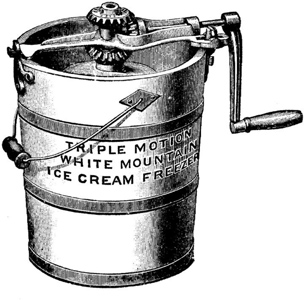 In 1843 Nancy Johnson developed the first hand-crank ice cream maker (her basic design of the freezer is still used today), and received Patent No. 3254 for it. Much of the confusion (and lack of credit) to Ms. Johnson comes from the fact that she sold her rights to William Young for just $200 (still a pretty good sum in those days.) He at least had the courtesy to call the machine the “Johnson Patent Ice-Cream Freezer.”
Johnson’s invention simplified the process of making ice cream, marking a revolution in the history of the dessert. From this time on, anyone could make the very best quality ice cream at home (especially since rock salt, which came to be commonly called "ice cream salt" until the early 20th century, had became a cheap commodity).
The inner can was placed in the outer bucket, and ice and salt were placed between the inner can and outer bucket. The salt lowered the freezing point of the ice, and contact with the inner bucket made a thin layer of milk freeze on the inside of the inner can. The rotating paddle, turned by a crank, scraped off the frozen milk, and let a new layer freeze.
Meantime, by 1919 the ice cream industry was churning out (NOT by hand!) 150 million gallons a year, so if you really didn’t want to wait the time it took to hand-crank your own, you could probably scoot down to the general store for a cup or a cone.
However you take your ice cream, can Ice Cream Socials be far away?
Sources: http://www.zingersicecream.com/history.htm
http://whatscookingamerica.net/History/IceCream/IceCreamHistory.htm
Ice+cream+maker ice+cream+socials appalachia appalachian+culture appalachian+history history+of+appalachia
Shivaree was a nineteenth and early twentieth century Appalachian custom (originally dating back to sixteenth-century France) of teasing a married couple on their wedding night or shortly thereafter. The bride was carried around in a tub at times, and the groom was ridden on a rail. In Tennessee the custom was more commonly called “serenading,” and in West Virginia and western Virginia the term “belling” also referred to this raucous, spontaneous celebration.
"One of the things that people really looked forward to was when a couple got married, they would have what they called shivaree. Everybody that was going to take part in it, they would slip right easy, and nobody would know they was anywhere about until the guns went to shootin'.
They would just march around the house shooting guns one right after another. When they would go so many rounds around the house shooting their guns, and then they would go to the door and stick a fence rail through the door and the man would get on the rail and they would ride him around the house on the rail or down the road.
Sometimes the women would join in and push the man's wife in a tub and carry her. I was shivareed. They put me on a rail and rode me around, and I fell off of it and I just got up and went in the house and told them that was all the riding on a rail I was going to do."
Oral Page, Monroe County, KY
Rosa Walden, Pi Beta Phi Settlement School (Gatlinburg, TN) teacher and Tacoma, Washington native Ruth Sturley participated in a serenade in September 1919, and described the event in a letter to her family: “One of my girls Flora Reagan has a sister who was married . . . and the young people got up the affair in their honor. Abbie [Runyan], Evelyn [Bishop] and I went with three of the school girls and a dozen more youths. Lillard Maples took us girls in his Ford three miles up to the Forks of the river [to the newlyweds’ home]. . . .
We stopped and assembling our forces proceeded to march round and round shouting--blowing ox horns--ring cow bells--sheep bells and I know not what. My noise was produced by clapping together two tin pan covers--then some sticks of dynamite were set off--by this time strange to say the cabin was astir.”
sources: "Monroe County Folklife," Lynwood Montell Ed. Monroe County, KY: privately published, 1975. p 72
http://xroads.virginia.edu/~UG97/albion/cumb2.html#wedding
http://www.lib.utk.edu/arrowmont/Steve/Southern%20Appalachian%20Culture.pdf
Shivaree Belling Serenading appalachian+culture appalachian+history history+of+appalachia appalachia
An important tradition symbolic of the vital place of family in Appalachian life is Decoration Day, usually held on a Sunday in June. Families gather at rural churches and cemeteries to honor the memory of deceased family members. A few days earlier, neighbors and kin gather to mow the cemetery grass, clean the graves, and prepare flowers. Homes are opened to accommodate family members returning from far and wide, communal meals are prepared, and folks gather to make a little music. On Decoration Day, special preaching and church singing pay homage to the dead and bring families and communities closer together. The service is followed by "dinner on the grounds," with large quantities of food cooked by local community members. Graves are decorated with flowers, visited, and stories told of humor, love, and remembrance about family members buried there.
Timing of the event reflects Appalachia's agrarian heritage. Mid-June was a time when crops were planted and growing, but long before harvest, mountain weather allowed for outdoor activity and made travel easier, and flowers were in bloom for decorating graves. It was a betwixt and between time when mountain folk could reflect on their shared family and community heritage. Decoration Day is also a ritual for healing rifts and wounds among living family members. For all families, Decoration Day is a time and place for reconnecting kinship networks and remembering core family values. The tradition of Decoration Day in Appalachia is an old one, but it is a living tradition.
Smithsonian Center for Folklife & Cultural Heritage
Source: http://tinyurl.com/27wzpu
Decoration+Day appalachia appalachian+culture appalachian+history history+of+appalachia
ONE TIME away back years ago there was a boy named Jack. He and his folks lived off in the mountains somewhere and they were awful poor, just didn't have a thing. Jack had two brothers, Will and Tom, and they are in some of the Jack Tales, but this one I'm fixin' to tell you now, there's mostly just Jack in it.
Jack was awful lazy sometimes, just wouldn't do ary lick of work. His mother and his daddy kept tryin' to get him to help, but they couldn't do a thing with him when he took a lazy spell.
Well, Jack decided one time he'd pull out from there and try his luck in some other section of the country. So his mother fixed him up a little snack of dinner, and he put on his old raggedy coat and lit out. …
--from Jack in the Giants' Newground!
 Jack is a kind of trickster-hero, one who is successful through his cleverness. Certainly he is not the admirable prince of fairy tales, but rather a quick witted and not always too scrupulous farm boy. In these tales as told in Appalachia Jack is an ordinary poor boy who achieves success in only one of two ways: either by his wits, or by sheer luck --- and the latter predominates. Quite a contradiction to the “American fairy tale” mythos that honesty and hard work are the means to success!

Caption to the photo reads: "Pike County, Kentucky. Mother of two children (husband is tubercular and bed ridden) supports her family and buys necessary medical supplies with her WPA wages."
Goodman-Paxton Photographic Collection, 1934-1942
University of Kentucky
Digital ID: kukav:64m1:833
Pike+County Kentucky WPA +appalachia appalachian+history history+of+appalachia
"I started working at tanning when I was fifteen years old and I'm 63 now. It's hot. Like putting your nose right on the grindstone all the time-- day in and day out like taxidermy. Deer hides, deer skin products, clothes, bags, coats --- we do the whole thing right from the rawhide to the finished garment. Most of it's deerskin and some cowhide. We don't manufacture anything from cowhide. Deer hide. Everybody wants deer hide. It's softer and has a better feel, but they're hard contemptible things to tan. The enamel in the grain is so easily damaged it's hard to tan them and get a glaze on the finished product. Much more so than cow. But there's no leather that can be made to feel like deerskin. That had that soft suppleness that deerskin has.
"[We sell] locally mostly. To tourists and people who come into the store. Oh, we sell some to other craftsmen. Well, I call them hippie clothes that they make. It varies from year to year, but on an average [we process] about a thousand [hides a year]. Equivalent to a thousand deerskin. We have a fleshing machine and we have power drums. The hides are seldom ever touched by hands. The paddle wheel, all that's necessary to . . . The broiler, hot water. There's very little handwork to it. Splitting machines that split them to a uniform thickness after they're tanned. This day and time, handwork don't count. In this kind of work. There's too much to be done.
"We just, I used to flesh them by hand, used to air 'em by hand. I used to do everything by hand. If I counted my time at normal wages, I'd have to have two or three hundred dollars per hide to come out and make wages. I used to flesh cowhides by hand with a sharp knife about two feet long. Handles on each end. Sharpen it up just sharp as a razor and actually shave that flesh, fat and membrane from the hide . . . hide after hide I shaved that way. Now we can put them through the flesh machine that takes about 30 seconds to clean one up and do a better job than I can do it.
"The little man hasn't much chance now. He can't operate with the big man. No use to try. Getting worse every day. The little man. They're going to push him out. We bought dyes from DuPont for 35 years. Until two years ago. We called them in Philadelphia and they wouldn't sell us a thing."
Kerth Snyder
Greenbank, WV
(1913-1995)
Source: http://www.marshall.edu/library/speccoll/cass/html/kerth_snyder.asp
Kerth+Snyder Deerhide+tanning appalachia appalachian+culture appalachian+history history+of+appalachia
Tennesseans called it the “la-la.” Elsewhere known as the john, the shanty, the shack, the throne, the shed, the relief office—it was the humble outhouse. The little buildings "out back" were as important as any building built before indoor plumbing. This was the building you located as soon as possible when you came to visit, and if your guest was the preacher, you invited him outside on some pretext so he could spot "the necessary room" without asking.
During the 1930s the WPA built thousands of outhouses across America. Three-man teams would spend an average of twenty hours on the construction of each one. Where possible the farm family receiving the new outhouse would pay for the materials (about $17 per outhouse), while the WPA supplied the labor free.
These were outhouses like America had never seen before. The American Red Cross developed the basic design. This design featured an enclosed, vented pit for the waste, was fly and vermin proof, and afforded a standard of cleanliness and sanitation that earlier generations would have considered effete. The building had a concrete floor and a carefully carpentered seat with a close fitting lid to exclude flies. Although many design variations existed, the two basic designs were single seater and two seater.
The two seater was preferred by large families---the second seat had a smaller hole to prevent children from falling through---by those who liked company, and by those who needed a place to set their lantern at night.
“To the right of the narrow entrance was a complete collection of fishing equipment ranging from rods and reels to every size, shape and color of lure imaginable. Directly above these hung an array of ingenious traps which proved to be the scourge of every muskrat and mink for five miles up or down river. In the rear of the little edifice stood two tall bushel baskets containing an endless conglomeration of treasures ranging from outdated articles of clothing to ancient magazines.
“The latter provided amusement and literary driblets for the perusal of the lackadaisical visitor who wished to bide his time informatively. And we must not overlook that standard piece of equipment without which the outhouse would not have been an outhouse--that savior of the toilet-paper-destitute family--the good old catalog. Where would we have been without it? Why do you think the mail-order house was such a thriving success?”
Robert E. Dalton
born Robert E. Lee Dalton, 1938,
in Itman, Wyoming County, WV
In October 1960, Dr. Bernice Eddy gave a talk to the Cancer Society in New York without warning her employer, the National Institutes of Health, in advance. She startled the attendees by announcing that she had examined cells from monkey’s kidneys in which the polio virus to be used in polio vaccines was grown, and had found they were infected with cancer causing viruses. 
She had decided on her own initiative to test extracts by innoculating newborn hamsters, since these animals developed tumors with a type of virus she and Dr. Sarah Stewart had previously discovered in mice and named polyoma virus (one of the early known cancer-causing viruses, it was later named the SE (Stewart-Eddy) Polyoma Virus in their honor.)
The inoculated hamsters developed tumors similar to those induced with polyoma virus. Her inference was clear: There were cancer-causing monkey viruses in the polio vaccine. She warned an epidemic of cancer in America was in the making. When the word got back to her NIH bosses, they exploded in anger.  When the cussing stopped, her superiors crushed Bernice Eddy professionally. Any mention of cancer-causing monkey viruses in the polio vaccine was not welcomed by NIH. They took away her lab, destroyed her animals, put her under a gag order, prevented her from attending professional meetings, and delayed publication of her scientific paper. In the words of Edward Shorter, author of The Health Century, ‘Her treatment became a scandal within the scientific community.’
Later, it became the subject of a congressional inquiry. In the words of Dr. Lawrence Kilham, a fellow NIH researcher who wrote a latter of protest to the Surgeon General’s office, ‘the presence of a cancer virus in the polio virus vaccine is the matter demanding full investigation.’ Her discovery was in fact subsequently validated by Drs. Maurice Hilliman and Benjamin Sweet of Merck. After additional studies, the vaccine was found to not cause tumors in humans, but Dr. Eddy was still restricted by the government from publishing anything about her work.
The work of Dr. Eddy and others led to safe polio vaccines through thorough testing, and provided a major impetus for further research on cancer viruses. The United States Department of Health, Education and Welfare awarded her a Superior Service Medal in 1967.
Bernice Eddy Wooley, Ph.D
(1903-1989)
born Glendale, WV
http://epics.ecn.purdue.edu/abiwt/work/GAW/westvirginia.html
http://www.sv40foundation.org/
http://www.vaccinetruth.org/page_13.htm
Dr.+Bernice+Eddy SE+Polyoma+virus appalachia appalachian+history history+of+appalachia
“The T. stands for Taliaferro. I was named after Booker T. Washington. My people came from Sherrill's Fort in Catawba County, NC. I was brought up by my mother, but in 1920, came to Asheville to live with my father. I went to high school at Bennett in Greensboro, NC and two years at Livingston College in Salisbury. I was sorry I couldn't finish but went into the hotel work. Booker T. Washington's philosophy was ‘drop your bucket wherever you are,’ and I have done well.
“Asheville was hit hard by the Depression. Work was hard to find, but I worked in the Langren Hotel from 1930-1933 and the Battery Park from 1934 until it closed in 1972. When I worked at the Battery Park for 38 years, blacks couldn't go in the front door - now I am living here!
“I had a ‘hotel reputation.’ During those times there weren't many jobs open to blacks - chauffeuring, working at Oteen or in hotels. It was hard getting work in the railroad unless one had good connections. Many blacks were on WPA but I was always employed. Bellmen were paid $1 a day and depended on tips and didn't anticipate Social Security, where benefits were based on how much they had paid in.
“The Langren Hotel was one of the largest in the area in the 20's, catering mostly to business men. A good room cost $1.50 a night and a corner room $3. The price was comparable to the Battery Park but the clientele was different. The Vanderbilt and Battery Park catered to tourists. 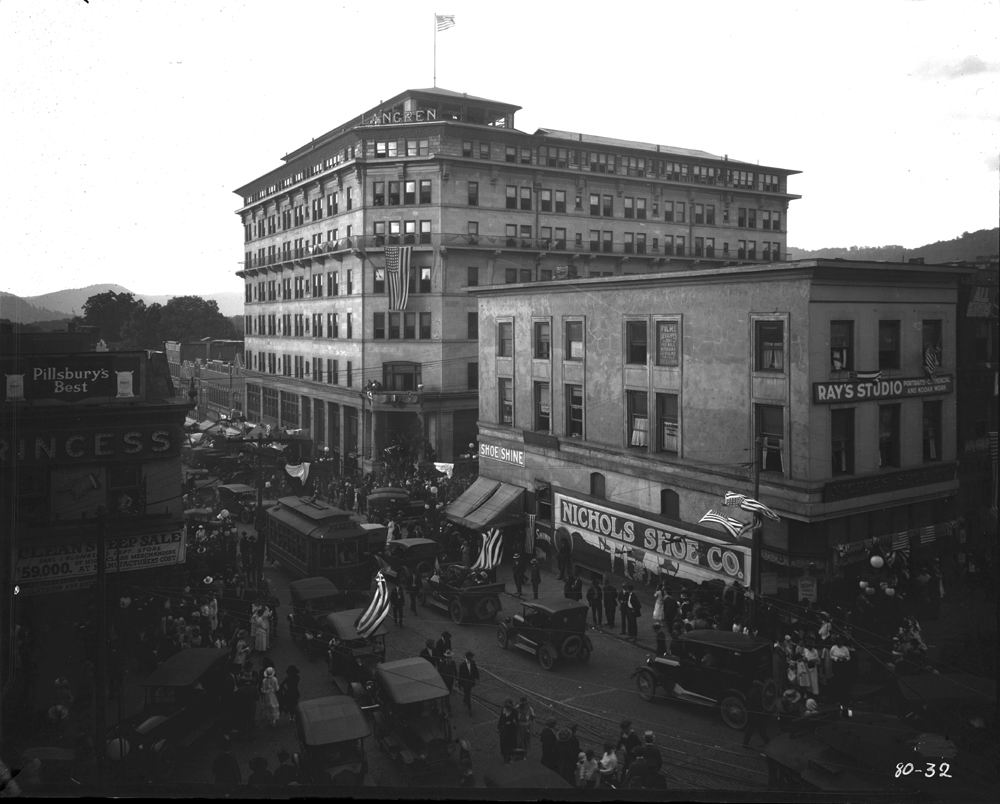
“In 1933 I lost my job at the Langren and went to Florida for the season. I returned to my wife and daughter and, after applying around, came here and worked under Charles Sisney, a famous, widely known bell man who died in 1935.
“My first wife was 16 when we married, and the marriage broke up. In 1936 I remarried a lady with the same name as a character in "Amos 'n' Andy" radio program. [Ruby Taylor]
“We were married on Saturday, August 1936, and the following day Martin Moore confessed to murdering Helen Clevenger, who was visiting the hotel with her uncle in room 224. The sheriff hired a detective from New York who found a weapon in Moore's house. Moore was tried, convicted and executed. People in the hotel were reluctant to go on the 2nd floor.
“I was off duty during the time of the 1936 murder and was not questioned but there were bad feelings about this. Some think it was never solved. Some think the son of the manager was to blame. It upset this city and it took 8-10 years for the people to relax. Room #224 was permanently blocked. Although I kept my thoughts to myself, I don't think Moore, a relatively new night janitor, had the mentality to commit the crime.”
Booker T. Sherrill
Asheville, NC
(1907-2003)
Source: http://toto.lib.unca.edu/findingaids/oralhistory/VOA/S_Z/Sherrill_B.html
Asheville+NC Langren+Hotel appalachia appalachian+history appalachia history+of+appalachia
Ahhhh, dandelion wine! The popular name comes from dent de lion, French for "lion's tooth," referring to the teeth on the leaves. Wine is made from the heads. Choose dandelions from an open field far from any insecticide spraying. Pick early in the season when the leaves of the plant are still tender. Flowers that have just opened are best. To make dandelion wine: "Four good quarts of dandelion blossoms, four pounds of sugar, six oranges, five lemons. Wash dandelion blossoms and place them in an earthenware crock. Pour five quarts of boiling water over them and let stand 36 hours. Then strain through a muslin bag, squeezing out all moisture from dandelions. Put the strained juice in a deep stone crock or jug and add to it the grated rind and juice of the six oranges and five lemons.
Tie a piece of cheese-cloth over the top of jug and stand it in a warm kitchen about one week, until it begins to ferment. Then stand away from stove in an outer kitchen or cooler place, not in the cellar, for three months. At the end of three months put in bottles. This is a clear, amber, almost colorless liquid. A pleasant drink of medicinal value. Aunt Sarah always used this recipe for making dandelion wine, but Mary preferred a recipe in which yeast was used, as the wine could be used a short time after making."
For dandelion wine made with yeast: "Four quarts of dandelion blossoms. Pour over them four quarts of boiling water; let stand 24 hours, strain and add grated rind and juice of two oranges and two lemons, four pounds of granulated sugar and two tablespoonfuls of home-made yeast. Let stand one week, then strain and fill bottles."
Source: "Mary at the Farm and Book of Recipes Compiled During Her Visit Among the "Pennsylvania Germans," by Edith M. Thomas, 1915.
http://fohn.net/dandelion-pictures/dandelion-wine-recipe.html
http://enature.com/fieldguides
dandelion+wine appalachian+culture appalachian+history history+of+appalachia appalachia
"Here are some of the Indian tales I have heard. I don't remember the names of any of the whites or Indians involved in these stories. The old folks used to tell us children these tales while we sat before the fireplace at night. "In Indian times, the whites would put pickets out about the camp or fort to keep the Indians from slipping upon them. At one place, several of the pickets had disappeared. The officers placed a man on duty on night, with orders to shoot anything he saw moving. Pretty soon he noticed an old sow rooting in the leaves under the trees and it came closer and closer. He hated to shoot an old sow that would later make good meat. But he had his orders to shoot, which he did. At the crack of his rifle, the saw r'ared upon its hind feet and feel over backwards. It proved to be an Indian in an old sow's skin, and this was the way the Indians had been slipping up and killing and carrying away the other pickets.
"Another Indian story was often told to us by the older folks. The Indians took a woman captive and took her into Kentucky. After a few days, they let her go and get firewood in the evenings. Each day she went further and further. Finally, she ran into the woods and tried to get back to her old home. At night, she hid in a hollow log. The Indians followed her with a dog. The dog got ahead of the Indians and went into the log after her, but she choked it to death. Spiders wove a web over the open end of the log. The Indians came and saw the spider web. They were so mad they struck the log with their tomahawks and went away. She got out next morning and found her way back to the settlements. She had little to eat in her travels. At one place, the path forked and while she was debating which way to go, a little bird fluttered in front of her and darted up stream. She was still undecided which way to go. The bird came back and fluttered away in the same direction. She followed the bird and got home safely."
Interview with Nannie Sykes Kerr Dotson
on Oct. 11, 1951 at Millard, VA
(born 1882 in what is now Clinchco, Dickenson County, VA)
http://ftp.rootsweb.com/pub/usgenweb/ky/pike/misc/sykesetc.txt
Related posts: "The Jack Tales. Not just beanstalks."
"Now I've got my Tailypo!"
Nannie+Sykes+Kerr+Dotson Indian+tales appalachia Appalachian+tales,appalachian+culture appalachian+history
I don't want you any more, mama
Ain't no use in you hanging around
For I found another mama,
And now I am Chicago bound
You've been fooling me, baby
You've been telling me your lies
When I thought you were an angel
Just sent down from the skies
 Sing those parting blues to me, sweet Nell
When you leave you'll leave me sad
'Cause my daddy's gone and left me
I just wouldn't treat him right
You've been fooling me, baby
You've been telling me your lies
When I thought you were an angel
Just sent down from the skies
I wouldn't give him much loving
Wouldn't stay home at night
Now I hear the train a-coming
He has gone out of sight
You've been fooling me, baby
You've been telling me your lies
When I thought you were an angel
Just sent down from the skies
In the late 1920's, A.P. Carter, his wife Sara, and his brother's wife Maybelle came together to make music as The Carter Family. Their music, a composite of traditional ballads, blues songs, gospel numbers, heart songs, and instrumentals both reflected and shaped the tastes of the rural south. Together, their career spanned a little over two decades and nearly 300 recordings. Maybelle became the matriarch of a great country music dynasty as the mother of the Carter Sisters.
Despite dying in relative obscurity, A. P. Carter was inducted into the Nashville Songwriters Hall of Fame in 1970. In 1993, his image appeared on a U.S. postage stamp honoring the Carter Family. In 2001 he was inducted into the International Bluegrass Music Hall of Honor. Today there are Carters in the very veins of country music.
sources: http://countrymusic.about.com/od/cdreviewsmz/gr/blunbrkncircle.htm
http://www.bluegrasswest.com/ideas/carter.htm
http://famouslikeme.com/35061/article.html
AP+Carter Carter+Family bluegrass Appalachian+history Appalachian+culture Appalachia history+of+Appalachia
“Such things as shelling peas or shucking corn took place on the front porch when friends and relatives came over to help. During the hottest time of the summer, some front porches that were screened, contained beds to sleep in. These were called "sleeping porches." The residents of the home would escape the heat of the upstairs bedrooms by sleeping on the porch in the summer. “Families spent time on porches in the evenings watching other people going for strolls, or waiting to see if someone would drop by. Everyone knew who their neighbor was. If someone moved in, neighbors knew who they were, who their kin were, and where they were from. New neighbors expected the old neighbors to drop by and would have felt very unwelcome if they didn't.
“You could tell who was visiting who and who was courting who, by walking past the front porches of the houses. Some people think that the arrival of the automobile moved socialization from the front porch to the front seat of a car, and caused the demise of front porch life, and the front porch itself. With the arrival of the 20th century, many new houses were built completely without front porches. It is a pity, because the front porch allowed everyone to see what was going on in the neighborhoods. Young and old alike were entertained, and everyone was included in activities.”
Lady Lydia Speaks, Homeliving Helper blog
http://homeliving.blogspot.com/search?q=shelling+peas
Front+portch appalachia appalachian+culture appalachian+history history+of+appalachia


